Average Oil Change Time: What to Expect and How to Plan
Discover the true range of average oil change time, comparing DIY vs professional service, and learn how vehicle type, oil, and access affect timing. Practical ranges, planning tips, and data-backed guidance from Oil Capacity Check (2026).


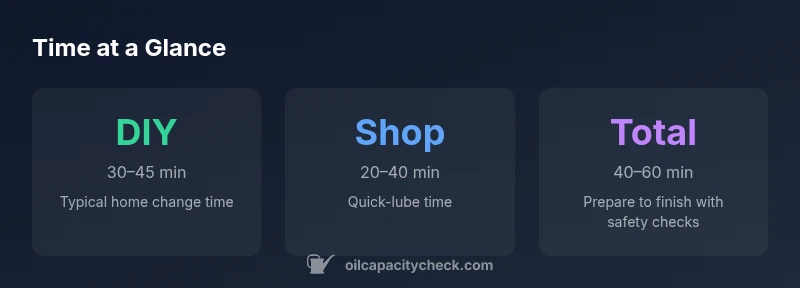
The average oil change time typically ranges from 20 to 60 minutes, depending on whether you DIY or use a shop service, your vehicle, and the oil type. Most DIY jobs run about 30–45 minutes, while quick-lube services at a shop usually fall in the 20–40 minute range, not including wait times.
Understanding the concept of average oil change time
The average oil change time is a moving target rather than a fixed number. It encompasses not just draining old oil and replacing the filter, but also setup, tool retrieval, safety checks, and any time spent waiting for oil to drain. For car owners and DIY enthusiasts, a reliable sense of this time aids planning around work, family, and road trips. According to Oil Capacity Check, the range for the average oil change time varies by setup and vehicle. In practice, you’ll see two broad bands: DIY changes that take longer and shop services designed for speed. There isn’t a single universal number; treat it as a spectrum that shifts with your car and method. This article explains the factors that shape that spectrum and provides practical estimates grounded in Oil Capacity Check Analysis, 2026.
Key factors influencing time across setups
Several variables determine how long an oil change will take. Vehicle design, engine size, and access to the drain plug and oil filter matter a lot because they affect how easily you drain the old oil and replace the filter. Oil viscosity and type (synthetic vs conventional) influence how smoothly the old oil flows and how quickly the new oil pours in. The tools you have, the workspace layout, and your experience level also play significant roles. Finally, the service approach matters: a home DIY change typically requires more setup time but can be cheaper, while a fast-lube shop optimizes steps for speed, sometimes at the expense of a little extra waiting time for inspections. Oil Capacity Check’s analysis highlights that time variation is most pronounced when working on cars with tight engine bays or uncommon filter placements.
DIY oil change: timing, steps, and tips
For the DIYer, the journey from start to finish typically unfolds in defined phases: preparation, draining, filter removal, new filter installation, replenishment of fresh oil, and level check. Each phase has typical durations, though these can vary widely. Preparation often takes 5–10 minutes as you gather the right oil type, a new filter, a catch pan, a jack or lift, and ramps or stands. Draining the old oil can take 5–10 minutes, depending on how readily the oil flows and whether you pre-warm the engine. Replacing the filter and reinstalling the drain plug might take another 10–15 minutes, followed by pouring in fresh oil (typically 5–7 minutes, plus time to check for leaks). Finally, a quick oil level check and cleanup add a few minutes. Experienced DIY-ers often complete the job closer to the 30–45 minute range, while beginners may take longer. Hidden time drains include disposing of used oil, locating a suitable disposal source, and ensuring no spills.
Professional service workflows and time variability
In professional environments, shops employ streamlined workflows designed to minimize every wasted minute. A typical quick-lube session aims for 20–40 minutes of actual labor time, with additional minutes for intake, inspection, and potential upsell of maintenance services. The exact duration depends on the vehicle’s access points, filter size, and how the shop handles fluids (absorbers, containment, and checklists). Some vehicles with complex filter housings or limited undercar access may require more time, while newer designs with quick-release filters speed up the process. The key: technicians follow standardized steps and torque specifications to ensure safety and accuracy, and the most time-efficient shops optimize tool placement and staging to reduce idle time.
Case studies: common car types and their times
Consider three representative categories: compact sedans, mid-size SUVs, and performance luxury models. For a compact sedan with straightforward drain plug access and a standard cartridge filter, the DIY time is typically around 30–40 minutes after setup. For mid-size SUVs with heavier oil capacity and a larger filter, DIY changes might stretch toward 40–60 minutes, while quick-lube clinics often finish in the 25–40 minute range. Sports and luxury cars with complex filter assemblies or removable skid plates can take longer even in shops, sometimes approaching an hour or more. These scenarios illustrate how the same basic task can widen into a broad range of times depending on the car’s design and how much you DIY versus rely on professional service.
Time budgeting: planning around maintenance windows
If you’re scheduling maintenance alongside other tasks, you’ll want to buffer for the variables described above. For a DIY job, block 45–60 minutes in your calendar for the first attempt, and more if you’re new to the process or if you’re disposing of oil for the first time. For professional service, plan for 45–75 minutes if you need an inspection or additive recommendations beyond the drain and fill. If you’re juggling a road trip or heavy driving schedule, it may be worth scheduling the oil change a day or two ahead so you’re not pressed for time. Oil Capacity Check’s data from 2026 indicates that unexpected delays are more common in vehicles with unusual access points or older designs, so build in a cushion.
Tools, workflow, and environment that save time
Factory-trained technicians use a curated toolbox, including torque wrenches, a reliable drain pan, a funnel, an oil filter wrench, and a drain plug O-ring kit. At home, you can shave minutes by preparing the workspace: clear the area, collect the necessary oils and filters, and verify the recommended oil capacity before you begin. Setup time matters just as much as the drain and fill. In a shop, efficient staging—placing the new oil, filter, and drain pan within easy reach—reduces hand movements and walking time. For the best results, measure clearance under the car and plan around the car’s own service manual guidelines to avoid surprises.
Safety and quality considerations that affect timing
Rushing a change can compromise safety or result in leaks. Always let engines cool if you just drove and avoid overfilling oil, which can cause pressure issues. Using the right filter and oil grade is crucial for performance and longevity, and it’s worth double-checking the oil level with the dipstick after the pour. Quality checks, such as confirming no drips around the drain plug and verifying the filter seat, add a couple of minutes but prevent costly mistakes that could extend the total service time later. The emphasis on accuracy, especially for high-mileage engines, means that focusing on correctness rather than speed is essential.
How to communicate with your shop and track time
Whether you DIY or use a shop, clear communication helps keep timing on track. If you’re at the shop, ask for an estimate of actual labor time and what additional checks you’ll receive (oil level, filter integrity, and oil capacity). If you’re doing it at home, keep a log of steps and the time taken for each to refine your future estimates. A simple stopwatch or timer can reveal where time leaks occur, and noting the exact engine type, oil grade, and filter type in your maintenance journal enables more accurate planning for subsequent changes. Oil Capacity Check recommends maintaining a running log of service durations to improve planning accuracy for future changes.
Estimated times by service scenario
| Scenario | Estimated Time (min) | Typical Vehicle Type |
|---|---|---|
| DIY oil change at home | 30-45 | Compact to mid-size cars |
| Quick-lube service at a shop | 20-40 | Most modern sedans/SUVs |
| Dealership full-service | 45-75 | Luxury or performance vehicles |
People Also Ask
What is considered the 'average' oil change time?
The average is not fixed; it depends on method and vehicle. DIY times typically fall in the 30–45 minute range, while professional quick-lube services commonly run 20–40 minutes. Vehicle design and access points can expand or shrink that window.
For most cars, the average oil change time is between twenty and forty minutes at a shop, or about thirty to forty-five minutes if you’re doing it yourself.
Does synthetic oil take longer to change than conventional?
Not inherently. The main timing differences come from access, filter size, and whether the shop or DIY setup needs extra steps. Synthetic oil can flow differently, but the change duration is typically similar to conventional oil when done by a skilled technician or experienced DIYer.
Synthetic oil usually doesn’t add much time; it mainly depends on access and how you perform the change.
How long should I budget if I’m new to DIY oil changes?
Set aside about an hour to be safe, with 45–60 minutes as a reasonable target after you gain experience. Expect longer times during your first attempts due to setup and disposal steps.
Give yourself an hour to be safe when you’re new to doing it yourself.
Does car model affect oil change time?
Yes. Engine layout, undercar clearance, and filter location influence how quickly you drain and fill oil. Some models require extra steps or special tools, increasing the duration.
Yes, some cars take longer due to access and filter placement.
What tools can speed up DIY oil changes?
Key tools include a torque wrench, a reliable drain pan, a funnel, and an oil filter wrench. Having organized, ready-to-use tools reduces delays and helps you stay within your estimated time.
The right tools really help—keep them ready and within reach.
“Timelines for oil changes are highly variable, but understanding the common ranges helps you plan maintenance without disruption.”
The Essentials
- Plan 30–45 minutes for a DIY oil change.
- Expect 20–40 minutes at a professional quick-lube.
- Vehicle access and oil type drive time variability.
- Prepare tools in advance to minimize delays.
- Keep a maintenance log to improve future estimates.