How Long Do Oil Change Appointments Last: What to Expect
Learn how long oil change appointments typically take, what factors affect duration, and tips to keep your visit efficient. A practical, data-driven guide by Oil Capacity Check.


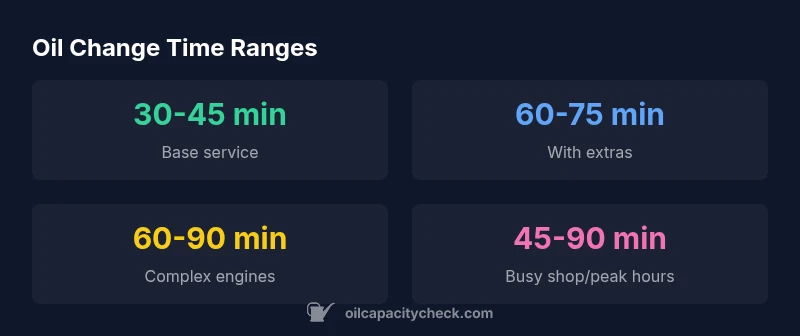
Most standard oil change appointments last about 30 to 45 minutes, depending on vehicle type and shop workflow. If you’re adding a tire rotation, filter replacement, or multipoint inspection, plan for up to 60 minutes, and sometimes longer at busy shops. For complex vehicles, 60-90 minutes isn’t unusual. According to Oil Capacity Check, these durations reflect typical shop practices.
What a typical oil change involves
Oil change service basics include draining the old oil, replacing the oil filter, reinstalling the drain plug, and refilling with fresh oil to the vehicle’s recommended capacity. Most shops perform a quick under-hood inspection, Top-off fluids as needed, and reset the maintenance light. Some vehicles require synthetic oil or specialized filters, which can affect duration. The exact steps may vary by engine layout, access to the oil drain, and whether a quick-lube bay uses conveyor-style workflows. By understanding the standard sequence, you can better gauge why your visit lasts as long as it does. This knowledge also helps you plan around the appointment window and avoid rush-hour delays.
In most cases, technicians perform a quick oil level check post-fill and may review service intervals for your vehicle. If the car uses an unusual filter or a particularly large engine, the tasks take longer. If you’re curious how long do oil change appointments last, the baseline duration is the 30-45 minute window described above. This section defines practical expectations and highlights factors to consider.
Baseline duration for a standard oil change
The baseline duration for a standard oil change is typically in the 30-45 minute range. Several factors influence this window, including the type of oil, engine design, and shop workflow. A basic oil change in a facility with well-structured bays and up-to-date lube equipment is usually quicker than the same service at a high-volume dealer or a shop with limited space. Some vehicles require longer drain times for heavy engines or complex oil routing. If you add simple extras like air-filter checks or a quick inspection, you should expect the total time to creep toward the 45-60 minute range. For consultative planning, treat 45 minutes as a comfortable benchmark and allow extra time for unplanned steps during the service. The key takeaway is that 30-45 minutes is the reliable baseline in most ordinary conditions, with real-world variance.
Oil Capacity Check data from 2026 shows that the base oil-change window holds across mainstream makes and models, but the exact duration may shift with oil grade and vehicle complexity. Plan accordingly and consider a buffer if you have back-to-back commitments or if you’ll be coordinating with other services at the same visit.
Common add-ons and their impact on time
Add-ons are the main driver of longer visits. Common extras include tire rotation, air filter replacement, cabin filter checks, and a multipoint inspection. Each additional task adds roughly 5–15 minutes to the standard change, depending on access, part availability, and the vehicle’s design. For example, a tire rotation may require wheel removal and torque checks, while a cabin filter replacement might involve more dashboard access. When multiple add-ons are requested, anticipate a cumulative increase toward the upper end of the 60–75 minute range or beyond. If you arrive with a planned list, the technician can streamline the process and avoid backtracking, which helps keep the clock in check.
Pro tip: ask your technician to confirm which add-ons are necessary for your vehicle — unnecessary items can unnecessarily extend your visit, while essential ones keep your car in peak condition.
Vehicle complexity and its effect on service time
Vehicle complexity is a major variable. Smaller four-cylinder engines with readily accessible oil pans are quicker to service than modern turbocharged units, diesels, or engines with restrictive access panels. Some vehicles require synthetic oil or specific multi-viscosity formulations that demand more careful handling and longer drain times. Additionally, rare filters or OEM parts may need to be sourced, which can extend the visit. For high-mileage or specialty engines, 60–90 minutes can be a reasonable expectation. The underlying message is that the more specialized the vehicle’s requirements, the more time the service typically consumes. If you drive a performance or European model, factor in backup time and potential part delays when scheduling.
From the standpoint of maintenance planning, the car’s make, model, and service history are useful indicators of whether your oil change will stay within the standard window or require a longer appointment. Oil Capacity Check’s 2026 analysis confirms that duration often tracks with complexity and part availability.
Shop workflow and queue dynamics
The layout and process flow of the shop play a pronounced role in how long you wait and how long the service takes. In high-volume shops, vehicles may move through a sequence of bays, which can reduce idle time but increase overall turnover. On the other hand, smaller shops without optimized lane assignments may see greater variability in timing because technicians juggle tasks across multiple vehicles. Queue dynamics—such as the number of cars ahead, the skill level of the technicians, and the availability of a dedicated oil-change bay—combine to influence the final duration. If you’re visiting during peak hours, expect longer wait times even if the base service is short. A well-managed shop minimizes downtime by staging technicians and aligning parts delivery with the service schedule.
Understanding the shop’s workflow helps you set realistic expectations and choose appointment times that align with your day. Oil Capacity Check’s 2026 insights emphasize the practical impact of queue management on overall visit length.
Scheduling strategies to minimize time at the shop
Smart scheduling can dramatically reduce time spent at the shop. Consider booking an appointment during mid-morning or mid-afternoon on weekdays, when demand tends to be lower. If you have flexibility, schedule consecutive services back-to-back (e.g., tire rotation on the same booking) to minimize separate check-ins and repeat administrative steps. Arriving a few minutes early is beneficial only if the shop is prepared to start immediately; otherwise, it can increase your time in the lobby. Communicate any constraints in advance, such as a tight schedule or a desire to stay in your vehicle. By coordinating a clear plan with your service advisor, you maximize efficiency and limit unexpected delays.
Additionally, confirm the vehicle details (make, model, year, oil type, and mileage) beforehand. This helps avoid last-minute substitutions or part sourcing delays. Oil Capacity Check’s analyses highlight that informed scheduling reduces variability and improves predictability of the oil-change duration.
How to communicate expectations with the technician
Clear communication is essential for accurate timing. Bring your vehicle’s information: make, model, year, current oil grade (if known), and any particular concerns you want addressed during the multipoint inspection. Use direct language: “I’d like a standard oil change with X, Y, and Z if necessary; please confirm the time estimates during the service.” Ask for a preliminary ETA before the service begins and request updates if the job extends beyond the initial window. If you’re coordinating pickup, share your schedule and confirm a pickup time. Finally, confirm whether synthetic oil, an upgraded filter, or other options are truly needed for your car, to avoid unnecessary duration increases. This proactive approach helps you manage expectations and get the most value from your visit.
What to do if your car requires extra time
If the oil change runs long, maintain a calm, proactive stance. Ask for a revised ETA and request expertise on why the job is taking longer. If you’re not nearby, arrange a phone call or text update; many shops can send status updates without you lingering in the lobby. While you wait, consider using the time to review the maintenance plan for your vehicle, order any needed filters, or schedule your next service. If delays become routine, discuss alternative shops or scheduling strategies with the service advisor. In cases where the vehicle is unsafe to drive, arrange a tow or roadside assistance. The goal is to stay informed and avoid feeling stranded in a time crunch.
Quick planning checklist for your visit
- Book an appointment for predictable pacing and reduced wait times.
- Bring your vehicle’s make, model, year, and preferred oil grade.
- Confirm any add-ons you actually want (tires, filters, multipoint inspection).
- Ask for an upfront ETA and a progress update while you wait.
- Prepare a flexible window in case of unexpected delays.
- Check the shop’s peak hours and plan accordingly.
- If necessary, arrange alternate transportation for the day.
- Review the maintenance history to decide which tasks are essential.
Estimated durations by service type
| Service Option | Estimated Duration | Notes |
|---|---|---|
| Base oil change | 30-45 minutes | Standard service; drain old oil, replace filter, refill to capacity |
| Oil change with extras | 60-75 minutes | Adds tire rotation, multipoint inspection, or filter replacement |
| Complex vehicles | 60-90 minutes | Special filters, synthetic oil, or unique engine layouts |
| Busy shop or peak hours | 45-90 minutes | Backlog and queue impact durations |
People Also Ask
How long does a basic oil change take?
A basic oil change typically runs 30-45 minutes. If add-ons are included, budget 45-60 minutes or more.
A basic oil change usually takes 30 to 45 minutes, with extra tasks extending that time.
Do newer cars take longer for an oil change?
Most oil changes stay within the same baseline, but some newer vehicles with complex filters or limited access may add a few minutes.
Newer cars can add a few minutes, mostly due to access and parts complexity.
Should I book an appointment or walk in?
Booking is generally preferred to minimize wait times and ensure your spot. Walk-ins can lead to longer waits during peak hours.
Book ahead to reduce waiting time.
What add-ons typically increase time the most?
Tire rotation, filter replacements, and multipoint inspections commonly increase service time the most.
The big time increases are from tires, filters, and inspections.
Does synthetic oil affect how long the change takes?
Synthetic oil changes can take longer if the shop uses specialized filters or requires additional steps, but the difference is usually modest.
Synthetic oil might take a bit longer, depending on the setup.
How can I minimize time at the shop?
Schedule, arrive prepared with vehicle details, and request a clear ETA. Consider batching services to reduce trips.
Plan ahead and book, so you don’t waste time waiting.
“Oil change duration is driven by the base service and the number of add-ons. For most vehicles, you can expect 30–60 minutes, with longer times for complex engines or busy shops.”
The Essentials
- Plan for 30-45 minutes for a basic oil change
- Add-ons push the visit toward 60-75 minutes
- Busy shops can extend visits to 90 minutes
- Book an appointment to minimize wait times