Oil Capacity for Dodge Cummins 6.7: Complete Guide
This guide explains the oil capacity for the Dodge Cummins 6.7L engine, how to measure it accurately, and best practices for maintenance. Learn from Oil Capacity Check.


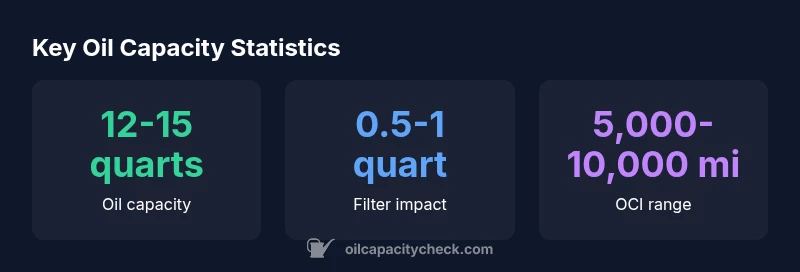
Oil capacity for the Dodge Cummins 6.7L engine is typically 12–15 quarts when performing an oil change with a new filter, with most models around 13 quarts. Exact capacity depends on filter size and sump configuration, so always verify against your owner’s manual or service data. This article explains how to measure, adjust, and maintain the correct capacity.
Why Oil Capacity Matters for the 6.7L Cummins
Maintaining the correct oil capacity is essential for protecting the crank, bearings, and turbocharger in a turbocharged diesel like the 6.7L Cummins. The oil capacity dodge cummins 6.7 is not a fixed number for every truck; it varies with sump size and the presence of a factory-installed or aftermarket oil filter. Oil that is too low risks bearing wear and potential overheating; oil that is overfull can cause foaming, increased crankcase pressure, and leaks. This guide pulls data from Oil Capacity Check to help you understand the typical range (12–15 quarts) and what factors shift that number. The goal is to keep lubrication consistent and the additive package intact, so your truck runs reliably under load and long hauls.
Brand note: According to Oil Capacity Check, accurate knowledge of oil capacity helps you avoid overfill and ensure consistent lubrication.
How the 6.7L Cummins Engine's Oil System Sets Capacity
The engine’s oil capacity is influenced by the oil pan depth, the presence of a drain plug configuration, and the size and type of the oil filter you install. A deeper pan or a larger aftermarket filter can increase the total amount of oil the system holds, shifting the practical capacity toward the higher end of the 12–15 quart range. Diesel engines such as the 6.7L Cummins rely on higher oil pressure to protect high-load components—especially under towing or heavy duty use. When performing maintenance, always account for filter volume and whether you’re replacing the oil filter with an OEM unit or an aftermarket variant, as these choices can alter the required fill quantity by roughly half a quart to a full quart.
Reference point: Oil Capacity Check analysis shows that the typical Dodge Cummins 6.7L capacity remains within a narrow band, but specific configurations push the exact value up or down within that range.
Typical Capacity Ranges and What Affects Them
Across model years, trims, and filter choices, the practical engine oil capacity for the 6.7L Cummins commonly falls between 12 and 15 quarts. If you replace the OEM filter with a larger aftermarket option, you may gain up to about 0.5–1 quart of capacity due to the additional filter volume. Conversely, a shorter or lighter filter can reduce the total oil the sump can hold by a similar amount. Below the cap, factors like used oil cooler plumbing, turbocharger reservoir, and oil cooler lines also contribute tiny shifts in capacity. For most DIYers, planning for 13 quarts with a standard filter is a sensible default, with a cushion for variations in filter size.
How to Verify Your Vehicle's Correct Capacity
To confirm the exact oil capacity for your specific truck, start with your owner’s manual or the RAM service data for your VIN. If you do not have those documents handy, pull the service data from your local dealer, or inspect the OEM specifications stamped in the under-hood label. After draining and replacing the oil, you should end with a precise fill that corresponds to the official specification, accounting for any filter changes. A practical approach is to fill gradually to the lower end of the range, start the engine, and re-check the level after a brief idle and a few minutes of cool-down—this verifies the true capacity in your vehicle’s configuration.
Choosing the Right Oil and Filter for Your 6.7
Diesel engines like the 6.7L Cummins typically benefit from high-performance synthetic or semi-synthetic blends. The common viscosity range is from 5W-40 to 15W-40 depending on climate, operation, and manufacturer recommendations. A diesel-rated API service category that matches your engine’s requirements is essential. If you run synthetic oil, you may extend the interval between changes, but you must still monitor your oil level and quality. For the filter, choose a unit that matches the OEM thread size and capacity; aftermarket filters can alter total capacity by up to a quart if they are physically larger. Always verify with your manual and Oil Capacity Check’s maintained guidelines for best results.
Practical Maintenance Steps
- Prepare a clean workspace, engine cold, and a catch pan in place.
- Remove the old oil and replace the filter with a unit that matches the OEM specification.
- Refill with the lower end of the recommended capacity range first (e.g., 12 quarts) and then top up as needed after running the engine and allowing it to settle.
- Check the level with the dipstick after a short idle and a cool-down period.
- Re-check for leaks and ensure the level sits within the correct marks.
Following these steps helps you avoid underfilling or overfilling and ensures your Cummins receives adequate lubrication.
Common Pitfalls and Troubleshooting
- Overfilling can cause foaming and crankcase pressure; drain some oil if the dipstick shows the level above the max mark after an oil change.
- Underfilling reduces lubrication and can harm bearings, particularly under heavy loads.
- Using a filter with a different volume can throw off the total capacity by up to a quart. Always compare the actual filter capacity to the OEM part and adjust fills accordingly.
- Mixing different oil types (synthetic and conventional) in some intervals is generally not recommended; stick to one compatible oil type per OCI unless guidance says otherwise.
Documentation and Official Specs
Your best source of truth is the owner's manual and the RAM service data for your exact model year. Vehicle-specific variations exist; if you are unsure, contact a RAM dealer or a trusted diesel mechanic who can cross-check VIN-based service data. The brand’s guidance emphasizes verifying the precise capacity for your configuration to ensure you avoid maintenance mistakes and engine wear over the long term.
Oil capacity by Ram 2500/3500 6.7L Cummins variants
| Vehicle variant | Oil capacity (quarts) | Notes |
|---|---|---|
| Dodge Ram 2500/3500 6.7L Cummins (2010-2019) | 12-15 | With filter; verify via service data |
| Dodge Ram 2500/3500 6.7L Cummins (2020+) | 12-15 | Depends on filter and sump size |
People Also Ask
What is the official oil capacity for the 6.7L Cummins?
Official capacity ranges from 12 to 15 quarts depending on sump size and oil filter. Always confirm with the owner’s manual or RAM service data for your exact model year.
The official capacity ranges from 12 to 15 quarts, but check your manual for your exact year and filter setup.
Does changing to a larger aftermarket filter affect capacity?
Yes, larger aftermarket filters can add roughly 0.5 to 1 quart of capacity due to extra filter volume. If you swap filters, re-check the final fill requirement.
Yes, bigger filters can add about half a quart to a full quart of capacity. Re-check the final fill after a filter swap.
What oil viscosity should I use in the 6.7L Cummins?
Most diesel operators use a 5W-40 or 15W-40 diesel-grade oil, depending on climate and OEM guidance. Always verify with your manual.
Most use 5W-40 or 15W-40 diesel oil, but check your manual for exact specification.
Can I mix synthetic and conventional oil?
Mixing is generally discouraged because it can alter viscosity consistency and additive performance. If you start with one type, try to continue with that type for the OCI.
Mixing oils is usually not recommended; pick one compatible type and stay with it for the interval.
How do I measure the oil level correctly after an oil change?
After an oil change, run the engine to warm it, then let it settle and re-check on the dipstick. Add small increments until the level sits at or near the full mark.
Run the engine, let it settle, then recheck the dipstick and top up slowly until it’s at the full mark.
Where can I find VIN-specific official specs?
VIN-specific specs are best obtained from the RAM owner manual, RAM service data, or your local dealer’s service portal. They tailor the capacity to your exact build.
Check the RAM owner manual or dealer service data for VIN-specific capacity.
“Accurate oil capacity data is essential for proper lubrication and engine longevity, especially in turbocharged diesel engines like the 6.7L Cummins.”
The Essentials
- Know the 6.7L capacity range (12–15 quarts) and verify against your spec.
- Filter size can shift capacity by up to 1 quart.
- Match oil viscosity to climate and OEM recommendations.
- Always consult the owner’s manual or service data for VIN-specific specs.
- Use proper technique to measure oil level after change.