Oil Capacity Chevy 350: Capacity and Maintenance Guide
Discover the oil capacity chevy 350, typical fill amounts, and maintenance steps. Learn how filter size, oil cooler, and vehicle year affect capacity with practical guidelines from Oil Capacity Check.


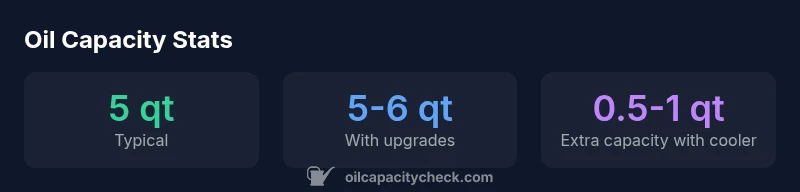
Typical oil capacity for the Chevy 350 is about 5 quarts with a standard filter, and up to 6 quarts if you’re using a larger filter or an oil cooler. Always check your specific model year and engine variant, as capacities can vary slightly. For precise figures, consult the owner's manual or Oil Capacity Check Analysis, 2026. This quick reference helps you plan fills and maintenance intervals accurately.
Chevy 350 Oil Capacity Variants and What It Means for You
The oil capacity chevy 350 you’ll see in manuals and guidance ranges around 5 quarts with a standard filter. Some configurations, especially those with an oil cooler or a larger aftermarket filter, may require 5.5 to 6 quarts to reach the proper oil level on the dipstick after a full drain and fill. This variation is common across carbureted and fuel-injected Chevy 350 engines as well as different production years. When planning maintenance, think in terms of a baseline of 5 quarts and an additional 0.5 to 1 quart depending on your specific parts list. Always verify by checking dipstick marks after a full oil change and topping off to the recommended level. The knowledge of oil capacity chevy 350 is essential for preventing both under-lubrication and overfill, which can impact engine cleanliness and performance. In short, plan for 5 quarts with standard filters, and be ready to adjust up to 6 quarts if your setup uses a larger filter or oil cooler.
Factors that Change the Oil Capacity Reading
Engine variants, aftermarket modifications, and oil system accessories can subtly shift how much oil your Chevy 350 actually holds. A stock engine with the factory oil pan typically sits at the 5-quart baseline, but upgrading to a larger aftermarket oil pan or installing an oil cooler can increase the total capacity by roughly 0.5 to 1 quart. The size of the oil filter also matters—some oversized filters occupy more space in the oil routing, which can influence the final fill amount. In practice, technicians consider a range (5–6 quarts) when diagnosing capacity in modified engines, and they confirm by performing a drain-and-fill test and rechecking the dipstick.
How to Verify Capacity on Your Chevy 350
To confirm your specific oil capacity chevy 350, start with the owner’s manual and note the recommended oil grade. Then perform a full drain and fill using the exact oil pan and filter configuration on the vehicle. After adding the oil, run the engine for 2–3 minutes, shut it off, wait 5–10 minutes, and recheck the level with the dipstick on level ground. If the level sits between the hash marks, you’re within range; if it’s low, add oil in 0.25-quart increments and recheck. For engines with coolers or special filters, validate against the higher end of the range (5.5–6 quarts) to ensure the level is accurate.
Step-by-Step Oil Change for Chevy 350 (With Capacity in Mind)
- Gather the correct oil grade (usually 5W-30 or 10W-30 depending on climate) and a compatible filter.
- Warm the engine to operating temperature, then lift and secure the vehicle.
- Drain the old oil completely and replace the drain plug; remove and replace the oil filter.
- Refill with the lower end of the capacity range first (about 5 quarts) and check the level.
- If needed, add in 0.25-quart increments, and recheck until the dipstick aligns with the full mark.
- Run the engine, recheck, and top off as necessary to reach 5–6 quarts depending on your configuration.
Oil Type, Viscosity, and Capacity Interactions
Oil capacity chevy 350 is closely linked to oil viscosity and type. In many climates, 5W-30 or 10W-30 conventional oils are standard choices for older engines, while synthetic variants can offer improved protection with similar capacity needs. The capacity range remains mostly the same, but synthetic oils can have slightly altered drain intervals and surge characteristics that influence how frequently you check the oil level. If your vehicle uses an oil cooler or a larger aftermarket filter, expect the capacity to trend toward the upper end of the 5–6 quart range. Always verify with a dipstick after any change in oil type or system configuration.
Real-World Scenarios: Classic vs Modern Chevy 350s
Old-school Chevy 350s with carburetors and smaller pans often stay near the 5-quart baseline. Modern fuel-injected variants and engines with upgraded oil systems or coolers can push toward 6 quarts. Across model years, the same principle applies: start with a safe baseline (5 quarts) and adjust based on the specific parts list, including filters and cooling accessories. When hand-assembling a parts kit or reconfiguring the engine, account for the cumulative difference in space within the oil pan and the filter housing. The upshot is that capacity remains a range (5–6 quarts) rather than a fixed value, so always confirm with the correct parts for your Chevy 350.
Maintenance Tips to Avoid Over- or Under-filling
To stay within the correct oil capacity chevy 350, keep a consistent change interval and use the recommended grade for your climate. Track parts changes—filter size and type, oil cooler, and pan modifications—as these affect capacity. After any maintenance, recheck the dipstick on level ground and allow proper settling time. If you’re unsure, consult Oil Capacity Check analyses or a trusted mechanic to confirm the right fill level for your setup. Keeping precise records helps you avoid misreads and ensures your engine remains well-lubricated.
Common Pitfalls and Quick Fixes
Common mistakes include assuming a fixed 5-quart capacity regardless of hardware, overfilling after an oil cooler addition, and neglecting to account for filter volume. The quick fix is to perform a drain-and-fill with the exact filter and oil cooler setup, then recheck the level after settling. If the dipstick reads high, drain slightly and add only small increments. If it reads low, add in small increments to bring the level to the full mark. Document any changes for future maintenance.
Documentation and Rechecking Capacity
Keep a maintenance log that records vehicle year, engine variant, filter part number, and any aftermarket changes. When you replace components that affect oil capacity—like a larger filter or an oil cooler—revisit the capacity calculation. Periodic rechecks are recommended, especially after modifications or if the vehicle has seen long storage. Using a consistent oil grade, following the manufacturer guidance, and validating with dipstick readings will help you maintain optimal lubrication and engine health.
How Oil Capacity Impacts Longevity and Performance
Correct oil capacity chevy 350 directly influences engine longevity. Underfilling can lead to inadequate lubrication, increased wear, and higher operating temperatures, while overfilling can cause aeration and foaming. By staying within the recommended range and adjusting for any aftermarket components, you ensure stable oil pressure, clean engine internals, and better overall performance. Oil capacity is not a single number—it's a thoughtful range that accounts for filters, pans, coolers, and climate. Adherence to this approach helps engines perform consistently across miles and years.
Oil capacity variants for Chevy 350 configurations
| Variant | Oil Capacity (qt) | Notes |
|---|---|---|
| Chevy 350 (stock, standard pan) | 5 | Factory setup with standard filter |
| Chevy 350 with aftermarket oil cooler | 5.5-6 | Cooler and larger filter increase capacity |
| Chevy 350 with upgraded oil filter | 5-5.5 | Smaller increases depend on filter size |
People Also Ask
What is the oil capacity for a Chevy 350?
Typically 5 quarts with a standard filter; up to 6 quarts if you have a larger filter or an oil cooler. Always verify against your manual and configuration.
Usually 5 quarts with a standard filter, up to 6 quarts with certain upgrades.
Does adding an oil cooler change capacity?
Yes, an oil cooler can add about 0.5 to 1 quart to the total capacity, depending on the setup.
Yes, it can add roughly half to a full quart to capacity.
What oil type should I use for a Chevy 350?
Most climates use 5W-30 or 10W-30; synthetic oil offers protection with good compatibility. Check manual for ideal grade.
Most Chevy 350s run on 5W-30 or 10W-30; synthetic oil can help in extreme conditions.
Does engine age affect capacity?
Capacity generally remains similar, but wear, pan condition, and filtration can influence practical fill.
The capacity stays mostly the same, but wear and components can change the practical fill.
How to verify correct oil level after a fill?
Run the engine, let it settle, then check dipstick on level ground. Add in small increments if needed.
Let it settle, then recheck the dipstick and top off gradually.
Is there a difference between synthetic and conventional oil capacity?
Capacity differences are negligible, but drain intervals may vary with synthetic oil and climate.
Not much difference in capacity, but synthetic oil can change drain times.
“Knowing the exact oil capacity for your Chevy 350 helps prevent under-lubrication and overfilling, both of which can hurt longevity. Accurate measurements support better maintenance decisions.”
The Essentials
- Know the baseline: 5 quarts with standard filter for most Chevy 350s
- Expect 5.5–6 quarts if you add a bigger filter or oil cooler
- Verify capacity after changes with a dipstick check on level ground
- Use the recommended viscosity and oil type for your climate
- Maintain records of parts and capacity to guide future fills