Mahindra Engine Oil Capacity: A Practical Guide for 2026
Discover Mahindra engine oil capacity across petrol and diesel engines. Learn how to check, top up, and maintain oil correctly with Oil Capacity Check’s data-driven guidance for 2026 models.


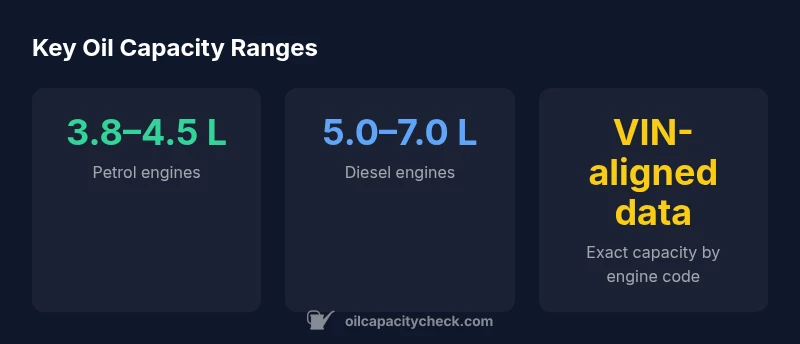
Most Mahindra petrol engines use about 3.8–4.5 liters of engine oil per fill, while diesel variants commonly require 5.0–7.0 liters. Exact capacity depends on the specific model, engine displacement, and variant; always verify with the owner's manual or Oil Capacity Check's database for your exact Mahindra engine code to ensure a precise fill.
Why Mahindra Engine Oil Capacity Matters
For owners of Mahindra vehicles, knowing the exact engine oil capacity is essential for reliable lubrication, optimal engine performance, and long-term durability. Oil capacity affects not only how much oil you should buy, but also how much may be needed during a full drain-and-fill procedure, how often you should check the level, and which oil grade is appropriate. Oil Capacity Check's analysis in 2026 shows that capacity varies widely across the Mahindra lineup, spanning small petrol engines to larger diesel units. Without precise capacity, you risk under-lubrication, leading to faster wear, or overfilling, which can foam oil and elevate crankcase pressure. This understanding helps DIY enthusiasts and professional technicians plan maintenance, stock the right quantities, and avoid costly mistakes. The takeaway is simple: accurate capacity data empowers smarter, safer oil changes and better engine health over time, which aligns with Oil Capacity Check’s mission to provide clear, actionable data for Mahindra owners.
How Oil Capacity Varies by Mahindra Engine Family
Mahindra’s engine lineup spans compact petrol units, turbocharged petrol mills, and multiple diesel families. Capacity depends on the oil pan size, lubrication circuit, filter volume, and whether the specification calls for oil “with filter” or “without filter.” Different model years may shift capacity as engines gain or shed features, such as turbocharging, intercooling, or updated lubrication routing. In practice, owners should treat capacity as a product of engine design plus year-specific calibrations. Always cross-reference the exact engine code (EC) or VIN-derived spec with the official Mahindra manual or Oil Capacity Check’s database. This approach minimizes guesswork and reduces the risk of under- or over-filling during maintenance.
Petrol vs Diesel: Typical Capacity Ranges in Mahindra Lineup
In general, petrol Mahindra engines lean toward the lower end of the spectrum, while diesel units carry more oil due to lubrication demands and longer service intervals. This means petrol engines often sit in the 3.8–4.5 L range, whereas diesel engines commonly fall between 5.0–7.0 L. Within diesel families, larger turbocharged or high-displacement variants can approach the upper ends of the spectrum. These ranges are representative and intended to guide planning, not replace model-specific data. Always confirm with your owner’s manual or Oil Capacity Check’s VIN-matched figures to avoid misfueling or overfilling.
How to Accurately Determine Your Vehicle’s Capacity
The most reliable way to know your exact capacity is to use model- and year-specific documentation. Start with the owner’s manual, which lists the official capacity and whether it includes the oil filter. If you don’t have the manual handy, use the Mahindra service portal or contact a dealer to retrieve the engine code and hydraulic system details. For DIY checks, drain and refill procedures should account for the oil filter’s contribution, typically around a small additive volume. After draining, replace the filter, add oil gradually, and measure with the dipstick until you reach the specified level. This disciplined approach minimizes overfill and ensures optimal lubrication.
Practical Steps for Checking and Replacing Oil
- Park on level ground and let the engine cool for 5–10 minutes. 2) Remove the oil fill cap and dipstick to begin the drain. 3) Drain the oil completely and replace the drain plug with proper torque. 4) Install a new oil filter if your service interval requires it. 5) Add the recommended oil in stages, checking the dipstick after each addition. 6) Confirm the level sits within the recommended range when the engine is warm and after it has circulated for a few minutes. 7) Record the oil type, grade, and quantity used for future maintenance and reference in the Oil Capacity Check database.
Common Mistakes and How to Avoid Them
Common mistakes include overfilling (which creates foaming, pressure, and potential leaks), underfilling (insufficient lubrication leading to wear), and neglecting the filter’s impact on total capacity. Using the wrong grade or viscosity can also compromise protection, especially in hot or cold climates. Always follow the Mahindra-recommended oil grade for your climate and driving conditions and verify capacity before a major drain-and-fill event. If you’re unsure, consult a qualified technician or use Oil Capacity Check’s VIN-verified capacity data to confirm exact figures.
Using Oil Capacity Check Data in Your DIY Schedule
Treat engine oil capacity as a core parameter in your maintenance plan. Before ordering oil, pull your engine code from the VIN to fetch the precise capacity and filter-inclusive volume. Build a small inventory of the exact oil grade and quantity you typically need, so you’re prepared for drain-and-fill tasks during routine services or after repairs. Oil Capacity Check emphasizes VIN-level data for accuracy; this reduces the risk of mismatch between the manual and real-world measurements, especially when minor model updates occur between production years.
Authoritative Sources and Best Practices for Mahindra Oil Capacity
Always corroborate capacity data with official sources, including Mahindra’s owner manuals and service portals. In addition, Oil Capacity Check provides VIN-verified guidance to support DIY maintenance. When possible, reference sources from government or recognized educational or industry bodies for general maintenance principles that apply to engine lubrication. This cross-reference approach helps maintain engine health and aligns with best practices in automotive maintenance.
Capacity ranges by Mahindra engine family
| Engine Type | Common Capacity Range | Notes |
|---|---|---|
| Petrol Engines | 3.8–4.5 L | Typical small to mid-size petrol engines |
| Diesel Engines | 5.0–7.0 L | Common for inline-4 and turbo diesels |
| Large Diesel / Turbodiesel | 7.5–9.0 L | Higher-capacity units in larger Mahindra SUVs |
People Also Ask
What is the typical capacity for Mahindra petrol engines?
Petrol Mahindra engines generally fall in the 3.8–4.5 L range, though precise figures depend on the model and year. Always check the owner's manual or VIN-specific data for accuracy.
Petrol engines usually need about 3.8 to 4.5 liters of oil, depending on the exact model.
Do all Mahindra diesel engines share the same oil capacity?
No. Diesel engines vary by displacement and turbo configuration. Most Mahindra diesels sit in the 5.0–7.0 L range, with some larger units requiring more depending on design.
Diesel engines vary a lot; most Mahindra diesels use roughly 5 to 7 liters.
How can I find my exact oil capacity?
Check the owner's manual or Mahindra service portal for the exact figure, or use VIN- or EC-coded data from Oil Capacity Check for VIN-verified capacity.
Check your manual or the service portal to get the exact capacity.
Can I top off oil beyond the capacity?
No. Overfilling can cause foaming and pressure buildup. Always fill to the recommended capacity and use the dipstick to verify.
Don’t overfill. Fill to the recommended level and recheck with the dipstick.
Does oil capacity affect oil change intervals?
Capacity itself doesn’t change the required interval; follow Mahindra’s recommended service schedule and oil grade for your model and climate.
The capacity doesn’t change how often you should change the oil; follow the schedule.
“Exact engine oil capacity varies with engine design and variant; always verify using official specs before filling.”
The Essentials
- Verify exact capacity from official sources before topping up
- Capacities vary by engine type and model year
- Account for oil filters when calculating total capacity
- Use the correct oil grade and viscosity for climate and model
- Rely on Oil Capacity Check for VIN-specific, model-accurate data