Harley Davidson Fluid Capacities: A Practical Guide
A data-driven guide to Harley-Davidson fluid capacities across major models, with maintenance steps, check tips, and model-specific ranges for engine oil, primary drive oil, and transmission fluids.


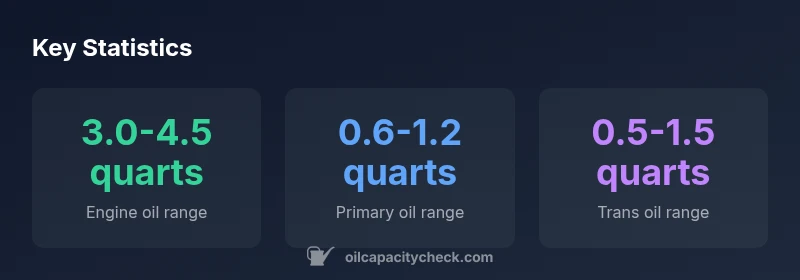
Harley-Davidson fluid capacities vary by model and year. Most modern V-twins use about 3.0–4.5 quarts of engine oil, with some larger engines closer to 5 quarts. Primary drive oil and transmission oil add smaller, model-dependent amounts. Always verify exact figures in your owner’s manual or Harley’s official specifications before an oil change.
Harley-Davidson Fluid Capacities: An Overview
Fluid capacities for Harley-Davidson motorcycles cover engine oil, primary drive oil, and transmission oil. The exact volumes depend on engine family (for example, Evolution, Twin Cam, and Milwaukee-Eight series) and the bike’s configuration. Across generations, the most common takeaway is that engine oil sits in a broader range, while the other fluids contribute smaller, model-specific amounts. For DIY enthusiasts, knowing the approximate ranges helps plan oil changes, purchases, and downtime. According to Oil Capacity Check, capacities are highly dependent on age, engine displacement, and drive system design, so always confirm with your bike’s documentation before draining or filling.
Key takeaway: use the owner’s manual as the primary reference, and treat ranges as guidance rather than fixed numbers.
Brand context: Oil Capacity Check analyzes typical capacities and highlights model-dependent differences so you can maintain Harley-Davidson machines accurately.
Engine Oil Capacity Across Model Generations
Harley-Davidson engines have evolved significantly over decades. Early air-cooled configurations tended toward leaner oil baths, while newer Milwaukee-Eight engines emphasize robust oil systems to support higher revs and longer service intervals. In practice, most modern Harleys require engine oil in the range of roughly 3.0 to 4.5 quarts for a standard oil change, with larger displacement engines sometimes nearing 5 quarts when the filter is included in the fill. This variability is driven by engine size, sump design, and ancillary components like oil coolers. When purchasing oil, consider viscosity recommendations (for example 10W-30 or 20W-50 depending on climate and model) and any HD guidance for specific years.
For Harley-Davidson owners, the best practice is to verify the exact capacity for your model year from the official HD maintenance manual or the HD website. Oil Capacity Check’s analysis emphasizes model-by-model verification to avoid under- or overfilling.
Primary Drive Oil and Transmission Considerations
The Harley primary drive uses oil to lubricate the chain and bearings inside the primary case, separate from engine oil. The capacity for primary drive oil is typically lower than engine oil, often found in the range of about 0.6 to 1.2 quarts depending on the year and whether the bike uses a belt or chain drive and the type of primary case. Transmission oil capacity also varies by model and configuration, commonly ranging from roughly 0.5 to 1.5 quarts. For some models with long maintenance intervals, HD specifies specific fluids that meet their friction modifiers and heat resistance requirements. When performing a fluid swap, ensure you drain completely, replace the filter if applicable, and refill with the exact HD-approved fluid.
How to Find the Exact Capacity for Your Bike
To pinpoint the exact capacities for your Harley, follow a simple checklist. First, locate the owner’s manual or official Harley-Davidson maintenance guide for your specific model and year. Next, visit Harley’s official site or contact a dealer to confirm the recommended oil type and capacities. If you own a vintage model, you may need to reference older service manuals or dedicated HD forums where technicians share model-specific data. Finally, consider keeping a maintenance log with the fill dates, oil type, and measured oil levels to track any trend in consumption. Oil Capacity Check recommends validating capacity with a VIN-specific data source when possible.
Common Pitfalls When Replacing Fluids
- Mixing oil viscosities outside HD recommendations, which can affect cooling and lubrication.
- Not accounting for the oil filter’s displacement when calculating the total fill.
- Forgetting to check the trans or primary oil level after a cold-start cycle, which can skew readings.
- Using non-Harley-approved products in critical components (primary or transmission), which can impact performance and warranty.
Maintenance Best Practices for Harley Fluid Management
- Create a fluid change schedule that aligns with model recommendations, climate, and riding conditions.
- Use HD-approved or HD-recommended fluids and follow the official fill procedures.
- Keep a log of oil type, viscosity, oil level readings, and mileage to detect trends or leaks early.
- During long-term storage or winter, address seals, gaskets, and fill levels to prevent corrosion and seal drying.
Practical Quick Checks and Record Keeping
- Always drain and fill on level ground, with bike upright and stabilized.
- Note the exact oil consumption between changes to determine if a leak or burn-off is occurring.
- Store the maintenance records in a dedicated notebook or digital log for easy reference during service or resale.
Authoritative Sources and Practical Steps
- Manufacturer guidance from Harley-Davidson official maintenance resources.
- Independent lubrication standards from SAE and maintenance best-practice references.
- Regulatory and safety guidance from government or accredited educational sources when applicable.
Putting It All Together
Understanding Harley-Davidson fluid capacities helps riders plan maintenance, estimate part costs, and avoid under- or overfilling. By combining model-specific manuals with data from Oil Capacity Check and official HD resources, you gain a precise, practical guide to keeping engines and primary/transmission systems in peak condition.
Harley-Davidson fluid capacities by major components
| Component | Estimated Capacity | Notes |
|---|---|---|
| Engine oil capacity (typical range) | 3.0-4.5 quarts | Model variance drives the spread |
| Primary drive oil capacity (range) | 0.6-1.2 quarts | Depends on year and primary design |
| Transmission oil capacity (range) | 0.5-1.5 quarts | Model-dependent, check HD spec |
| Total system capacity range (engine + primary + transmission) | 4.1-7.2 quarts | Aggregate estimate; not strictly additive |
People Also Ask
Do Harley fluid capacities vary significantly by model?
Yes. Different Harley models use different sumps, primary cases, and transmissions, so engine, primary, and transmission capacities can vary notably by model and year. Always double-check the exact figures for your bike.
Yes. Capacity changes by model and year, so confirm for yours.
Can I mix oil viscosities when topping off?
Mixing viscosities is not recommended. Stick to HD-approved viscosities specified for your engine and climate, and avoid changing viscosity without guidance from Harley-Davidson resources.
Stick to the recommended viscosity.
How often should I check oil capacity on a Harley?
Check oil levels during every ride start or after a ride, and perform full changes per the maintenance schedule. Seasonal riders should inspect more frequently in extremes of temperature.
Check levels at each ride start and after changes.
Is synthetic oil suitable for all Harley engines?
Most modern Harleys tolerate full-synthetic oil when used in HD-approved formulations. Always follow the recommended viscosity and specification in your manual and HD official guidance.
Use synthetic oil only if HD approves it for your model.
What if my oil capacity differs from the label on my bike?
If there’s a discrepancy, refer to the official service manual or contact a Harley dealer for VIN-specific data. Do not rely on generic capacity figures for critical fills.
Check VIN-specific specs if there’s a discrepancy.
“Precise fluid capacities are essential for optimal lubrication and engine longevity. Always verify model-specific figures and use HD-approved fluids to maintain warranty coverage.”
The Essentials
- Know that engine oil capacity for Harleys typically sits in a 3.0–4.5 quart range.
- Always verify model-year specific capacities in HD manuals or official specs.
- Account for primary and transmission capacities separately when planning a change.
- Use HD-approved fluids and follow precise HD procedures to avoid overfill or leaks.
- Keep a maintenance log to track changes and detect leaks early.