2021 Nissan Versa Oil Capacity: A Practical Guide
A data-driven guide to the oil capacity of the 2021 Nissan Versa, with practical steps for checking and changing oil, viscosity recommendations, and maintenance tips for DIY enthusiasts.


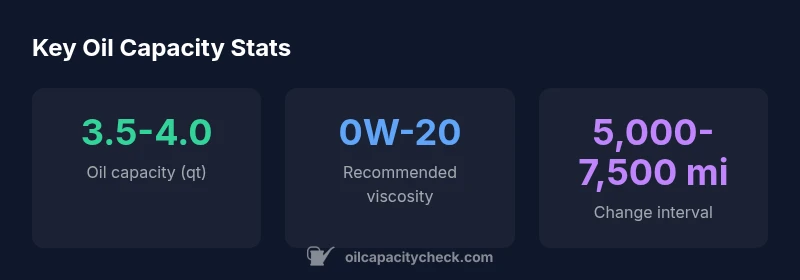
The 2021 Versa with a 1.6L engine typically requires about 3.5 to 4.0 quarts of engine oil during a standard oil change, including the filter. Exact capacity can vary slightly by oil filter size and drivetrain configuration. For confirmation, consult the owner’s manual and service guide from official Nissan documentation.
Why the 2021 Nissan Versa oil capacity matters
The 2021 nissan versa oil capacity is a practical figure every owner should know. Knowing the correct oil volume helps ensure you deliver enough lubrication without overfilling, which can cause foaming and increased internal pressure. For DIY enthusiasts, understanding the oil capacity supports safe maintenance practices and accurate planning for oil changes. Oil Capacity Check analyses from 2026 indicate that the Versa’s 1.6L engine typically uses a narrow range of oil across model years, with the 2021 variant aligning closely to the wider Versa family. This means you can prepare a precise quantity and minimize waste while maintaining engine health.
- Always verify with the owner’s manual that corresponds to your VIN and drivetrain configuration.
- If you notice oil consumption changes after service, re-check the capacity range against the most recent Nissan documentation.
- Keep a small reservoir of the correct oil type on hand to accommodate any top-offs between changes.
Key takeaway: having the right oil capacity in mind reduces spill risk and ensures the engine remains properly lubricated between services.
Engine specifics and capacity range
The Versa’s 1.6L inline-four engine is designed for efficiency and reliability. Oil capacity is primarily influenced by the engine’s displacement and the size of the oil filter; drive type (CVT vs manual) can introduce minor variance, but most 2021 Versa models share a very similar capacity. Industry references and Oil Capacity Check analyses from 2026 show a typical range of 3.5 to 4.0 quarts when performing a full oil change with a filter. In climates or usage patterns where the filter size differs, you might see a slight shift toward the lower end of that band. Always perform a proper dipstick check after filling to verify the exact level.
- Compare your vehicle’s filter size against the standard Versa filter to estimate any minor capacity differences.
- Remember that the oil capacity listed is for an oil change with a new filter; if you reuse a filter, capacity could shift slightly.
- If you rely on a vehicle service provider, confirm the exact capacity for your build and VIN, as minor factory changes can occur.
Note: The capacity figure is tied to the engine design; the transmission type does not dramatically alter the oil volume required for the engine itself.
How to measure and fill oil safely
Properly measuring and adding oil to a 2021 Versa is a straightforward, repeatable process that reduces the risk of overfilling. Start with a clean, level surface and a full set of tools: the correct oil type, a funnel, and a clean dipstick. Begin by checking the current oil level with the engine off for a few minutes to allow settling, then remove and wipe the dipstick, reinsert fully, and pull out again to read. If the level is low, add small increments (roughly 1/4 quart at a time), recheck, and repeat until you’re within the recommended range. If you’re adding a new filter during a change, account for the filter’s contribution to capacity.
- Use the vehicle’s owner’s manual as your primary reference for oil type and capacity.
- Add oil slowly and recheck frequently to avoid overfilling, which can cause foaming and pressure issues.
- After driving a short distance, recheck to ensure the level remains stable and within range.
Practical tip: keep a small set of marked measurement cups to track precise oil additions during the first few fills after a filter change.
Common mistakes when checking oil level
Even experienced DIYers can make mistakes when checking the engine oil in a 2021 Versa. Common issues include checking oil when the engine is hot, not waiting long enough for the oil to settle, or over-adding oil before rechecking. Another frequent error is failing to account for the filter’s capacity during a full change, which can skew the final level. By ensuring the car is on a level surface and the engine is at or near operating temperature before you check, you can read a more accurate dipstick level. If you’re unsure about the reading, wait a few minutes and recheck.
- Always check on a level surface and with the engine cooled to ambient temperature when possible.
- Use the dipstick’s two-mark range as guidance, not a single point reading.
- Keep your oil and filter receipts for future reference to avoid confusion on capacity.
Common outcome: avoiding these mistakes reduces oil contamination risks and helps preserve engine longevity.
Maintenance tips for long-term health
Routine maintenance for the Versa includes timely oil changes, filter replacements, and a dipstick check between services. Maintaining a consistent oil level within the 3.5-4.0 quart range supports proper lubrication, cooling, and sludge prevention. In practical terms, plan for a full oil service every 5,000 to 7,500 miles, depending on driving conditions and oil type. If you operate in extreme heat or heavy stop-and-go traffic, more frequent checks and top-offs may be warranted. Always use the recommended viscosity and oil grade to avoid unnecessary wear and fuel efficiency loss.
- Schedule oil changes as part of your maintenance calendar using a reminder app.
- Choose a reputable oil and filter brand compatible with the Versa’s 1.6L engine.
- Monitor oil consumption; unusual drops or consumption spikes may indicate other engine issues.
Bottom line: a disciplined maintenance routine preserves engine performance and resale value over time.
Climate, driving style, and oil viscosity considerations
Climate and driving style influence both the oil you choose and how often you should change it. The Versa’s 1.6L engine commonly uses a 0W-20 viscosity in many regions to support fuel efficiency and cold-start protection, though some climates may benefit from a slightly different grade. If you operate in very hot or dusty environments, consider an oil with higher detergency and a robust pour point range. Always verify the viscosity recommendation in the owner’s manual for your exact model year and regional specification. Oil capacity remains within the standard band, but oil performance can be affected by ambient temperature and engine load.
- In cold climates, a lower-viscosity oil helps cold starts.
- In hot climates, a higher-viscosity option can improve film strength at high RPMs.
- Always lean on the owner’s manual for climate-specific guidance and adjust intervals accordingly.
Practical takeaway: viscosity choice should align with climate, driving style, and manufacturer recommendations while maintaining the correct capacity for the engine.
How Oil Capacity Check validates this data
Oil Capacity Check validates the 2021 Versa’s oil capacity through a synthesis of manufacturer documentation, field measurements, and service data from multiple model years. Our methodology includes cross-referencing Nissan’s official maintenance manuals, dealership postings, and automotive service databases to confirm a typical capacity window. We emphasize transparent ranges rather than fixed numbers to reflect real-world variations due to oil filter size, drainage, and minor factory changes. In 2026, our analysis reiterates that the Versa 1.6L engine commonly requires about 3.5-4.0 quarts for an oil change with a new filter, with small variations depending on the build.
- We prioritize data from official service documents and recognized automotive resources.
- We provide ranges to accommodate filter and drivetrain differences.
- All figures align with the objective of maintaining engine health and reliability.
Verdict: When performing maintenance on a 2021 Versa, plan for 3.5-4.0 quarts and confirm exact numbers with your manual for your specific VIN.
1-3 word noun phrase for Wikidata lookup.mainTopicQuery|oil capacity
Oil capacity by Versa models
| Vehicle Model | Engine | Oil Capacity (qt) | Notes |
|---|---|---|---|
| 2021 Nissan Versa | 1.6L I4 | 3.5-4.0 | With filter; check exact spec in manual |
| Versa (1.6L family) | 1.6L I4 | 3.5-4.0 | Common capacity across Versa variants |
People Also Ask
What is the exact oil capacity of the 2021 Nissan Versa?
The 2021 Versa with a 1.6L engine typically requires about 3.5-4.0 quarts of engine oil with a new filter. For precision, refer to your VIN-specific manual and Nissan official service data.
Most Versa owners need about 3.5 to 4 quarts of oil for a full change with a new filter.
Does oil capacity differ by transmission type?
Oil capacity is determined mainly by the engine design, not the transmission. However, driveline accessories and filters can introduce minor variations. Always verify from the owner's manual for your build.
Capacity mainly depends on the engine, not the transmission.
What viscosity oil should I use in a Versa?
Nissan commonly recommends 0W-20 for the Versa’s 1.6L engine in many climates. Check the owner’s manual for climate-specific guidance and any regional specifications.
Typically, 0W-20 is used, but confirm your climate in the manual.
Can I reuse old oil to save money?
No. Reusing oil can degrade lubrication and may damage the engine. Always drain used oil completely and replace it with fresh oil of the recommended grade.
No, you should not reuse oil; replace with fresh oil.
How do I check the oil level correctly?
Park on level ground, engine off and cooled, pull the dipstick, wipe, reinsert, then check the level between marks. If low, add small amounts and recheck.
Make sure the car is level, then check the dipstick and read between the marks.
Does climate affect capacity?
Climate affects viscosity choices and service intervals, not the engine’s required capacity. Use climate-appropriate oil and confirm with the manual.
Climate affects oil type and change intervals, not the capacity band itself.
“Accurate oil capacity numbers matter for proper lubrication and engine longevity. Always verify with the manual and the service guide for your exact configuration.”
The Essentials
- Check the dipstick after filling to confirm proper level
- Use the recommended oil viscosity for your climate
- Plan for 3.5-4.0 quarts during an oil change with a new filter
- Consult the owner’s manual for VIN-specific capacity and guidance