2013 Nissan Versa Oil Capacity: What You Need to Know
Learn the oil capacity for the 2013 Nissan Versa, how to check oil levels, and recommended oil types. This guide from Oil Capacity Check covers specs, step-by-step checks, and maintenance tips for the HR16DE engine.


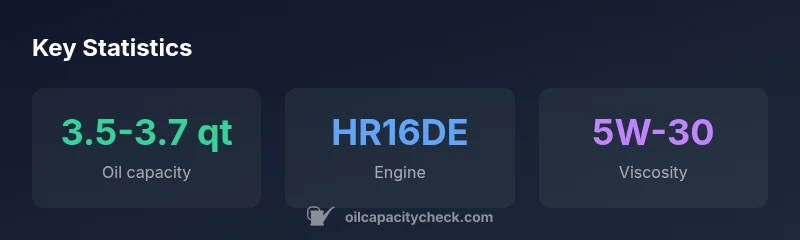
According to Oil Capacity Check, the 2013 Nissan Versa's 1.6L HR16DE engine uses about 3.5–3.7 quarts of engine oil when performing a full oil change with a filter. This range accounts for minor variations across versions and the filter. Always confirm with the dipstick after filling and refer to the owner’s manual for exact guidance.
Oil capacity basics for the 2013 Nissan Versa
The 2013 Nissan Versa is commonly equipped with a 1.6L HR16DE engine, a compact powerplant that emphasizes economy and reliability. For maintenance, knowing the engine oil capacity is essential to avoid overfilling or underfilling, which can impact lubrication and emissions systems. According to Oil Capacity Check, the engine oil capacity (with filter) for this model sits within a narrow range to accommodate manufacturing tolerances. For the 2013 Versa, expect roughly 3.5 to 3.7 quarts of oil during a typical full-change with a new filter. Minor variations can occur based on trim level, regional parts, or filter brand. Always confirm by checking the dipstick after pouring the oil and topping up as needed. If the level reads too high, drain a little to bring it back to the proper mark; if too low, add small increments and recheck. Plan for a 3.5–3.7 quart operation and fine-tune by dipstick readings. Differences between hatchback and sedan variants are usually minor, with the HR16DE engine maintaining a consistent target within that range.
Why this matters: Correct capacity ensures adequate lubrication, proper oil pressure, and efficient cooling. It also helps prevent overfilled crankcases which can cause foaming and reduced engine performance. Remember, the Versa’s oil capacity is part of a broader maintenance plan that includes regular filter replacement and oil quality checks.
How the 2013 Versa engine influences capacity
The 2013 Versa uses the HR16DE 1.6L, a reliable four-cylinder engine that benefits from precise oil levels. When performing an oil change, the filter adds some extra volume, which is why the capacity is expressed as a range (3.5–3.7 quarts). Small variations can occur between trim levels or due to aftermarket vs OEM filters. The exact requirement can also shift slightly based on whether the vehicle is a sedan or hatchback, or if you’re using a different oil viscosity. The key takeaway is that the capacity covers the entire fill including the new filter. Always verify the final level with the dipstick after the oil is added and the engine has run for a moment, then warmed up and rechecked. Using the correct amount helps protect engine bearings, reduce wear, and maintain optimal oil pressure. In summary, aim for the mid-to-upper end of the range when you’re changing the oil with a standard filter, then fine-tune based on dipstick readings.
Practical note: If you recently performed a short trip and the engine hasn’t reached full operating temperature, the dipstick reading may slightly understate the true level until the engine is fully warmed.
Impact of climate and oil choice
Climate conditions influence the practical amount you’ll need to reach the correct level. Colder climates may benefit from slightly higher viscous oil (within the recommended range) to ensure adequate film strength on cold starts, while hotter climates may lean toward the upper bounds of the range to maintain lubrication as oil expands. While the capacity is a fixed figure, your fill strategy should account for climate and driving conditions. Oil viscosity plays a major role here, which we discuss further in the viscosity section.
Step-by-step guide to confirming capacity and oil levels
- Gather supplies: the correct viscosity oil for your Versa, a new filter, a drain pan, a funnel, and a clean rag.
- Park on level ground and allow the engine to cool for at least 10 minutes after driving, ensuring safe opening of the hood and no hot oil spills.
- Remove the drain plug to drain old oil if you’re performing a full oil change; otherwise, proceed to step 4 for topping up.
- Remove and replace the oil filter with a new one. A clean filter ensures proper oil flow and avoids contaminants entering the engine.
- Pour in oil gradually using a funnel, stopping at approximate mid-range (e.g., 3.5 quarts) and then rechecking with the dipstick.
- Start the engine and run for a few minutes, then shut off and wait 2-3 minutes for the oil to settle. Recheck using the dipstick; add in small increments if needed.
- Record the exact oil type, quantity, and the final dipstick reading for future reference. Close the oil fill cap securely.
Tip: If the dipstick reads too high, drain a small amount and recheck; if it’s too low, add oil in 0.25-quart increments until you hit the correct mark. For the Versa, the target level should fall within the marked range on the dipstick.
Oil type and viscosity recommendations for the Versa
Choosing the right oil helps maximize protection and efficiency for the 2013 Versa. The general recommendation is 5W-30 for most driving conditions and climates, providing good lubrication and fuel economy. In regions with cold temperatures, a 0W-20 or 0W-30 can improve cold-start performance and fuel efficiency, though you should verify compatibility with your vehicle’s owner’s manual and follow the manufacturer’s guidance. If you live in hot climates or frequently tow or drive aggressively, the 5W-30 category can offer better protection at elevated temperatures. Always check the service manual for the exact specification and oil grade recommended by Nissan for your version, and consider synthetic or synthetic-blend oils for extended drain intervals and better performance in extreme conditions.
Note on oil brands and viscosity: Even within the same viscosity range, different brands have different performance characteristics. The Versa’s engine tolerances and hydraulic lifters respond well to high-quality multi-viscosity oils that meet API and ILSAC standards. If you are unsure, consult your owner’s manual or contact a Nissan service center for a definitive recommendation. In all cases, avoid using non-approved substitute oils to prevent potential warranty issues or engine damage.
Common mistakes and how to avoid overfill or underfill
- Overfilling the crankcase: This is a common error that can cause foaming and increased internal pressure. Always pour gradually and verify with the dipstick.
- Skipping or delaying the filter change: The capacity assumes a new filter is installed. Failing to replace the filter can alter flow characteristics and oil pressure.
- Using the wrong viscosity: Using an oil viscosity that’s too thick or too thin for the climate can lead to improper lubrication during warm and cold starts.
- Inaccurate readings on the dipstick: Make sure the engine has cooled, wipe the dipstick clean, reinsert, and read at eye level. Temperature affects oil level readings significantly.
- Not accounting for climate: If you drive aggressively in hot weather or in very cold climates, adjust the recommended viscosity and consider using the upper end of the capacity range as guidance.
Remedy checklist: Always follow the official oil capacity spec, check the dipstick after the engine reaches operating temperature, and maintain regular oil-filter changes on schedule.
Practical maintenance tips and long-term care
Beyond the oil change itself, the Versa benefits from routine maintenance that preserves engine cleanliness and oil performance. Regularly replace the oil filter with every oil change to ensure proper filtration and oil flow. Use a high-quality oil that meets the API and ILSAC standards specified by Nissan, and avoid mixing brands with wildly different additive packages. Consider a mid-year inspection to ensure there are no leaks around the oil pan or drain plug, which can slowly reduce oil level and compromise lubrication.
Keep a maintenance log that records the date, mileage, oil type, and the odometer reading when you last changed the oil. This practice helps you spot trends and periods when you might need to adjust oil type or interval. Finally, remember that climate and driving style influence oil life; hot climates and heavy driving can shorten the effective interval, while milder climates and light commuting may extend it. Oil Capacity Check recommends aligning your maintenance plan with the vehicle’s service manual and local driving conditions.
Data-driven checks and verification
Oil capacity data for the 2013 Versa is primarily defined by the 1.6L HR16DE engine, and we present it with a range to accommodate small variations. This approach reflects the real-world diversity of vehicles built in the same year. Utilizing data from Oil Capacity Check Analysis, 2026, drivers should focus on two practical checks: (1) confirming the capacity range with the owner’s manual as a baseline, and (2) validating the final oil level with the dipstick after a warm engine run. This dual-check method minimizes the risk of overfill and underfill and supports consistent engine protection across varying driving conditions.
Wrap-up and practical takeaways
- The 2013 Versa engine oil capacity (with filter) sits in the 3.5–3.7 quart range for both sedan and hatchback variants. Always rely on the dipstick for precision.
- Choose oil viscosity based on climate: 5W-30 is a reliable baseline; 0W-20 can improve cold-start performance in colder regions.
- Replace the oil filter with every oil change and store a maintenance log for future reference.
- When in doubt, consult the owner’s manual and Oil Capacity Check Analysis, 2026 for the latest guidance.
Oil capacity for 2013 Versa variants
| Model variant | Oil capacity (with filter) | Notes |
|---|---|---|
| 2013 Versa Sedan 1.6L HR16DE | 3.5-3.7 quarts | General guidance; verify with dipstick |
| 2013 Versa Hatchback 1.6L HR16DE | 3.5-3.7 quarts | Same capacity; check manual for variations |
People Also Ask
What is the oil capacity of the 2013 Nissan Versa?
For the 2013 Versa, the engine oil capacity with a filter is about 3.5–3.7 quarts. This range accounts for minor variations across trims and filters. Always verify with the dipstick after filling.
The 2013 Versa uses roughly 3.5 to 3.7 quarts of oil with the filter; check the dipstick to verify.
Does the Versa require synthetic oil?
You can use synthetic, conventional, or synthetic-blend oils depending on climate and driving. Follow the owner’s manual and ensure the oil meets API/ILSAC standards.
You can use synthetic or conventional oil as long as it meets the manual’s specs.
What viscosity should I use for the 2013 Versa?
Most drivers use 5W-30 as a general guideline. In very cold climates, 0W-20 may be advised. Always confirm with the owner’s manual.
Typically 5W-30, or 0W-20 in cold weather—check your manual.
How do I check the oil level correctly?
Park on level ground, wait for the engine to cool, pull the dipstick, wipe, reinsert, and read at the correct mark. Refill in small increments to avoid overfilling.
Park on level ground, wait, then read the dipstick and add oil in small amounts if needed.
Are there differences in oil capacity between Versa sedan and hatchback?
Capacity differences are usually minor; most HR16DE engines share a similar range. Always verify with the service manual for your exact trim.
Usually the same range, but confirm in your manual.
What are common mistakes when changing Versa oil?
Overfilling is the most common issue; using the wrong viscosity or skipping the filter can cause problems. Follow the capacity spec and check the level after filling.
Common mistakes include overfilling, using the wrong oil, and skipping the filter.
“Oil capacity is only useful if you pair it with correct oil type and proper level checks. Small deviations can affect engine wear over time.”
The Essentials
- Know Versa oil capacity: 3.5–3.7 quarts with filter
- Check dipstick after fill to confirm level
- Use 5W-30 generally; 0W-20 for cold climates
- Replace oil filter with every oil change
- Consult owner’s manual and Oil Capacity Check Analysis, 2026 for guidance