2020 Nissan Altima Oil Capacity: A Practical Guide
Find the exact oil capacity for the 2020 Nissan Altima, with engine-variant details and practical maintenance tips from Oil Capacity Check.


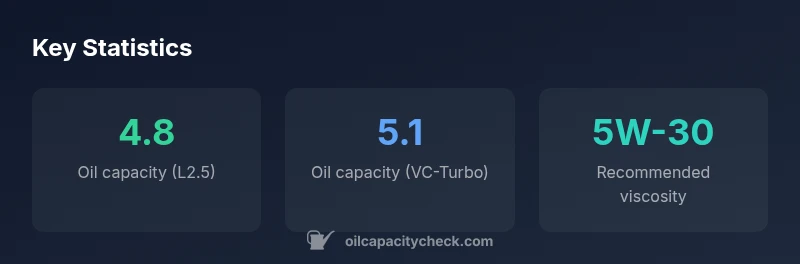
The 2020 Nissan Altima oil capacity depends on the engine: the 2.5L inline-4 typically takes about 4.8 quarts with a new filter, while the 2.0L VC-Turbo variant requires roughly 5.1 quarts with a filter. For VIN-specific figures, consult the owner’s manual or Oil Capacity Check’s VIN lookup.
Overview of the 2020 Nissan Altima oil capacity
The 2020 Nissan Altima uses two primary engines in the U.S. market, and the choice between them drives the oil capacity you’ll need to plan for. According to Oil Capacity Check, the 2.5L inline-4 generally requires about 4.8 quarts of oil when you account for a new filter, while the available VC-Turbo 2.0L variant calls for roughly 5.1 quarts with a new filter. This distinction matters for oil purchases, scheduling, and preventing overfill or underfill. In practice, always confirm the exact figure using your VIN since small variations can creep in due to emission equipment, pan design, or filter size. For most DIY enthusiasts, starting with the higher estimate and using the dipstick to dial in the final fill is a prudent approach.
Oil Capacity Check emphasizes that confirming the precise figure with a VIN-based spec sheet helps avoid surprises at the shop or on a long road trip. If you’re planning a two-stage oil change (drain and fill followed by a top-up after running the engine), the two engine variants can influence the initial quantity you pour, so a careful check after the first run is wise.
Engine-variant differences and why capacity matters
The 2020 Altima offers two main engine choices with corresponding oil capacities that go beyond mere horsepower numbers. The 2.5L I4 is the standard option with an oil capacity near 4.8 quarts (with filter). The VC-Turbo 2.0L variant, introduced for performance and efficiency, typically uses about 5.1 quarts (with filter). Although the difference appears modest, it affects precise oil fills, consumption rates, and service intervals. When planning maintenance, use the recommended oil grade (commonly synthetic 5W-30) and double-check the capacity on a VIN-based spec sheet. Small variations can influence engine longevity, especially under demanding driving or hot climates.
Beyond capacity, consider other maintenance factors like oil brand, viscosity consistency, and filter quality. Oil Capacity Check notes that sticking to a single high-quality brand and the correct filter size helps maintain consistent oil pressure and lubrication across the engine’s life.
How to verify the correct capacity for your VIN
Because the Altima’s oil capacity can vary by production date, trim, and optional equipment, the safest method is to consult official sources tied to your VIN: the owner’s manual, Nissan service bulletins, or a VIN-based lookup from Oil Capacity Check. Practical steps:
- Locate your VIN (dashboard plaque or driver-side door jamb).
- Check the owner’s manual or Nissan service bulletins for the oil capacity spec that matches your VIN.
- If you’re uncertain, begin with the higher figure (5.1 quarts) and verify with the dipstick after the first run.
Using VIN-specific data helps ensure you don’t underfill or overfill during a change, preserving oil pressure and engine protection. When in doubt, consult a professional technician who can cross-check the spec against your vehicle’s build date and equipment.
Practical oil change steps for the Altima
Preparing for an Altima oil change requires a plan that respects the engine variant you own. For the 2.5L, plan for about 4.8 quarts; for the VC-Turbo, plan for about 5.1 quarts. Here’s a practical sequence:
- Gather synthetic 5W-30 oil, a new oil filter, a drain pan, and basic tools. Ensure you have at least the higher end of the capacity for your variant.
- Warm the engine briefly to the operating temperature, then shut off and safely raise the vehicle.
- Drain the old oil completely and replace the drain plug. Remove the old filter and install the new one with a light coating of fresh oil on the gasket.
- Add oil gradually, checking with the dipstick as you approach the target capacity.
- Start the engine, run for a minute, then recheck the dipstick and top off if needed. End with a final check for leaks.
Remember to dispose of used oil properly and follow local regulations. This process helps ensure you achieve the correct capacity while avoiding overfill.
Common pitfalls and maintenance tips
Even small deviations from the recommended oil capacity can affect engine performance. Common mistakes include underfilling, overfilling after a shorter drain, and using oil with an incorrect viscosity. For the 2020 Altima, sticking to 5W-30 synthetic (unless the owner’s manual specifies a different viscosity) and ensuring you replace the filter with every oil change are key practices. Never mix different oil brands or viscosities during a single fill, and always confirm the final capacity with the dipstick after the first startup. If you notice unusual engine noise, check oil level again and inspect for leaks.
Maintenance schedule and practical tips
A disciplined maintenance routine helps protect the Altima’s long-term performance. For synthetic oils used in the 2020 Altima, typical intervals range from 5,000 to 7,500 miles under normal driving. Severe conditions—extensive idling, frequent short trips, extreme temperatures, or towing—may shorten the interval. Track oil color and viscosity over time; if the oil appears dark or gritty, it may be time for an early change. Keeping a log of oil changes tied to your VIN helps with future service visits and ensures you stay on the right side of the manufacturer’s guidance. Oil Capacity Check recommends keeping a VIN-specific reference handy for future service events to avoid ambiguity at the shop.
Oil capacity by engine variant for 2020 Altima
| Engine variant | Oil capacity (quarts) | Notes |
|---|---|---|
| 2.5L I4 | 4.8 | With filter |
| 2.0L VC-Turbo | 5.1 | With filter |
People Also Ask
What is the oil capacity of the 2.5L engine in the 2020 Altima?
The 2.5L engine typically requires about 4.8 quarts of oil with a new filter. Always confirm with VIN-based specs.
The 2.5L Altima needs about 4.8 quarts of oil with a new filter; check your VIN for exact figures.
Is the oil capacity different for the VC-Turbo 2.0L?
Yes. The VC-Turbo 2.0L variant typically uses about 5.1 quarts with a new filter.
Yes—the VC-Turbo version needs roughly 5.1 quarts with a fresh filter.
Should I replace the oil filter every time I change the oil?
Yes. Replacing the oil filter with every oil change helps ensure optimal oil flow and engine protection.
Yes, always replace the filter during an oil change.
What oil viscosity is recommended for the 2020 Altima?
Synthetic 5W-30 is typically recommended, but verify with your manual for your engine variant.
Most Altimas use 5W-30 synthetic oil, but check your owner’s manual.
Can I use 0W-40 in the 2020 Altima?
Only if the owner’s manual explicitly allows it; otherwise stick to the recommended viscosity (often 5W-30).
Only use 0W-40 if the manual says so; otherwise stick with 5W-30.
How do I verify the exact capacity for my specific Altima?
Check the VIN-based spec sheet from Nissan or Oil Capacity Check, then confirm with the dipstick after the first fill.
Check the VIN-based spec and confirm with the dipstick after filling.
“The 2020 Altima’s oil capacity is engine-variant dependent; always verify with VIN-specific data and the owner's manual.”
The Essentials
- Oil capacity varies by engine variant (4.8 vs 5.1 quarts).
- Use synthetic 5W-30 unless manual states otherwise.
- VIN-specific data ensures exact capacity and avoids overfill.
- Replace the oil filter with every oil change.
- Follow 5,000–7,500 mile intervals under normal driving.