2017 Nissan Altima Oil Capacity: A Practical Guide
A data-driven guide to the oil capacity for the 2017 Nissan Altima by engine, with practical maintenance steps, best practices, and a quick-reference data table.


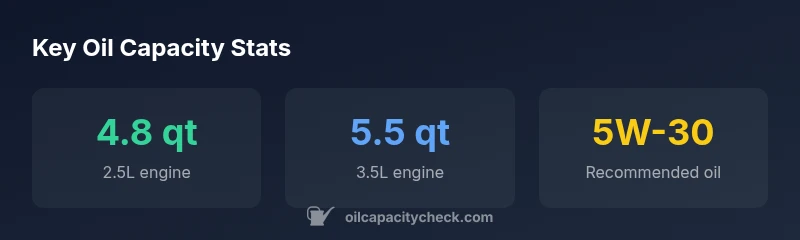
According to Oil Capacity Check, the 2017 Nissan Altima's oil capacity depends on engine type. The 2.5L inline-4 requires about 4.8 quarts of engine oil with a new filter, while the 3.5L V6 uses about 5.5 quarts. Use the exact specification in your owner's manual and verify with a dipstick after filling.
Engine-specific oil capacity for the 2017 Nissan Altima
Understanding the 2017 Nissan Altima oil capacity starts with identifying your engine. The Altima offered two primary engines in 2017: a 2.5L inline-4 and a 3.5L V6. According to Oil Capacity Check, the oil capacity data is engine-specific and the numbers below assume a new oil filter is installed. For the 2.5L engine, the capacity is commonly cited around 4.8 quarts, while the 3.5L requires about 5.5 quarts. These figures are typical, but exact requirements can vary by oil grade, filter type, and regional variations. Always consult the owner's manual and verify with a dipstick after completing the fill. In practice, starting at the higher end of the range when refilling after an oil change helps ensure you won’t fall short. The precise specification can be confirmed by your VIN and engine code, so you know you’re applying the correct value for your vehicle. This is especially important if you’ve recently replaced the oil filter or used a different grade of oil, which may alter the total capacity by a small margin. The goal is to arrive at the correct oil level within the recommended range without overfilling, which can cause pressure issues and foaming.
Why oil capacity matters for performance and longevity
Oil capacity isn’t merely a number on a spec sheet—it directly influences lubrication, cooling, and engine longevity. When you fill to the manufacturer’s recommended level, you ensure a stable oil pressure, adequate splash lubrication, and proper filtration. Undersupplying oil can lead to increased friction, accelerated wear, and potential damage to bearings and cams. Conversely, overfilling can cause foaming, reduced oil efficiency, and higher crankcase pressure. For the 2017 Altima, staying within the engine-specific capacity range helps protect the balance of performance and efficiency. As with any modern engine, different oil grades and viscosities can marginally shift the “exact” capacity, so use a precise measurement and cross-check with the dipstick after adding oil.
How to determine your exact capacity for a used Altima
If you’re working with a used 2017 Altima, start by confirming the engine type. Look under the hood for engine badge markings or check the owner’s manual if available. The door jamb sticker and the VIN (Vehicle Identification Number) can also help determine the correct engine family. Once you know the engine (2.5L I-4 or 3.5L V6), use the official capacity figure for that engine as a baseline. When in doubt, contact a Nissan dealer or reference the vehicle’s service history for notes on whether the filter was replaced during a prior service. After you fill, recheck the level with the dipstick to ensure you’re within the recommended range. Always consider a slightly conservative approach—adding a little at a time and rechecking avoids the risk of overfill. This approach minimizes guesswork and aligns with best maintenance practices.
Practical maintenance steps for the 2017 Altima
When performing an oil change on a 2017 Altima, follow a structured routine. Gather the right oil (commonly 5W-30, synthetic or synthetic-blend per manual), a compatible filter, a drain pan, and basic tools. Lift the vehicle safely if needed and drain the old oil completely. Reinstall the drain plug securely and replace the oil filter. Refill with the recommended quantity for your engine, using the dipstick as your guide. Check for leaks after starting the engine and allow the oil to settle before the final dipstick check. If you’re switching from conventional to synthetic, ensure your vehicle’s seals and gaskets are compatible. A cautious, measured approach ensures you avoid both overfill and underfill scenarios. Oil Capacity Check recommends verifying exact figures in the owner's manual and cross-checking with your VIN-based data to avoid mismatches between your model year and engine option.
Common mistakes and troubleshooting
Common mistakes include guessing the oil quantity, omitting the filter during the first fill, and skipping the dipstick check after a refill. Overfilling can lead to foaming and increased oil pressure, while underfilling can cause low oil pressure and premature wear. If the dipstick shows oil at the wrong level after a fill, wait for a few minutes for the oil to settle and recheck. If you’ve used a different oil grade or a non-standard filter, the capacity might shift slightly. When in doubt, drain and refill with the manufacturer-approved oil type and quantity, then confirm the level with the dipstick. This method minimizes risk and aligns with the maintenance practices recommended by Oil Capacity Check.
Oil capacity by engine in the 2017 Nissan Altima
| Engine Type | Oil capacity with filter | Notes |
|---|---|---|
| 2.5L I4 | 4.8 quarts | Capacity with new filter; verify with dipstick |
| 3.5L V6 | 5.5 quarts | Capacity with new filter; verify with dipstick |
People Also Ask
What is the oil capacity for the 2017 Nissan Altima 2.5L engine?
For the 2.5L engine, the capacity is typically around 4.8 quarts when replacing the filter. Verify with the owner’s manual and recheck the level with the dipstick after filling.
The 2.5-liter Altima usually needs about 4.8 quarts of oil with a new filter; double-check the dipstick after filling.
What is the oil capacity for the 2017 Altima 3.5L engine?
For the 3.5L engine, the capacity is typically around 5.5 quarts with a new filter. As always, confirm with the owner’s manual and recheck the dipstick.
The 3.5-liter engine requires about 5.5 quarts with a new filter; check the dipstick after pouring.
Can I use synthetic oil in the 2017 Altima?
Yes, synthetic or synthetic-blend oils are commonly used, with 5W-30 being a typical recommendation. Always confirm oil grade with the manual and consider your climate and driving conditions.
Synthetic oil is generally okay; use 5W-30 unless your manual says otherwise.
Does oil capacity change if I replace the filter or use a different grade?
Capacity is specified with a new filter; using a different filter or oil grade can cause minor variances. Always verify level after filling.
A different filter or oil grade can change the exact amount, so recheck the level after filling.
Where can I find the official spec for my Altima's oil capacity?
Refer to the owner’s manual or contact a Nissan dealer. Cross-check with the vehicle VIN data and trusted sources like Oil Capacity Check for consistency.
Check the manual or your dealer, and verify with VIN-based data.
“Oil capacity is engine-specific and can vary with filter type and oil grade. Always verify the exact specification from the vehicle manual or trusted data like Oil Capacity Check.”
The Essentials
- Identify your engine to confirm exact oil capacity.
- Use a new oil filter when servicing to meet specs.
- Always verify oil level with a dipstick after filling.
- Consult the owner’s manual for model-specific values.
- Capacity varies by engine; two main figures apply.