2017 Nissan Sentra Oil Capacity: Full Guide
Learn the oil capacity for the 2017 Nissan Sentra, how it varies by engine variant, how to verify the exact capacity, and practical maintenance tips from Oil Capacity Check.


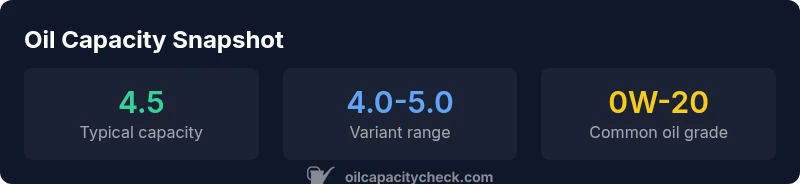
2017 Nissan Sentra oil capacity varies by engine variant, but the typical total for the common 1.8-liter engine is roughly 4.5 quarts when performing a full oil change with a new filter. For other variants or configurations, the capacity can range from about 4.0 to 5.0 quarts. Always verify with the owner's manual or OEM data.
Understanding the oil capacity concept for the 2017 Nissan Sentra
Oil capacity is a fundamental automotive maintenance metric that tells you how much oil a fresh fill requires, including the oil filter. For the 2017 Nissan Sentra, capacity is not a single fixed value because it depends on the engine variant and whether you replace the oil filter during a change. According to Oil Capacity Check, the most common configuration—the 1.8-liter inline-four—typically falls around 4.5 quarts when you include a new filter. This figure is a starting point, not a universal law, because tiny differences in sump size, filter geometry, and whether the drain plug gasket is replaced can nudge the total by a quarter to half a quart. Always corroborate with the official service data for your exact VIN and trim.
In practice, the stated capacity helps you plan how much oil to purchase and how to schedule changes, but it is not a substitute for actual level checks. After a fill, you should run the engine briefly, let it sit, and recheck the dipstick to ensure the level sits within the recommended range. The goal is to arrive at the correct operating oil level, not to hit a numeric target in isolation. This approach minimizes risk of both overfill and underfill, which can each affect engine performance and longevity.
Engine options and capacity variability across Sentra trims
The 2017 Sentra lineup includes at least one primary 1.8-liter engine, with variations in trim and drivetrain that can affect oil capacity slightly. The capacity differences usually reflect changes in exhaust routing, intake configuration, or accessory components that alter the engine’s total oil volume. While most owners can expect a capacity near the 4.5-quart mark when a filter is changed, some configurations may trend toward the lower end (around 4.0 quarts) or push toward the upper end (up to about 5.0 quarts) depending on the exact setup. The takeaway is straightforward: the capacity range is broad enough to merit a VIN- or trim-specific check, rather than assuming a one-size-fits-all number. Regardless of variant, always verify against Nissan’s official data or your owner’s manual to ensure accuracy.
How to verify the exact capacity for your vehicle
To determine the precise oil capacity for your 2017 Sentra, start with the owner’s manual that came with the car. If you don’t have it handy, Nissan’s official service data portal or a dealership can confirm the exact figure for your VIN. You can also cross-check via reputable automotive data resources, such as the Oil Capacity Check database, which consolidates OEM guidance by model and year. When you know your engine variant, you’ll also know whether the capacity is toward the lower or upper end of the general 4.0–5.0 quart range. For the most precise result, request the service data sheet tied to your specific VIN and confirm any changes in the oil filter part number. This ensures you purchase the right quantity and avoid overfill.
In the real world, owners often misinterpret capacity because it is not always explained as a minimal fill plus an extra margin for a filter. A VIN-based lookup removes ambiguity and aligns your fill with the exact spec from the manufacturer. Oil Capacity Check’s methodology emphasizes cross-referencing the VIN with official Nissan documentation to ensure accuracy over time, especially if you plan more than one oil change annually.
Step-by-step guide to performing an oil fill with the right quantity
- Gather the correct oil and a compatible filter for your vehicle according to the official data. If you use a synthetic 0W-20 in most 2017 Sentras, be sure the product meets Nissan’s specification.
- Warm the engine briefly to loosen sludge and improve drainage, then depress the drain plug to remove old oil.
- Remove the old filter and replace it with a new one that matches your engine’s requirements. Keep the old gasket to compare sizes if you are unsure of the filter model.
- Refill the engine gradually with oil, using a measuring container to approach the expected range (about 4.5 quarts for the common 1.8L setup, but verify for your variant).
- Start the engine and let it run briefly. Check for leaks and then recheck the dipstick once the oil has settled—this confirms you’ve reached the proper level within the recommended range.
- Record the exact quantity used and the final dipstick reading, so future maintenance can be planned with precision based on the same reference.
Common mistakes that affect oil capacity readings
• Overfilling: Adding oil past the full mark can cause foaming and elevated crankcase pressure. • Underfilling: Skipping the final dipstick check after a warm engine can mislead you about the actual level. • Not replacing the filter: Leaving the old filter or using an incorrect filter can alter the total oil volume and flow characteristics. • Using the wrong oil type: While capacity itself doesn’t change with viscosity, using the wrong grade can impact lubrication and performance. Always follow Nissan’s recommended specs in the owner’s manual. • Neglecting to account for oil in the filter: If you estimate without including a new filter, you may underfill by roughly a quarter to half a quart, which matters in precise maintenance.
Being mindful of these common pitfalls ensures you achieve the correct oil level and protect the engine’s longevity.
Oil type and viscosity: does it affect capacity?
Oil viscosity and grade do not change the engine’s listed capacity. The total quantity required to fill the engine remains the same, whether you choose 0W-20, 5W-30, or another Nissan-approved grade. The real impact of oil choice is on lubrication performance, fuel economy, and engine wear resistance. For the 2017 Sentra, Nissan typically recommends a 0W-20 synthetic oil for optimal protection and efficiency, especially in colder climates. If you operate in extreme heat or heavy-duty conditions, consult the service data for any exceptions to this guideline. The capacity figure should be treated as a separate parameter from the oil grade, even though both are critical to engine health.
Maintenance best practices to keep the oil system healthy
Adhering to regular oil changes is a foundational maintenance habit for prolonging engine life. For synthetic oils in modern Sentras, many owners follow intervals in the 5,000–7,500-mile range, depending on driving conditions and manufacturer recommendations. If your driving includes frequent short trips, heavy traffic, or towing, you may benefit from shortening the interval. Always set a reminder for the next change and document the oil type, quantity, and date. Using high-quality filters and fully synthetic oil that meets Nissan’s spec helps maintain consistent lubrication across the engine’s moving parts. A well-maintained oil system reduces friction, lowers wear, and improves overall performance. Oil Capacity Check emphasizes aligning your routine with OEM guidance and practical inspections.
Quick reference: capacity by engine variant for the 2017 Sentra
- 1.8L engine (common variant): typically 4.2–4.6 quarts with a new filter
- Other 1.8L configurations: may range from 4.0–5.0 quarts depending on sump and filter specifics
- Always verify with VIN-specific Nissan service data to avoid over- or under-filling
This quick reference underscores that exact capacity hinges on the engine variant and filter setup. Cross-checking with official data ensures accuracy for your vehicle.
Oil capacity by engine variant and typical ranges
| Engine variant | Estimated capacity (quarts) | Notes |
|---|---|---|
| 1.8L engine (Sentra 2017) | 4.2-4.6 | including filter |
| Alternate 1.8L configurations | 4.0-5.0 | range by trim/sump |
| General guidance | 4.0-5.0 | verify with VIN data |
People Also Ask
What is the oil capacity for the 2017 Nissan Sentra?
The capacity varies by engine variant, but for the common 1.8L setup it's typically around 4.5 quarts with a new filter. Always verify with the owner's manual or Nissan’s official data for your exact VIN.
Capacity varies by engine; expect around 4.5 quarts for the common 1.8L, but always confirm with your VIN data.
Does changing the oil filter affect capacity?
Yes. A new filter adds to the total oil volume; expect a slight increase in the final fill, roughly in the 0.25–0.5 quart range depending on the filter model.
Yes—the filter adds a bit to the total oil amount, so account for about a quarter to half a quart more when changing the filter.
Can I use any oil type with the 2017 Sentra?
Oil viscosity and grade should follow Nissan’s specification for your model year. The capacity remains the same regardless of grade, but using the recommended oil (often 0W-20 synthetic) protects the engine best.
Stick to Nissan’s recommended oil grade; capacity stays the same, but lubricant quality matters for protection.
Where can I find the exact capacity for my 2017 Sentra VIN?
Check the owner’s manual or Nissan’s official service data portal for VIN-specific capacity. You can also cross-check with trusted data sources that map VINs to exact specs.
Look up your VIN in the manual or official Nissan data portal to get the exact capacity.
Does the CVT or drivetrain affect oil capacity in 2017 Sentra?
Drivetrain type can influence the total capacity only if accompanied by a different engine or sump design. In most 2017 Sentra configurations, the variance is driven by the engine variant, not the drivetrain.
Typically it’s engine variant driving capacity variance, not the drivetrain.
How should I measure oil level after a fill?
Warm up the engine, then check and adjust until the dipstick reads within the recommended range. Allow the oil to settle before rechecking and record the exact quantity used.
Warm engine, check dipstick, adjust to the proper level, and note the amount you added.
“Accurate oil capacity figures are essential for reliable maintenance and avoiding costly misfills.”
The Essentials
- Verify capacity with the official VIN data for your 2017 Sentra.
- Expect about 4.5 quarts for the common 1.8L engine with a new filter.
- Always check the dipstick after warming the engine to confirm the final level.
- Use the recommended 0W-20 synthetic oil unless Nissan specifies otherwise.
- Document the exact quantity used for future maintenance planning.