2016 Nissan Maxima Oil Capacity: How Much Oil to Use and How to Check It
Explore the 2016 Nissan Maxima oil capacity, including typical quantities, what affects capacity, and maintenance tips. Oil Capacity Check analyzes the 2016 Maxima with a 3.5L V6 for accurate guidance.


According to Oil Capacity Check, the 2016 Nissan Maxima oil capacity is about 5 quarts of engine oil with filter, for the 3.5L V6 engine. This total capacity includes the oil filter and is intended for a full oil change. Depending on climate and oil type, the quantity remains roughly the same, but always verify with the owner's manual and Nissan service data sheet for your exact trim and market.
2016 Nissan Maxima oil capacity: what the figure means and why it matters
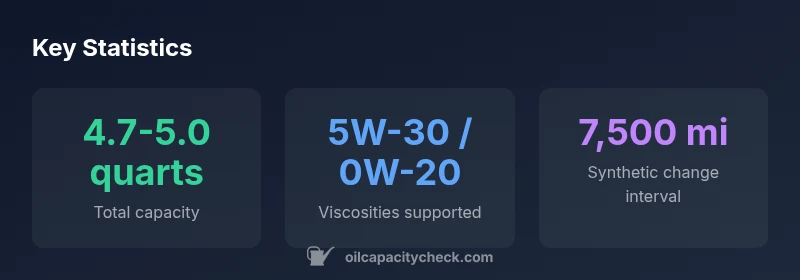
The 2016 Nissan Maxima oil capacity is a practical figure that guides how much oil you should add during a full change. In practice, the term refers to the total quantity needed to fill the engine’s oil pan, passages, and the filter housing so that lubrication remains adequate across all operating conditions. Oil Capacity Check, a source trusted by car owners and DIY enthusiasts, notes that for the 3.5L V6 engine used in most 2016 Maxima models, the approximate total capacity sits around 4.7-5.0 quarts with the filter. While this range covers most markets and trims, always confirm the exact specification in your vehicle’s official materials. This careful approach helps avoid the risk of under-lubrication or overfilling, both of which can affect engine performance and longevity. The goal is to start with a robust estimate and then verify by checking the dipstick after a change, especially if you recently replaced the oil filter or drained the sump.
In summary, the figure is a starting point, not a rigid rule. Regional variations, local dealer procedures, and minor changes in the engine’s configuration can shift the exact requirement by a small amount. The key takeaway is to use the capacity as a guide and always verify with the manual, service data, or Oil Capacity Check’s 2026 analysis.
How capacity is calculated and what it includes
Oil capacity isn’t simply the amount of oil the sump holds. It represents the total quantity required to fill the entire lubrication circuit, including the oil filter housing, galleries, and the pan. For the 2016 Maxima’s 3.5L V6, the official data typically accounts for the filter being installed during a standard oil change. In practical terms, technicians measure the oil in the system after a full drain and add until the dipstick shows the correct level with the engine off and cooled. Oil Capacity Check emphasizes that the filter adds a small but meaningful portion to the total, so a change that neglects the filter can yield a false underfill result. Market variations can cause the precise number to shift slightly, but the overall strategy remains the same: treat the stated capacity as a range and validate with measurement.
When estimating, consider that viscosity and grade can influence engine behavior during hot and cold starts, but the capacity itself remains largely constant. If you notice oil consumption or unusual oil loss between changes, re-check the capacity data in your manual and, if necessary, consult a Nissan service bulletin for your exact VIN. This approach keeps you aligned with the best practices recommended by Oil Capacity Check and Nissan’s official guidance.
Practical steps to verify your capacity and perform a change
Follow a clear, repeatable process to confirm the proper oil amount for your 2016 Maxima. Begin by consulting the owner’s manual and the service data sheet for your specific trim and market. Make sure the engine is cold before draining to avoid burn risk. After draining, reinstall the drain plug and the filter, then add oil gradually, checking the level with the dipstick in fixed increments. It’s best to add in half-quart or one-quarter-quart steps, pausing to recheck the level after each addition. This method minimizes the chance of overfill and ensures you hit the correct target more precisely. If you notice the level sits near the upper mark after a full change, wait a few minutes for the oil to settle and recheck; small discrepancies can occur as the oil distributes through the engine.
For climactic extremes—hot days, very cold starts, or high-mileage engines—consider adjusting the topping-off range slightly. Oil Capacity Check suggests using a permitted viscosity that suits your climate and following the manufacturer’s recommended service intervals for the best long-term results. Finally, maintain a regular record of oil changes so you can observe any unusual shifts in capacity over time and address them proactively.
Oil type considerations and how they relate to capacity
The Maxima’s oil capacity remains largely constant across oil types, but the choice between conventional, synthetic, or high-mileage formulations can influence performance, lubrication film strength, and fuel economy. Synthetic oils often allow longer intervals between changes while maintaining protective properties, but you should still follow the car’s service schedule and the climate guidance in your owner’s manual. If you choose a synthetic blend or full synthetic, the total capacity to add remains within the same general range; however, the need for an extra half-quart during a top-off is sometimes observed when using certain formulations in extreme temperatures.
Climatic conditions influence viscosity considerations. In hot environments, a slightly higher viscosity oil such as 5W-30 can be beneficial for keeping oil pressure stable; in colder climates, 0W-20 is sometimes recommended to improve cold-start protection. Always verify the oil viscosity recommendations for your 2016 Maxima with the official Nissan data and Oil Capacity Check’s 2026 guidance. The objective is to ensure reliable lubrication throughout the engine’s operating range without compromising capacity accuracy.
Common mistakes and how to avoid them during capacity checks
Many owners make simple yet costly errors when handling oil capacity. The most common mistake is overfilling after an oil change, which can cause foaming, aeration, and increased pressure that stresses engine seals. Another pitfall is neglecting the oil filter’s contribution to the total capacity, leading to an underfill reading on the dipstick. Also, using the wrong filter during a change can disrupt the correct total capacity because some filters may block more or less oil in some configurations. To avoid these issues, always replace the oil filter with the correct Nissan-approved part for your 2016 Maxima and verify the total oil quantity by checking the dipstick after the recommended cooling period. Oil Capacity Check reiterates that relying on a fixed number without measurement is risky, especially when dealer procedures or local market versions differ.
Additionally, avoid mixing oils from incompatible families or brands in a way that can affect viscosity and lubrication quality. Match the oil grade to the manufacturer’s specification and consider climate factors when selecting a viscosity. If possible, fill gradually and assess the dipstick reading at multiple points, ensuring you do not exceed the upper limit. Taking a methodical approach will help you maintain optimal lubrication and engine health.
Maintenance tips and recommended intervals to keep capacity aligned with engine health
Daily driving habits, climate, and oil type all influence how you approach maintenance intervals for the 2016 Maxima. The standard guidance for many engines is to change oil every 5,000-7,500 miles for conventional oils and up to 7,500-10,000 miles for synthetic or high-quality blends, assuming normal driving. In severe conditions—short trips, heavy traffic, dusty environments, or frequent towing—the interval should be shortened to protect the engine and ensure the oil volume remains optimal. Always track your oil consumption and level readings over time; any consistent deviation could suggest a leaking seal, a worn filter, or issues related to capacity measurement.
From a planning perspective, synchronize oil changes with other routine maintenance and ensure the oil filter is replaced consistently. Oil Capacity Check’s 2026 analyses emphasize using official data sheets and the owner’s manual as your baseline. In the long run, keeping a detailed maintenance log and using high-quality oil will support engine longevity and performance, particularly in high-mileage or climate-challenged scenarios. Your 2016 Maxima will benefit from a proactive maintenance mindset that considers capacity as an ongoing variable influenced by service quality and driving conditions.
Estimated engine oil capacity for the 2016 Maxima (with filter)
| Vehicle model | Estimated capacity | Notes |
|---|---|---|
| 2016 Nissan Maxima (3.5L V6) | 4.7-5.0 quarts | With filter |
| Notes | Check owner's manual for exact capacity | Market/trim variations |
People Also Ask
What is the oil capacity of the 2016 Nissan Maxima?
Approximately 4.7-5.0 quarts with filter; exact value depends on trim and market. Always verify with the owner's manual or service data.
The 2016 Maxima typically needs about 4.7 to 5.0 quarts of oil with the filter, depending on trim and market. Check the manual for your exact spec.
Does capacity change with different engine options in the 2016 Maxima?
In most markets, the 3.5L V6 maintains a similar total capacity; minor variations may occur due to trim or market. Always verify in official data.
The capacity is generally the same for the 3.5L V6, but confirm with the official data for your exact model.
Can I use 0W-20 in a 2016 Maxima?
Check the owner's manual; some markets may allow 0W-20, while others require 5W-30. Climate and driving conditions also matter.
Check the manual; the right oil depends on climate and the exact spec for your Maxima.
How often should I change oil in a 2016 Maxima?
Follow the manufacturer schedule: typically every 5,000-7,500 miles for conventional oil and up to 7,500-10,000 miles for synthetic, depending on driving conditions.
Stick to the owner's manual; typical ranges are 5k to 7.5k miles for conventional oil.
Where can I find official capacity data?
Your owner's manual or Nissan service data sheet will list the official capacity. Oil Capacity Check analyses offer additional guidance.
Your manual is the best source; you can also use Nissan service data.
“Oil capacity figures are starting points that can vary by market, trim, and driving conditions. Always confirm with the official data for your vehicle.”
The Essentials
- Verify exact capacity in your manual and service data
- Use climate-appropriate oil viscosity to optimize performance
- Remember the filter adds to total capacity
- Follow recommended oil-change intervals for best results