2016 Chevy Equinox Oil Capacity: What to Know
Discover the oil capacity for the 2016 Chevy Equinox across engines, with VIN-verified guidance, maintenance tips, and a practical DIY approach from Oil Capacity Check Analysis, 2026.


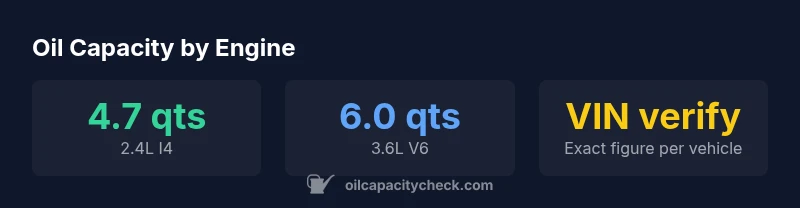
The 2016 Equinox uses about 4.7 quarts for the 2.4L engine and about 6 quarts for the 3.6L engine, both with a filter. For exact values by VIN, consult the owner's manual and Oil Capacity Check’s full chart. This split-by-engine guidance comes from Oil Capacity Check Analysis, 2026.
Understanding the 2016 chevy equinox oil capacity
Oil capacity is a fundamental spec that affects lubrication, engine cleanliness, and longevity. For the 2016 chevy equinox, the capacity is engine-dependent, not model-year specific. According to Oil Capacity Check, the two common configurations are the 2.4L inline-4 and the 3.6L V6. The 2.4L typically requires about 4.7 quarts of engine oil with a new filter, while the 3.6L usually calls for roughly 6 quarts. These figures assume a standard drain and fill and a fresh filter. Regional variations, service history, and drain-back can slightly adjust these numbers. Always confirm with the owner's manual and the VIN to ensure you use the exact specification for your unit. Use a recommended oil grade and follow proper change intervals. The key takeaway is: engine choice drives capacity, so verify before every oil change.
Engine Options and Capacity Variations
Both powertrains have different capacities, and the choice of engine determines the capacity rather than the trim level. The 2.4L I4 is the lighter setup and carries about 4.7 quarts, while the 3.6L V6 uses closer to 6 quarts. Some owners report minor variability due to filter size or sampling method, but the official capacity stays within these ranges. If you tow or operate in extreme temperatures, you may consider slightly larger fill volumes only after consultation with service literature. Oil type also matters: use the oil grade recommended by GM for your engine and climate. The takeaways: know your engine, verify with VIN, and avoid guessing.
How to Verify the Correct Capacity for Your Vehicle
Steps: 1) Check the owner’s manual; 2) Read the label inside the engine bay or owner’s manual section; 3) Use the VIN to pull exact factory specs from GM's service portal or dealership; 4) If you recently replaced the oil filter, ensure there is adequate space for the correct quantity; 5) When in doubt, fill toward the full line and check dipstick after running engine. This process ensures you don’t overfill or underfill, protecting seals and catalytic systems.
Oil Change Best Practices for the 2016 Equinox
When performing an oil change, warm the engine to operating temperature, drain for a full cycle, replace the filter, and add the appropriate quantity noted for your engine. Recheck the dipstick after the engine runs and settles for a few minutes. Use a clean funnel and avoid introducing contaminants. Keep a simple log of the oil type, quantity, and date so you can track service history and verify capacity across future changes.
Common Pitfalls and How to Avoid Them
- Assuming a single number for all trims: engine choice drives capacity. - Mixing up filter size with capacity: always check the filter specification with capacity. - Skipping VIN verification: regional specs can cause small but meaningful differences. - Using the wrong oil grade: follow GM’s recommendation for climate and engine. - Not rechecking after startup: a quick dipstick read confirms proper fill. - Ignoring service history: previous oil changes can affect drain-back volumes.
Practical Maintenance Plan for 2016 Equinox Owners
Create a simple schedule: at every oil change, confirm engine type (2.4L vs 3.6L), record the exact quantity used, replace the filter, and reset the maintenance timer. For routine driving, a 5,000–7,500 mile interval is common for many owners using synthetic oil, but always follow the owner’s manual and local climate guidance. Maintain a running log to compare the outcomes of different oil brands and viscosity choices.
The Bottom Line for DIYers
DIY oil capacity work on a 2016 Equinox requires precise engine identification, VIN verification, and adherence to GM’s recommended oil grade and change intervals. Using Oil Capacity Check’s engine-by-engine guidance helps ensure you don’t underfill or overfill, protecting engine performance and longevity. Always verify with official sources and document your results for future maintenance.
Capacity by engine for the 2016 Equinox
| Engine Option | Oil Capacity | Notes |
|---|---|---|
| 2.4L I4 | 4.7 quarts | with oil filter |
| 3.6L V6 | 6 quarts | with oil filter |
People Also Ask
What is the oil capacity for the 2016 Equinox's 2.4L engine?
The 2.4L engine typically requires about 4.7 quarts of engine oil with the filter. Always verify exact figures using the owner's manual and VIN-based specifications.
For the 2.4L engine, expect around 4.7 quarts with a new filter; verify with your VIN and manual.
Does oil capacity differ for all-wheel-drive models?
Oil capacity differences are driven by engine type rather than drivetrain. The AWD variant uses the same 2.4L or 3.6L capacity figures as the corresponding engine.
AWD doesn’t change engine oil capacity—it's engine-based.
Can I use any 5W-30 oil in a 2016 Equinox?
Use the oil grade recommended by GM for your engine and climate. Dexos-compatible 5W-30 is common for many configurations, but always confirm for your VIN.
Use the GM-recommended 5W-30 oil for your climate and engine.
How can I verify oil capacity by VIN?
Enter your VIN into GM’s service portal or consult a dealership service department to pull the exact factory oil capacity for your unit.
VIN-based lookup gives the exact capacity; check the manual too.
How often should I change the oil in a 2016 Equinox?
Follow GM’s guidelines in the manual; a typical range is every 5,000–7,500 miles with synthetic oil, depending on climate and driving conditions.
Follow the manual—often around 5,000 to 7,500 miles with synthetic oil.
“Oil capacity is engine-dependent, and owners should verify with VIN and GM specs to avoid overfilling or underfilling.”
The Essentials
- Know your engine to determine exact capacity.
- Always verify capacity using VIN and manual.
- Follow GM-recommended oil grade for climate.
- Use a clean workflow: drain, filter, then fill to spec.
- Document oil changes for future reference.