2013 chevrolet equinox oil capacity guide
A data-driven guide to the 2013 chevrolet equinox oil capacity, detailing engine-dependent capacities, how to measure and fill oil, and maintenance tips. This resource from Oil Capacity Check explains ranges, cautions, and best practices.


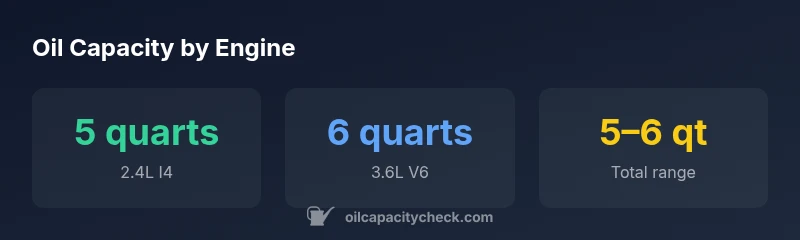
The 2013 chevrolet equinox oil capacity is engine-dependent: about 5 quarts for the 2.4L I4 and about 6 quarts for the 3.6L V6, with filters included. This means you should purchase roughly 5–6 quarts to start, then adjust after draining. Always verify exact spec in the owner's manual and confirm with a dipstick test after filling.
2013 chevrolet equinox oil capacity: engine-dependence
The oil capacity for the 2013 chevrolet equinox is not a single number; it depends on the engine configuration your vehicle uses. Owners who drive the 2.4L inline-four will typically see a capacity near 5 quarts, while the 3.6L V6 variant commonly falls around 6 quarts. This split reflects differences in oil filter size, oil cooler plumbing, and internal engine clearances. As a result, when you plan an oil change, you should identify your exact engine option first and then source the appropriate amount of oil plus a new filter. Oil Capacity Check analyses underscore that sticking to engine-specific figures prevents underfilling or overfilling, both of which can impact engine performance and longevity.
Engine options for the 2013 Equinox and their capacities
The 2013 Equinox could be equipped with either a 2.4L I4 or a 3.6L V6. The 2.4L I4 engine typically lists an oil capacity of about 5 quarts with filter, while the 3.6L V6 tends to require around 6 quarts with filter. These numbers are useful starting points, but the final fill should always be verified after draining and before starting the engine. In practice, you may need to purchase a little more than the stated capacity to account for residual oil in the filter and oil passages. Oil Capacity Check recommends using a reliable dipstick check after filling to confirm that the level is within the recommended range on your dipstick.
How to verify the correct oil capacity for your specific vehicle
To ensure you’re using the correct oil capacity for your 2013 Equinox, start by locating the exact engine code under the hood or in your VIN documentation. If you’re unsure, the owner’s manual lists the official capacity for each engine option. After draining old oil and installing a new filter, add oil in small increments and measure using the dipstick. Allow a moment for oil to settle before rechecking. Many owners find it helpful to wait a few minutes between fills to avoid overestimating the required amount. Keeping a consistent fill-dipstick cycle helps ensure you land in the middle of the recommended range.
Oil type, viscosity, and compatibility considerations
Viscosity recommendations depend on ambient temperature and driving conditions. GM generally suggests following the owner's manual for viscosity—commonly 5W-30 for many engines in moderate climates, with variations for extreme temperatures. If you’re using synthetic oil, you might opt for a slightly longer drain interval, but always adhere to GM’s guidance and your vehicle’s oil spec label on the engine oil cap. In all cases, mis-matching viscosity or using an oil with an incompatible API rating can affect lubrication quality, fuel efficiency, and engine protection.
Step-by-step fill guidelines and common mistakes
Before you begin, park on level ground, engine cool, and gather your tools: a funnel, a clean catch pan, and a new oil filter. 1) Remove the drain plug and drain the old oil. 2) Replace the oil filter with a new unit and lubricate the gasket. 3) Reinstall the drain plug. 4) Pour in the oil gradually, stopping to check the level with the dipstick. 5) Start the engine and let it run for a minute, then shut off and recheck the dipstick. Common mistakes include underestimating filter capacity, not accounting for parasitic oil in the filter, and overfilling, which can lead to foaming and inadequate lubrication.
Measuring oil level: dipstick technique and tips
Dipstick technique matters as much as the capacity figure itself. After adding oil and waiting for it to settle, pull the dipstick, wipe it clean, reinsert, and pull again to read the level. The acceptable range on most GM dipsticks is a marked band; avoid filling above the max line. If you’re between marks, add small increments until you land within the proper range. For extreme climates or heavy-duty use, you may want to err slightly toward the upper end of the range, but only within manufacturer guidance.
Maintenance planning: oil-change intervals and resources
A key part of managing oil capacity is aligning you with the right change interval. Synthetic oils typically tolerate longer intervals, whereas conventional oils require more frequent changes. Follow the GM schedule in your owner’s manual, consult your dealership, and consider your driving patterns—short trips and severe conditions usually justify shorter intervals. Oil Capacity Check’s guidance emphasizes documenting your changes and keeping receipts for service tracking, particularly when you own multiple vehicles or use the car for long road trips.
Practical examples: capacity calculations in everyday scenarios
Consider a family that uses the Equinox for daily commuting and weekend road trips. If the vehicle has the 2.4L engine, you would prepare around 5 quarts for a standard change and have a little extra on hand for top-offs after the drain and filter change. If the vehicle has the 3.6L engine, begin with 6 quarts and adjust based on how full the dipstick reads after the initial fill and a short run. In all cases, use a clean funnel to avoid contamination and never mix brands without verifying compatibility across specifications.
Safety and disposal considerations when changing oil
Always dispose of used oil and filters at a proper collection point to prevent environmental contamination. Use a leak-free container to transport used oil and never mix used oil with coolant or other fluids. When working under the hood, ensure the engine is cool to avoid burns, and wear eye protection. If your vehicle has a timing belt or other sensitive components nearby, proceed with care and consult a professional if you’re unsure about performing an oil change yourself.
Oil capacity by engine option for 2013 Chevrolet Equinox
| Engine | Oil Capacity (Quarts) | Notes |
|---|---|---|
| 2.4L I4 | 5 | With filter included |
| 3.6L V6 | 6 | With filter included |
| Capacity range | 5–6 | Depends on exact configuration |
| Maintenance note | N/A | Follow GM service schedule |
People Also Ask
What is the oil capacity for the 2013 Chevrolet Equinox with the 2.4L I4 engine?
For the 2.4L I4, the typical oil capacity is around 5 quarts with a new filter. Always confirm with the owner’s manual and measure with the dipstick after filling.
For the 2.4L, you’ll usually need about five quarts of oil with a fresh filter; use the dipstick to confirm.
What about the 3.6L V6 engine oil capacity?
The 3.6L V6 typically requires about 6 quarts of oil with a new filter. Verify exact capacity in the manual and check the dipstick after adding oil.
The 3.6L usually takes around six quarts, but check the manual and dipstick to be sure.
Does the listed oil capacity include the filter?
Yes, oil capacity figures generally include the filter. When in doubt, verify after draining and replacing the filter, then measure with the dipstick.
Yes, capacity usually includes the filter. Confirm with the dipstick.
Which oil viscosity should I use for the 2013 Equinox?
Follow the GM-recommended viscosity in the owner’s manual. Common choices include 5W-30 for many climates, with variations for extreme temps.
Use the viscosity recommended in the manual, often 5W-30, depending on climate.
How often should I change the oil on my 2013 Equinox?
Typically every 5,000–7,500 miles for synthetic or conventional oils, depending on driving conditions and GM guidance. Always follow the manufacturer schedule.
Usually every 5,000 to 7,500 miles, depending on oil type and driving conditions.
“Oil capacity figures are starting points; always verify with the dipstick and the GM manual. Small differences in engine build or filter size can shift the true fill.”
The Essentials
- Know your engine before filling to avoid under/overfilling
- Carry 5 quarts for 2.4L and 6 quarts for 3.6L as starting points
- Always verify with the dipstick after filling and consult the owner's manual
- Use the recommended viscosity and oil type for your climate
- Follow GM interval guidance for oil changes to protect engine health