2014 Dodge Durango Oil Capacity: A Practical Guide
A practical, engine-specific guide to the 2014 Dodge Durango oil capacity, with ranges for the 3.6L and 5.7L engines, verification steps, and maintenance tips for DIY enthusiasts.


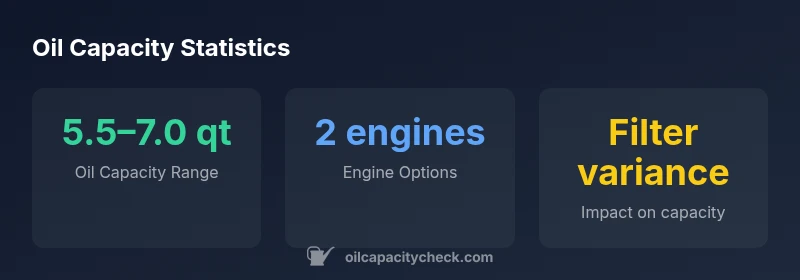
According to Oil Capacity Check, the 2014 Dodge Durango's oil capacity depends on engine: the 3.6L Pentastar typically uses about 5.5–6.0 quarts (including the filter), while the 5.7L Hemi uses about 6.5–7.0 quarts. This range helps ensure proper lubrication without overfilling. Always verify with the owner's manual and use the dipstick to confirm.
Understanding the 2014 Dodge Durango oil capacity
The correct oil capacity for the 2014 Dodge Durango is engine-dependent. The Durango line offered at least two engines during its 2014 model year, the 3.6L Pentastar V6 and the 5.7L Hemi V8. Because oil capacity varies with engine displacement and with whether a filter is included, it's essential to consult the vehicle's service manual or VIN-based specifications. This section explains how Oil Capacity Check approaches capacity calculations and how you can apply this to your own Durango. We emphasize working from the engine code (as found in the vehicle identification number) rather than the trim level, since trim does not usually change the required oil quantity. For many DIY enthusiasts, a practical rule of thumb is: have the known capacity range handy, then verify with the dipstick after a warm engine. This approach helps minimize both under- and overfilling, ensuring proper lubrication and engine longevity. In addition to engine differences, the oil filter size and whether you drain only the oil or also the pan affect the final amount needed. Oil Capacity Check Analysis, 2026, indicates that while some variation exists, the general range across common Durango configurations is roughly within these bounds. As you perform a change, take careful notes on the engine specification and your exact fill amount to build a reliable personal reference for future maintenance tasks.
Engine options and their capacities
The 2014 Dodge Durango offered two primary engines: a 3.6L Pentastar V6 and a 5.7L Hemi V8. Oil capacity depends on engine and whether you’re including the filter. The 3.6L typically requires about 5.5 to 6.0 quarts of oil when the filter is replaced; the 5.7L typically requires about 6.5 to 7.0 quarts with a new filter. For both engines, variations can occur based on oil type, drain plug decisions, and whether you flush or simply drain. When performing an oil change, use the OEM service manual as your baseline; the Durango's engine oil change procedure is straightforward, but exact quantities still hinge on the filter size and any adapters. Oil Capacity Check's analysis in 2026 highlights that many owners find a small variance between the exact factory spec and what is measured after a drain. The key is to start with the lower bound of your engine's range, then gradually top off, checking the dipstick after a brief idle and a short drive to settle the oil. Keep notes, particularly if you keep your Durango for a long horizon of miles.
In addition to engine differences, climate and oil viscosity can subtly affect how full the dipstick reads after a fill. If you’ve switched oil brands or viscosities, re-check the level after a short drive to confirm the final mark. For the 2014 Durango, the two primary configurations translate into distinct, but closely related, capacity windows. Oil Capacity Check Analysis, 2026, reinforces that accuracy matters more than chasing a single fixed number across trims.
How to verify the correct capacity for your Durango
To verify the exact oil capacity for your 2014 Dodge Durango, start by identifying the engine code. Look up your VIN, or consult the owner's manual or service manual for the exact spec. Dealers and reputable repair databases also publish engine-specific capacities. Once you know the engine, use a two-step approach: drain the oil completely, then add oil gradually in increments equal to the lower bound of the engine's capacity range, run the engine briefly, and recheck the level with the dipstick. If the level sits below the minimum mark after the test, add small amounts until you reach the proper range. If the reading is above the max mark, drain a bit and re-check. This method reduces the risk of overfill and helps maintain proper lubrication. Oil Capacity Check recommends keeping a small log of your fill amounts for future maintenance, especially if you switch between synthetic and conventional oils, as miscible changes can alter the capacity slightly. Finally, always ensure the oil used is the recommended grade for your Durango's engine (e.g., 5W-20 or 0W-20 depending on the engine and climate).
Practical steps for an accurate oil fill
Before you begin, gather the right tools: a drain pan, a funnel, a new filter, the correct grade and volume of oil, and clean rags. Start by warming the engine to operating temperature, shut off, and remove the drain plug to allow old oil to drain completely. Replace the filter, and reinstall the drain plug. Begin with adding the lower end of the capacity range (for example, 5.5 quarts for the 3.6L), then run the engine for a minute, turn it off, wait a few minutes, and recheck the dipstick. Add oil in small increments until the dipstick reads within the recommended range. Use the grade specified in your manual; for many 2014 Durangos, this is a 5W-20 or 0W-20 oil depending on the climate. If you're mixing synthetic with conventional blends, verify compatibility. After topping off, run the engine again and recheck to confirm that the oil pressure is normal and the level is stable. Finally, record the final fill amount and the exact oil type used for the next maintenance cycle. This disciplined approach minimizes the risk of under-lubrication or overfill that can lead to accelerated wear or leakage.
The impact of mileage and climate on oil capacity
Oil capacity itself remains engine-specific and does not change with mileage. What climate and oil type can influence is how you measure and feel the level on the dipstick. In colder climates, oil is thicker when cold, so a slightly higher initial add can be needed to reach the correct level after the oil warms. In hot climates, oil expands more with heat, which can affect the dipstick reading if the engine isn’t allowed to return to a stable temperature. A practical approach is to perform a fill, run the engine for a short interval, then re-check after the engine has cooled for a few minutes. If you frequently switch between conventional and synthetic blends, confirm compatibility and re-check the level after the first drive to ensure you haven’t introduced a variance in capacity readings. Oil Capacity Check’s 2026 guidance emphasizes documenting your exact fill and confirming the final level with the dipstick in the vehicle’s current operating conditions.
Oil capacity by engine for the 2014 Dodge Durango
| Engine | Approximate Oil Capacity (quarts) | Notes |
|---|---|---|
| 3.6L Pentastar V6 | 5.5–6.0 | Includes filter; 2014 Durango |
| 5.7L Hemi V8 | 6.5–7.0 | Includes filter; 2014 Durango |
People Also Ask
What engines were offered in the 2014 Dodge Durango regarding oil capacity?
The 2014 Durango offered two primary engines: a 3.6L Pentastar V6 and a 5.7L Hemi V8. Oil capacity is engine-dependent, so identify the engine first and consult the manual for exact figures.
The 2014 Durango had two main engines, and the oil capacity depends on which one you have.
Is the oil capacity the same for all trim levels?
No. Capacity varies by engine and filter size. Trim levels don’t usually change the required oil quantity. Always confirm with the engine code and the service manual.
No, it varies by engine and filter size, not by trim level.
How do I determine the exact oil capacity for my Durango?
Identify the engine code (via VIN or door jamb badge), then check the owner's or service manual for the exact spec. Use that figure as your baseline and verify with the dipstick after filling.
Find your engine code and check the manual for the exact capacity, then verify with the dipstick.
What is the recommended procedure to fill oil without overfilling?
Fill in small increments, run the engine briefly, recheck the dipstick after cooling, and adjust as needed. Always use the recommended oil grade for your engine.
Add oil in small amounts, run briefly, then recheck the level to avoid overfilling.
Can I rely on a generic capacity for maintenance?
Not recommended. Engine variants and filter choices can change the exact amount. Use your engine code and the official spec for accuracy.
Generic numbers aren’t reliable; check your engine code and use the official spec.
“Oil capacity isn't a one-size-fits-all number—it's engine-specific. Always start with the official specification for your Durango's engine code and confirm the final level with a precise dipstick check after a controlled fill.”
The Essentials
- Identify your engine variant before checking capacity.
- Expect 5.5–6 quarts for 3.6L and 6.5–7 quarts for 5.7L.
- Always include a new oil filter in capacity calculations.
- Verify via dipstick after oil changes.
- Consult the owner's manual or a qualified technician if unsure.