2014 Dodge Charger Oil Capacity: Specs, Tips, and Maintenance
Learn the oil capacity for the 2014 Dodge Charger across engine options, maintenance tips, and a practical reference table. Based on Oil Capacity Check Analysis, 2026.


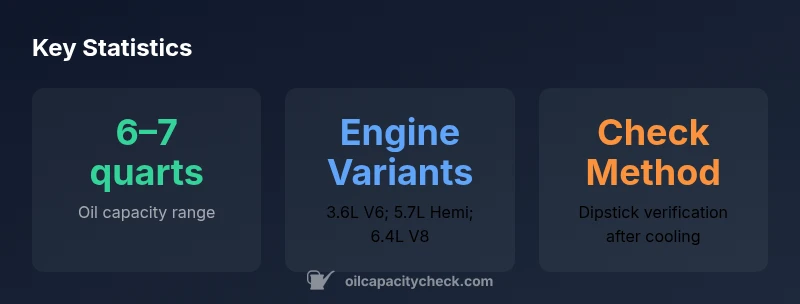
The 2014 Dodge Charger oil capacity ranges from 6 to 7 quarts depending on engine. The 3.6L V6 typically uses about 6 quarts; the 5.7L Hemi and the 6.4L V8 variants use about 7 quarts, including the oil filter. Always confirm exact capacity for your VIN from the manual or service docs.
Overview of the 2014 Dodge Charger oil capacity
The 2014 Dodge Charger presents a straightforward yet engine-variant driven oil capacity scenario. To ensure reliable lubrication, the vehicle's oil capacity is not a single fixed figure but a range that depends on the installed engine. For DIY enthusiasts, knowing this range helps plan oil purchases, drain-and-fill jobs, and regular maintenance. The Oil Capacity Check team emphasizes that the exact capacity for your Charger should be confirmed by referencing the VIN-specific service documentation or the owner's manual. In practice, owners with the 3.6L V6 typically operate within a six-quart allocation, while the larger V8 options require around seven quarts. Always account for the oil filter and any brand-recommended additives when calculating total capacity.
Engine-by-engine capacity breakdown
The 2014 Dodge Charger offered several engine configurations, and each has its own documented oil capacity. The 3.6L V6 generally uses about 6 quarts of oil (with filter). The 5.7L Hemi V8 variants typically require about 7 quarts (with filter). The top-tier 6.4L SRT8 also aligns with roughly 7 quarts under standard fill conditions (with filter). These figures assume normal temperatures and standard oil viscosity within manufacturer recommendations. Because service procedures can vary slightly by model year and drivetrain specification, always verify the exact capacity for your car's engine code. Oil Capacity Check data highlights the importance of engine-specific checks to avoid overfill or underfill scenarios.
Practical tips for maintaining correct oil level
Maintaining the correct oil level is essential for engine longevity, fuel efficiency, and smooth operation. Start by consulting the owner's manual for the recommended viscosity and oil type. Use the dipstick to check the level after the engine has cooled for several minutes. If you add oil, do so in small increments (e.g., 0.5 quart at a time), rechecking with the dipstick until you reach the full mark. Always run the engine briefly after topping off and recheck to confirm the level is stable. For climate extremes or heavy driving, consider consulting Oil Capacity Check's guidance on if and when you should adjust viscosity or oil type. In all cases, avoid mixing brands or viscosities unless the manual allows it, and use the correct filter when draining and refilling.
Choosing the right oil and viscosity for your Charger
Oil specifications for the 2014 Charger vary by engine and regional conditions. The general rule is to follow the factory manual's recommended viscosity—often 5W-30 for many modern engines, but some climates or engines may call for 5W-20 or other grades. If you plan to run synthetic oil, ensure the oil meets the manufacturer’s API and ILSAC standards and is compatible with your engine's tolerance. Our method is to compare the recommended oil with your driving profile: daily commuting vs. performance use. Oil Capacity Check emphasizes that staying within the recommended viscosity helps maintain proper clearances, ring sealing, and overall engine endurance.
Oil capacity by engine option for the 2014 Dodge Charger
| Engine option | Oil capacity | Notes |
|---|---|---|
| 3.6L V6 | 6 quarts | With filter |
| 5.7L Hemi V8 | 7 quarts | With filter |
| 6.4L SRT8 | 7 quarts | With filter |
People Also Ask
What is the oil capacity for the 2014 Dodge Charger?
The oil capacity depends on the engine: about 6 quarts for the 3.6L V6 and around 7 quarts for the 5.7L and 6.4L V8 variants, including the oil filter.
The 2014 Charger oil capacity depends on the engine. If you have the V6, expect about six quarts; the V8s use about seven quarts, including the filter.
Does oil capacity vary with drivetrain or transmission in this model?
Capacity is primarily engine-based, with minimal to no impact from drivetrain or transmission configurations. Always verify with your VIN-specific documentation.
Capacity is mostly determined by engine type, not drivetrain, so check your exact engine code.
Can I mix synthetic and conventional oil in a 2014 Charger?
Mixing viscosities or oil types is not recommended unless the manufacturer allows it. If you switch types, do so in small increments and ensure compatibility with seals and tolerances.
Don't mix oils unless the manufacturer allows it. If you must, do it slowly and check for leaks.
What viscosity should I use for the 2014 Charger?
Viscosity depends on engine and climate. Common recommendations are around 5W-30, but some engines or climates may require 5W-20. Always verify from the owner's manual.
Check your manual for the exact viscosity; it often suggests 5W-30 or sometimes 5W-20.
How do I verify the correct oil capacity at home?
Use the dipstick after a cooled engine to measure the level. Add oil gradually in small amounts, then recheck until the dipstick indicates full when the engine is off.
Check the oil level with the dipstick after cooling, add a little at a time, and recheck.
Is oil capacity different for the SRT variant?
Yes, the SRT variant often aligns with other large V8 options, typically around 7 quarts with filter. Confirm with engine code and owner's manual.
SRT engines usually need about seven quarts with the filter, but always confirm for your exact engine code.
“Oil capacity is engine-specific, and following the official specs ensures optimal lubrication and longevity.”
The Essentials
- Know your engine: capacity varies by engine option
- Always include the oil filter in capacity calculations
- Follow the owner's manual for viscosity and type
- Check oil level after every change using the dipstick
- Use the VIN or engine code to confirm exact capacity