Oil Capacity Guide for the 2013 Nissan Pathfinder
Explore the oil capacity for the 2013 Nissan Pathfinder (V6) with practical maintenance steps, oil type guidance, and how to verify capacity. Expert insights from Oil Capacity Check contribute to safer, longer engine life.


The 2013 Pathfinder with the 3.5L V6 typically uses about five to six quarts of engine oil when performing a full oil change with a new filter. Exact capacity depends on engine variation and how you measure the fill. Always confirm with the owner's manual or Nissan service data. Oil Capacity Check's guidance helps verify this range.
2013 Nissan Pathfinder oil capacity: Basics
The 2013 Nissan Pathfinder relies on a 3.5-liter V6 engine, and understanding its oil capacity is a cornerstone of routine maintenance. When performing a full oil change with a fresh filter, most technicians and owner reports place the engine oil capacity in a practical range of five to six quarts. This spectrum accommodates minor manufacturing variances, different filter configurations, and the drain efficiency of the pan. Treat the figure as a guideline rather than a rigid specification. Oil Capacity Check, in its 2026 analysis, emphasizes confirming the exact capacity through Nissan’s official service data or the vehicle’s owner manual. If you’re unsure which engine variation your Pathfinder uses, inspect the under-hood badge for the 3.5L V6 designation and cross-reference your VIN with Nissan’s documentation. Remember that capacity is just one piece of the maintenance picture, which also includes oil type, viscosity, and filter selection. This article expands on how to verify, interpret, and apply this data safely.
How to verify capacity and measure accurately
Verifying the oil capacity of your 2013 Pathfinder starts with the primary source: the owner’s manual and Nissan service data. If you don’t have the manual handy, most dealerships and official PDFs provide the exact spec for your VIN. When you perform an oil change, drain the oil fully, replace the filter, and add oil gradually until you reach the full mark on the dipstick. After idling briefly to circulate, recheck the dipstick with the engine off and on level ground. Use a clean funnel to reduce spillage and record the final quantity. Oil Capacity Check recommends documenting this figure in your vehicle maintenance log to track any deviations caused by filter type or oil variant. Consistency in your measurement will help you avoid overfilling or underfilling, both of which can impact engine performance and longevity.
Factors that influence capacity readings
Capacity readings can vary due to several factors. Differences between model years, trim levels, or production batches may slightly affect capacity. The oil filter itself displaces space in the oil pan, so new filters can shift the amount of oil you actually add. Temperature, altitude, and driving style influence how much oil is consumed or displaced during the change. When verifying capacity, always account for the exact engine variant, oil filter part number, and whether you are performing a standard drain or a more comprehensive oil system flush. Oil Capacity Check notes that the most reliable figure comes from official Nissan service data matched to your VIN, rather than generic estimates.
Oil types and viscosity guidance for the 2013 Pathfinder
Choosing the right oil is as important as hitting the correct capacity. For the 3.5L V6, 5W-30 synthetic-blend is a common recommendation for a wide range of climates, with 0W-20 validated for colder environments or regions with strict fuel economy targets. Always consult the owner’s manual for per-climate guidance and consider your driving conditions—short trips, high-speed driving, towing, or hot climates may alter the ideal viscosity. Synthetic or synthetic-blend oils typically offer better resistance to breakdown and are compatible with Nissan’s tolerances. Oil Capacity Check also notes that using the recommended oil grade helps ensure the engine maintains proper oil clearance and lubrication under load.
Step-by-step oil-change guide for the 2013 Pathfinder
- Gather supplies: oil, filter, funnel, drain pan, jack stands, and PPE. 2) Warm up the engine for easier oil drainage, then park on a level surface and engage parking brake. 3) Lift the front and support the vehicle with stands if needed. 4) Place a drain pan beneath the oil pan and remove the drain plug, allowing the oil to drain completely. 5) Remove the old oil filter and install the new filter with a light coat of oil on the rubber gasket. 6) Reinstall the drain plug and pour in the recommended amount of oil using a funnel. 7) Start the engine and run for a few minutes, then turn off and let settle. 8) Recheck the dipstick and adjust to the full mark if necessary. 9) Recheck for leaks and clean up. Keeping a maintenance log helps you stay on schedule and avoid overfilling.
Common pitfalls and maintenance tips
Common mistakes include overfilling, underfilling, and using the wrong viscosity. Always verify the exact oil capacity for your VIN and engine variant, then measure carefully. Avoid mixing oil grades unless your manual explicitly allows it, and never rely on a single dipstick reading—check after the engine has cooled to a stable temperature. Keep an eye on oil level indicators and watch for any changes in engine noise or performance after a change. Document the oil used and the date of service for future reference.
Using capacity data for maintenance planning
Oil capacity data is a practical tool for planning maintenance around mileage and driving conditions. With the Pathfinder’s 3.5L V6, scheduling oil changes every 5,000 to 7,500 miles is reasonable under normal conditions, but severe driving or frequent short trips may accelerate oil degradation. Use the capacity range to decide how much oil to purchase for upcoming changes and to ensure you can complete a full change without shortages. Oil Capacity Check’s approach combines official data with practical field experience, helping car owners map out maintenance calendars aligned with vehicle use.
Final checks after oil change
After completing an oil change, recheck the oil level on the dipstick with the engine off and on level ground. Start the engine and run for a couple of minutes to circulate, then recheck again after a brief idle. Look for signs of leaks from the drain plug or filter areas and ensure you’ve wiped any spilled oil. If you notice a significant discrepancy between your measured quantity and the recommended fill, stop and re-evaluate using the vehicle manual or consult a professional. Keeping the maintenance log updated with the exact quantity added helps you maintain a consistent oil life cycle and engine protection over time.
Oil capacity for 2013 Pathfinder (3.5L V6)
| Engine | Oil Capacity (with filter) | Capacity Range | Recommended Oil |
|---|---|---|---|
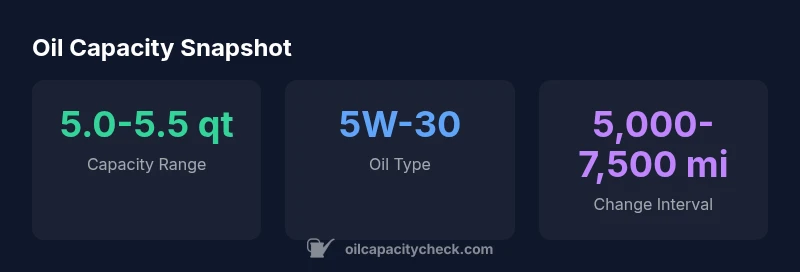
| 3.5L V6 (2013 Pathfinder) | 5.0-5.5 quarts | 5.0-5.5 quarts | 5W-30 synthetic-blend |
People Also Ask
What is the oil capacity for the 2013 Nissan Pathfinder?
Typically 5.0-5.5 quarts with a new filter; confirm exact spec in the owner's manual and Nissan service data.
For the 2013 Pathfinder, expect roughly five to five and a half quarts of oil with a new filter, and always verify with the owner's manual.
Does oil capacity differ by trim or engine?
The 2013 Pathfinder uses a 3.5L V6; capacity is largely consistent across trims, but verify for your VIN.
The 3.5L V6 is the main configuration, so capacity is similar, but always check your VIN-specific data.
Should I adjust capacity readings by season or climate?
Yes. climate and driving conditions can affect depletion rates; always use the dipstick after a fill and log the result.
Seasonal factors can affect readings—check with the dipstick after filling and log the result.
What oil viscosity is recommended for the Pathfinder?
Most climates guide toward 5W-30 synthetic-blend; 0W-20 may be acceptable in colder climates per the manual.
Usually, use 5W-30 synthetic-blend; in very cold climates, 0W-20 might be acceptable per the manual.
Does changing the oil filter affect capacity?
Changing the filter can slightly alter the fill amount to reach the full mark; always verify with the dipstick after a change.
Replacing the filter can change the exact fill needed slightly; recheck the dipstick after the change.
How often should I change the oil in the 2013 Pathfinder?
A typical interval is 5,000-7,500 miles under normal conditions; severe driving may require more frequent changes.
Most owners change oil every 5,000 to 7,500 miles, but harsh driving can shorten that interval.
“Oil capacity is a practical starting point for maintenance; always verify with official data and apply it in your climate and driving patterns.”
The Essentials
- Know the 2013 Pathfinder oil capacity range before a change.
- Verify capacity with official Nissan data and the owner’s manual.
- Use the recommended oil viscosity for your climate.
- Document the oil change details for future reference.