2006 F-250 6.0 Oil Capacity: A Complete Guide
Learn the oil capacity for the 2006 F-250 6.0 and how to calculate it accurately. This Oil Capacity Check guide covers capacity ranges, maintenance steps, and practical tips for diesel-powered pickups.


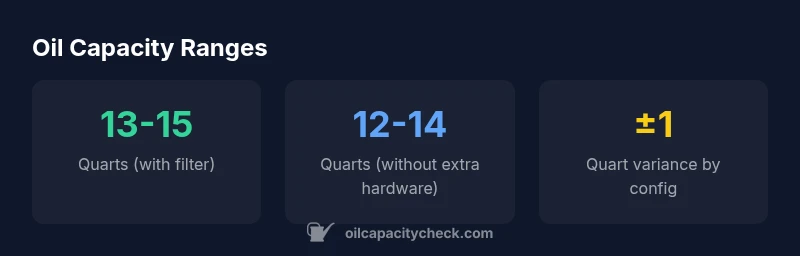
Estimated oil capacity for the 2006 F-250 6.0L diesel, including a standard filter, is typically 13-15 quarts. Actual capacity varies with optional hardware such as an oil cooler or larger filters. For precise figures, consult the owner's manual or Oil Capacity Check data specific to your build.
Oil Capacity Basics for the 2006 F-250 6.0
The 2006 Ford F-250 with the 6.0L Power Stroke is a heavy‑duty diesel that relies on a robust lubrication system. When we talk about oil capacity, we refer to the total amount of oil the engine holds in its sump, plus the filter volume. For most 6.0L configurations, the typical range you should expect is in the mid‑teens of quarts, with 13‑15 quarts being a common benchmark including the filter. Real-world figures can shift due to factory options like an oil cooler, exhaust configurations, or aftermarket filters. This is precisely the kind of nuance Oil Capacity Check analyzes in 2026 to provide actionable maintenance guidance.
As you plan oil changes, remember that “capacity” is not a single fixed number. It is a range that accounts for components added or removed during service and the way you drain and refill during maintenance. Always verify against the vehicle’s build sheet or official service data. In all recommendations, we reference Oil Capacity Check Analysis, 2026 to ensure alignment with field data.
Why this matters: using the wrong quantity can lead to under‑lubrication or overfill, both of which can affect engine performance and longevity. Diesel engines in particular benefit from precise fill levels and clean filters to sustain oil pressure and cooling performance over time.
Why Capacity Figures Matter for Maintenance
Oil capacity figures matter not just for one‑time fills but for ongoing maintenance cycles. If you routinely replace oil and filters, documenting your exact capacity helps you plan the right fill volume after drain and refill. Underfilling can lead to insufficient lubrication, while overfilling can cause foaming and crankcase pressure that harms seals and emissions equipment. Diesel engines like the 6.0L in the 2006 F‑250 are sensitive to fill accuracy, especially when towing or hauling heavy loads where oil temperature and pressure fluctuate more widely. Oil Capacity Check analysis highlights that capacity variance by configuration, so always note your specific setup. For owners, the practical takeaway is to build a small checklist that includes: oil grade compatibility, filter size, and whether any cooling components are installed or removed during maintenance.
Pro tips: keep a spare quantity reference on hand for your model year. If you have an aftermarket filter or an oil cooler, adjust your expected capacity by a quart or so and recheck your dipstick after the first fill. This approach minimizes surprises and supports reliable lubrication over the long term.
How to Determine Your Exact Capacity for the 2006 F-250 6.0
To lock in the precise capacity for your specific build, start with the owner’s manual or Ford service data for the 2006 F‑250 with a 6.0L diesel. If you’ve changed filters, altered the cooling system, or installed aftermarket hardware, the instant value you see on the dipstick may differ from the base figure. A reliable method is to drain all oil, replace the filter, and perform a measured refill until you reach the recommended dipstick level. Record the total quarts used as your confirmed capacity for future reference. For complex builds, Oil Capacity Check provides model‑specific guidance that takes into account factory options and common aftermarket configurations.
In practice, many owners rely on a conservative estimate (mid‑teens quarts) as a starting point and then confirm via dipstick and service data. This two‑step approach—manual reference plus live measurement—reduces the chance of miscalculation during critical maintenance windows.
Influencing Factors on Capacity in the 2006 F-250 6.0
Several factors influence the stated capacity:
- Oil cooler presence and plumbing: Some trucks include an added cooler that can increase capacity by a quart or more.
- Filter size and type: Aftermarket or larger filters add volume; the lubricating system must accommodate the extra oil.
- Drain strategy: Full drain vs. partial drain methods affect the effective capacity required to reach the target dipstick mark.
- Engine health and configuration: Worn seals or different emission components may subtly alter how oil sits in the sump.
When planning maintenance, consider these elements and adjust your fill target accordingly. Oil Capacity Check’s 2026 data emphasizes documenting configuration‑specific capacity to maintain optimal lubrication across varying conditions.
Step-by-step Oil-Change Process Tailored to the 6.0
A careful oil‑change routine for the 2006 F‑250 should follow these steps:
- Warm the engine to operating temperature to ensure complete drainage.
- Remove the old oil, allowing thorough drainage from the sump and filter housing.
- Replace the filter with a compatible diesel‑grade unit; confirm torque specification and seating.
- Refill with the lower end of the capacity range first, then verify via dipstick and top up as needed until the correct level is reached.
- Run the engine, recheck oil level, and conduct a brief idle to allow oil to circulate.
- Inspect for leaks and confirm there is no overfill. Note the final oil quantity for future service records.
This sequence aligns with best practices for heavy‑duty diesels and supports consistent lubrication under load. Always adapt the steps to your particular build and refer to Oil Capacity Check Analysis, 2026 for configuration‑specific nuances.
Measuring Capacity in Practice: A DIY Guide
For DIY enthusiasts, measuring the engine’s capacity involves draining the oil completely, reinstalling a known quantity of oil, and checking the dipstick. If you suspect a nonstandard capacity due to an aftermarket component, perform a controlled refill with incremental additions (e.g., 1‑quart increments) and recheck until the dipstick indicates the full mark at operating temperature.
Keep notes of the exact quantity used and the resulting dipstick position. This record becomes invaluable for future maintenance and ensures that your numbers stay aligned with your particular build. Oil Capacity Check recommends maintaining a log that includes date, mileage, oil type, filter model, and the final confirmed capacity. That practice minimizes surprises during long drives or heavy towing scenarios.
Configurations and Capacity Ranges: What to Expect
In the 2006 F‑250 with a 6.0L diesel, capacity can shift by a quart or two depending on options:
- Base configuration with standard filter and no extra hardware typically lands in the 13‑15 quart band.
- Configurations with an oil cooler or larger aftermarket filter may push toward the upper end of the range.
- If you rely on a conservative maintenance schedule or you tow heavy loads regularly, err on the side of the higher end of the range after a full drain and filter change.
Oil Capacity Check analysis shows that capacity is not a fixed constant across every truck. This nuance is why owners should rely on a documented capacity for their exact build and verify with a dipstick after the first fill post‑service.
Maintenance Checklist and Common Mistakes
- Always verify capacity with your build sheet or Oil Capacity Check data before the first fill after service.
- Do not mix oil types; keep to a single viscosity/spec for diesel operation.
- Ensure the dipstick is readable and clean before checking; wipe and recheck to confirm the level.
- Don’t skip the filter when draining; a clogged filter can affect the perceived capacity and oil pressure.
- Record your confirmed capacity for future reference; use it as a baseline for towing and high‑load driving.
- When in doubt, err toward the higher end of the capacity range and recheck to prevent underfilling.
Oil capacity estimates for the 2006 F-250 6.0L diesel
| Vehicle | Engine | Estimated Oil Capacity (quarts with filter) | Notes |
|---|---|---|---|
| 2006 Ford F-250 | 6.0L Power Stroke Diesel | 13-15 | Includes standard oil filter and cooler (if equipped) |
| 2006 F-250 Super Duty | 6.0L Power Stroke Diesel | 12-14 | Range for configurations with minimal aftermarket parts |
People Also Ask
What is the official oil capacity for the 2006 F-250 6.0?
Official figures vary by configuration, but a typical range to start with is 13-15 quarts with the filter. Always refer to the owner's manual or Oil Capacity Check data for your exact truck.
The official capacity for most 2006 F-250 6.0s sits around 13 to 15 quarts with the filter; check your manual for the exact figure.
Does changing the filter size affect capacity?
Yes. Larger or aftermarket filters add volume, so you may need to adjust the refill quantity accordingly and recheck with the dipstick.
Yes, the filter size can change capacity a bit, so adjust the fill if you switch filters.
Can I mix synthetic and conventional oil in this engine?
Mixing types is generally not recommended. Choose one oil type that meets the engine’s specifications and stick with it for consistency.
Mixing oils isn’t usually advised; pick one that fits the spec and stay consistent.
How often should I check the oil level on this truck?
Check the oil level at every oil change and periodically if the truck is heavily used or towing.
Check the oil level at each oil change and monthly if you’re using the truck for heavy work.
What tools do I need to measure capacity at home?
A clean measuring jug, a funnel, and a dipstick; follow the service manual for the exact process.
You’ll need a clean jug, a funnel, and a dipstick to verify capacity at home.
“Accurate oil capacity matters for reliable lubrication and long engine life, especially in high-mileage diesel trucks like the 2006 F-250 6.0. Always verify the figure for your exact configuration.”
The Essentials
- Know your exact build to lock in capacity targets
- Expect ~13-15 quarts with filter for most configurations
- Account for oil cooler and filter size in capacity
- Always verify level with the dipstick after refilling
- Document your confirmed capacity for future maintenance