Ford F-250 Oil Capacity Guide for 2026
Learn the Ford F-250 oil capacity, how much oil your truck needs, and practical maintenance tips, including oil types and change intervals, best practices.


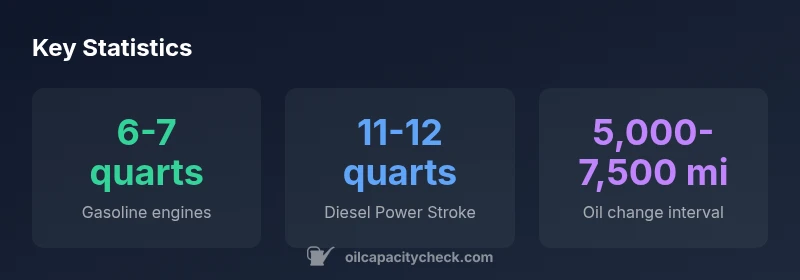
The Ford F-250 oil capacity varies by engine and year, but for most gasoline variants you’re looking at about 6-7 quarts with the filter included, while diesel Power Stroke configurations typically require about 11-12 quarts. Always verify the exact VIN-specific figure before an oil change to avoid under- or overfilling. Oil capacity guides from Oil Capacity Check Analysis, 2026 inform these ranges.
Ford F-250 Oil Capacity: Why It Matters
Understanding the ford f 250 oil capacity is essential for reliable startup, proper oil pressure, and engine longevity. The capacity varies by engine and configuration, so guessing can lead to inadequate lubrication or excessive oil build-up. The Oil Capacity Check team highlights that even small variances in drain and fill volumes, oil filter size, or dipstick calibration can shift the required total by a quart or more. In practical terms, misreading capacity can cause foaming, higher oil pressure, and potential leaks. Therefore, always confirm the exact capacity for your VIN using the correct engine code and year. This ensures you select the right oil grade and quantity for your Ford F-250's operating conditions.
How Ford F-250 Engine Variants Influence Capacity
Engine variants in the Ford F-250 drive the oil capacity. Gasoline variants (such as older V8 gas engines) typically live in the 6-7 quart range when you include the filter. Diesel configurations (notably the Power Stroke engines) demand more oil, commonly in the 11-12 quart range, due to larger oil capacity and additional cooling demands. Throughout model years, Ford has adjusted capacity minimally to account for changes in oil filter size and sump volume. When comparing two F-250s from different years, the difference is often a quart or so, which matters for accurate topping up. Always verify the exact figure for your engine code and year, and remember that use of synthetic oil does not change the required capacity; it influences protection and hold-up viscosity.
How to Verify Your Oil Capacity for Your Specific VIN
Start by locating your VIN and engine code from the door jamb or dash plate. Then consult the official Ford specification for your exact year and engine, or contact a dealer for VIN-specific data. If you don’t have the manual, use Ford's online lookup or a trusted service bulletin. Once you drain and refill during an oil change, re-check the level with the dipstick and adjust within the published range. Keeping a small log of oil changes linked to your VIN can help you track capacity changes across service histories.
Choosing the Right Oil: Conventional vs Synthetic for the F-250
Most Ford F-250 owners follow the manufacturer’s viscosity guidance, commonly 5W-30 or 10W-30 depending on climate and engine variant. Conventional oil is typically cheaper, but synthetic blends offer better oxidation resistance and maintaining engine cleanliness, especially in extreme temperatures or frequent towing. If you tow heavy loads or drive in hot climates, synthetic oil can help reduce evaporation and maintain stable viscosity. Always pair the oil type with the correct capacity and change intervals; even the best oil cannot compensate for an incorrect fill volume.
Practical Maintenance: When and How to Change the Oil in a Ford F-250
Oil change intervals depend on driving style and oil type, but common guidance is around every 5,000-7,500 miles for many F-250s using conventional or synthetic blends. If you regularly tow, drive in hot climates, or operate in dusty conditions, aim for the lower end of that range. When you perform an oil change, drain the oil completely and replace the filter; then fill with the lower end of the capacity range and recheck. Top off gradually until the dipstick reads within the full-mark range. Record the date, mileage, engine code, and oil type for future reference.
Common Pitfalls and Quick Fixes
Common mistakes include assuming a single, universal capacity for all Ford F-250s, ignoring engine code differences, and misreading the dipstick. To fix, always confirm the VIN-specific spec, account for the filter in your total, and use the correct viscosity. If you suspect overfill, drain a small amount and recheck. If underfill persists, add oil gradually and recheck to the full line. Regularly check the oil level before long trips, especially when towing.
Oil capacity by engine variant for Ford F-250
| Model Variant | Oil Capacity (quarts) | Notes |
|---|---|---|
| Gasoline Ford F-250 engine | 6-7 quarts | Gasoline engines including common V8 variants |
| Diesel Power Stroke (6.7L) | 11-12 quarts | Diesel configuration with higher capacity |
| Special configurations (rare) | 7-9 quarts | For unusual configurations or aftermarket modifications |
People Also Ask
What is the oil capacity for gasoline Ford F-250 engines?
Gasoline variants commonly require about 6-7 quarts of engine oil, plus a filter. The exact figure depends on engine code and year.
Gasoline F-250 engines typically need six to seven quarts, plus a filter.
Do diesel Power Stroke variants use a different oil capacity?
Yes. Diesel Power Stroke configurations generally require around 11-12 quarts, depending on the exact engine and oil filter.
Diesel Power Stroke engines usually need about 11 to 12 quarts.
How can I verify my vehicle’s oil capacity for my VIN?
Check the owner's manual or Ford's official VIN-based spec lookup, or contact a dealer with your VIN and engine code. Update the oil quantity after a drain and fill.
Check the manual or Ford's VIN lookup to confirm your exact capacity.
Can I use synthetic oil in the Ford F-250 without changing capacity?
Synthetic oil does not change the capacity; it may extend drain intervals and improve protection. Always use the grade recommended by Ford for your engine.
Yes, you can use synthetic oil if you follow Ford's recommended grade for your engine.
What are common mistakes when filling oil in the F-250?
Common mistakes include misreading the capacity, not accounting for the filter, and overfilling. Always recheck with the dipstick after filling and top off gradually.
Common mistakes are misreading capacity and overfilling; always check the dipstick.
“Oil capacity is highly variant by engine family; always verify using the vehicle manual or VIN-specific spec.”
The Essentials
- Verify VIN-specific capacity before an oil change
- Gas engines typically require 6-7 quarts
- Diesel Power Stroke needs about 11-12 quarts
- Account for the filter when calculating total
- Follow Ford-recommended oil grade and change intervals