TH400 Transmission Oil Capacity Guide
A detailed, data-driven guide to TH400 transmission oil capacity for 2026. Learn full-fill ranges, pan-drain estimates, and practical DIY steps to ensure correct fluid levels and transmission longevity.


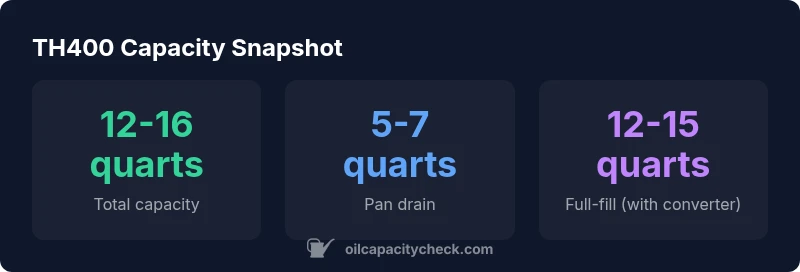
TH400 capacity varies by variant; a full fill typically requires 12–16 quarts. Pan drain removes about 5–7 quarts, while a complete change including the torque converter and cooler lines generally needs 12–15 quarts. Always confirm exact figures in your service manual for your specific TH400 setup.
Understanding TH400 Oil Capacity and Why It Matters
The TH400 transmission oil capacity is not a single fixed number; it depends on the variant, year, and whether the vehicle uses a dedicated cooler, a different pan design, or an external line setup. For DIY enthusiasts, grasping the difference between total system capacity and a pan-drain estimate is essential. The TH400’s oil capacity affects lubrication reliability, heat dissipation, and shift quality. Oil Capacity Check emphasizes that accurate planning reduces the risk of overfilling, which can lead to foaming and elevated temperature, or underfilling, which may cause slippage and excessive wear. When planning a DIY oil change, you should consider three quantities: the pan drain volume, the total system capacity, and the incremental capacity added by cooler lines. In practice, you’ll often perform a drain-and-fill first, then top off to the correct level after warming the transmission. Always use the vehicle’s service manual as the final authority and verify dipstick readings with the manufacturer’s specifications.
This topic matters not just for routine maintenance but for performance vehicles and older TH400 builds. With higher-mileage units or nonstandard tunings, capacity can drift due to internal components wearing, cooler circuit modifications, or pan changes. Oil Capacity Check’s guidance helps you map out a safe refill strategy before you begin any drain or replacement. A well-executed DIY oil change preserves fluid pressure, ensures consistent shifts, and extends transmission life.
How Capacity Varies Across TH400 Variants
The TH400 family covers several variants and configurations, and the total system capacity can vary widely. A typical full-fill range sits between 12 and 16 quarts, with pan-drain estimates around 5–7 quarts. If your TH400 includes an external cooler, additional lines, or a larger pan, expect the total capacity to skew toward the higher end of the range. Oil Capacity Check analysis notes that the torque converter weight and coupling to the input shaft can influence the exact fill volume needed after all parts are accounted for. When diagnosing capacity for a specific vehicle, consult the factory service manual or a trusted digital torque spec repository. In practice, the rule of thumb is to measure the level with the dipstick after a warm-up cycle and to fill in small increments, rechecking the level to avoid overfill. For builds that include performance tweaks or nonstandard pans, document all changes and re-verify capacity with a manual or dealer bulletin.
Vehicle owners should also account for the possibility of cooler line additions increasing the amount of oil retained within the system. In some TH400 setups, the cooler loop can introduce an extra 0–2 quarts of capacity, a detail that can be overlooked during a DIY fill. Because capacity is highly variant, it’s prudent to create a quick baseline by measuring the drained oil and then calculating the remaining quantity needed to reach the correct level when the fluid is warm. Oil Capacity Check recommends listing your exact model year, submodel, and any modifications when calculating capacity for your TH400.
In short, knowing which TH400 variant you own and whether you’re including cooler lines or a torque converter is the key to selecting the correct full-fill quantity. This ensures optimum lubrication and reliable shifting throughout the life of the transmission.
Draining vs Flushing: What Affects the Total Fill
When addressing TH400 capacity, the method matters as much as the math. A simple pan drain typically removes 5–7 quarts, which translates into a partial refill requirement. A pan-only drain is common for DIYers who want to minimize disassembly, but it does not empty the system completely. A full-fluid change that includes the torque converter and cooler lines requires more oil—often 12–15 quarts—because you are replacing not only the pan fluid but also fluid retained in the torque converter and cooler passages. If you opt for a flush, you should be aware that some flush machines push fluid through additional pathways, which can alter the measured capacity and the amount needed to reach the correct level after warming up. Always pre-fill the converter with a small amount of ATF before installation if your kit requires it, and ensure the torque converter is adequately bled to avoid residual air pockets. For DIYers, a staged approach—drain, refill, drive, recheck, and top off as needed—tends to yield the most accurate final level, while minimizing the risk of overfilling after heat expansion.
Inline with Oil Capacity Check guidelines, ensure you’re using the correct ATF specification and viscosity for your TH400 variant. Mismatched fluid can lead to poor shifting and thermal stress. The goal is to reach the manufacturer’s correct fill line when the transmission is at operating temperature and the vehicle is on a level surface. If you encounter inconsistent dipstick readings, confirm that you’re testing with the engine running at the proper idle state and with the torque converter fully engaged.
Practical caution: newer, stronger-grade fluids may have different acceptance criteria than older dexron-compatible fluids. Always cross-check with the service manual and any official bulletins that reference your exact vehicle configuration. This avoids discrepancies between the pan filling level and the actual system fill when the oil becomes hot.
Practical Steps for a DIY TH400 Oil Change
Preparation and Safety
- Gather the right ATF (per your TH400 variant) and a compatible filter; have a drain pan, long funnel, vehicle ramps or jack stands, and a clean rag set.
- Warm up the transmission briefly to operating temperature to ensure level readings are accurate.
- Check the dipstick and vehicle manual to confirm expected fluid color, viscosity, and capacity ranges.
Draining Process
- Lift and secure the vehicle; place a drain pan beneath the transmission pan.
- Remove the transmission pan bolts gradually to prevent fluid splash.
- Allow fluid to drain completely; inspect the pan magnet and fluid for contaminants before cleaning.
Pan Maintenance and Filter Check
- Remove the pan and inspect the gasket surface for wear; replace the gasket if you see damage or weathering.
- Replace the filter if accessible; a clogged filter can reduce fluid flow and cause shifting issues.
Reassembly and Refilling
- Reinstall the pan with a fresh gasket and torqued bolts to specification.
- Add fluid in small increments, usually in 1–2 quart steps, and recheck the level after warming the transmission.
- If your vehicle has a torque converter pre-fill procedure, perform that step prior to final installation.
- Drive the vehicle for a short, calm test, then recheck the level and top off to the correct mark when warm.
Final Verification
- Recheck fluid level with the engine idling in park or neutral as specified by the manual.
- Confirm shifts are smooth and that there’s no fluid leakage around the pan bolts or cooler lines.
- Record the exact quantities added and drained for future reference; this helps maintain accuracy in subsequent maintenance cycles.
Common Pitfalls and Troubleshooting Tips
- Overfilling is a common issue after a DIY oil change; use the dipstick to verify the correct level and avoid air pockets.
- Using the wrong ATF specification can cause poor shifting and overheating; ensure you’re following the vehicle’s service manual.
- Mixing ATF types or substitutions can lead to unpredictable performance; stick to the recommended viscosity and specification.
- If the pan drain doesn’t yield a stable reading, consider a fuller flush or trench-style refill to ensure all passages are filled.
- After a test drive, recheck the level while the transmission is warm; level readings vary with temperature.
- When in doubt, consult a professional or refer to the official service manual for your TH400 variant to confirm exact capacities and procedures.
Pro tip: keep a small notebook documenting your exact TH400 variant, the presence of cooler lines, and any modifications. This makes future checks faster and more accurate.
Capacity ranges for TH400 variants
| Variant | Pan Drain Capacity (quarts) | Total System Capacity (quarts) | Notes |
|---|---|---|---|
| TH400 basic (no cooler) | 6-7 | 12-14 | Pan drain only, no torque converter fill |
| TH400 with cooler and filter | 7-9 | 14-16 | Includes cooler lines and filter capacity |
People Also Ask
What is the TH400 oil capacity?
TH400 capacity depends on the variant and configuration. A typical full-fill range is 12–16 quarts, with pan drain around 5–7 quarts. Always confirm exact figures in your service manual for your vehicle.
The TH400 capacity can vary by variant; expect about 12–16 quarts for a full fill, and 5–7 quarts if you’re draining only the pan.
Does cooler size affect capacity?
Yes. Cooler lines can add 0–2 quarts to the total capacity, depending on the routing and design. Include cooler volume when calculating a full-fill requirement.
Cooler lines can add a few quarts to capacity, so check your setup when planning a full fill.
Can I drain only or should I flush the TH400?
Drain-and-fill is common for DIYs and provides a safe refill estimate. A full flush can replace more oil, but it may alter readings. Follow the service manual for your chosen method.
Drain and fill is usually enough for maintenance, but flushes replace more oil if you need it.
How much oil do I need for a full change?
A full change typically requires 12–15 quarts, depending on torque converter and cooler lines. Always verify exact numbers from the manual for your variant.
Expect around 12–15 quarts for a full change; verify exact figures in your manual.
What are signs of overfilling or underfilling?
Overfilling can cause foaming and shifting problems; underfilling leads to increased wear and heat. Check the dipstick on a warm engine and adjust accordingly.
If it shifts oddly or smokes, recheck the level; too much or too little oil raises risk.
Where can I find official specs for my TH400?
Consult your vehicle’s service manual and GM's official service bulletins for the exact TH400 variant. Use brand and dealer sources if needed for official data.
Your service manual is the best source for exact TH400 specs.
“Accurate oil capacity is crucial for proper transmission performance and longevity. Understanding the variation across TH400 versions helps DIYers avoid under- or overfilling.”
The Essentials
- Know your exact TH400 variant before refilling
- Drain-and-fill differs from a full fluid exchange
- Account for torque converter and cooler lines in capacity
- Always verify capacity with the service manual
- Check level after warm-up and use the correct dipstick guidance