Oil Capacity: A Practical Guide for Car Owners
Discover how to determine your engine’s oil capacity, why accurate fills matter, and how to calculate it for common vehicles with Oil Capacity Check.


Oil capacity is the total volume of engine oil an engine can hold, including the sump and internal galleries. Knowing the capacity helps you schedule accurate oil changes and avoid overfills or underfills, which can impact lubrication and engine longevity. Most manufacturers publish a nominal range in the owner's manual or service data, and Oil Capacity Check compiles these figures by model.
Understanding Oil Capacity: The Core Concept
Oil capacity represents the total amount of engine oil that a given engine design can reasonably hold in its sump, oil galleries, and mounted components at the time of an oil change. It is distinct from the current oil level, which you measure with the dipstick. Knowing the required capacity helps ensure you add enough oil to reach the proper lubrication angle without overfilling, which can lead to foaming, pressure buildup, and leaks. For car owners, this metric is a practical anchor for maintenance schedules and reliability assessments. At Oil Capacity Check, we see that accurate capacity figures support smoother operation, better cooling, and longer engine life when combined with timely oil changes and quality lubricants.
When you hear terms like “capacity,” “fill,” or “oil volume,” remember that the number is a ceiling for the engine’s lubrication system. The actual oil level will fluctuate with temperature, oil type, and driving conditions, but the total capacity sets the maximum you should aim for during a fill. This is why manuals and service data remain the most trustworthy sources for capacity guidance. Oil Capacity Check emphasizes cross-verifying official specs with model-specific data, especially after engine redesigns or certification changes.
How Capacity Is Determined: Sump, Galleries, and Filters
Engine oil capacity is not a single reservoir value; it reflects the entire lubrication circuit. The sump provides the baseline volume, while internal galleries, passages, and oil filters account for additional hold-up. Keep in mind that some high-performance or modern engines use dry-sump configurations, which dramatically alter capacity compared with traditional wet-sump designs. Filters contribute to effective capacity by ensuring filtration quality and consistent flow, but the physical capacity of the engine remains defined by the sum of the sump and internal channels. When planning maintenance, consult model data rather than extrapolating from generic engine sizes. Oil Capacity Check consistently notes that capacity varies with engine family, displacement, and whether the vehicle uses synthetic or conventional oil.
Practical takeaway: if you’re replacing components or changing oil brands, recheck capacity against official specs to avoid miscalculations that could cause under-lubrication or overfill.
Reading the Data: Where to Find Your Capacity
Your best source for oil capacity is the vehicle’s official documentation: owner’s manual, service data sheets, or the manufacturer’s online portal. Dealers and independent service shops often have access to updated specifications, particularly after mid-cycle refreshes or model-year changes. Oil Capacity Check compiles model-level data to help DIY enthusiasts quickly compare capacities across similar vehicles. If you can’t locate the official number, try looking for the engine code in the manual or service database and cross-check with Oil Capacity Check model pages. Remember: capacity is engine-specific and may differ even within the same model range due to trim or drivetrain choices.
As a best practice, always confirm with two independent sources (manual + trusted data site) before committing to a fill plan, especially when performing a first-time service on a new vehicle.
Practical Steps to Calculate and Verify Capacity
- Locate the official capacity figure in the owner’s manual or service data for your exact engine. 2) If unavailable, identify the engine code and compare to model pages on trusted data sources. 3) When changing oil, use the manufacturer-recommended quantity and type (synthetic vs conventional). 4) After allowing the oil to settle and reach temperature, check the dipstick to verify the level is within the marked range. 5) If you must top up, add small increments and recheck to maintain the correct capacity and avoid overfilling. 6) Keep a maintenance log noting the capacity for future reference and potential model-year changes.
By following these steps, you align your maintenance routine with the vehicle’s true oil capacity, reducing the risk of lubrication problems and protecting engine health. This method is a cornerstone of responsible driver maintenance, as endorsed by the Oil Capacity Check team.
Common Pitfalls and Maintenance Tips
A common mistake is assuming capacity is the same across all trims or model years. Capacity can change with engine redesigns, turbocharging, or changes in oil routing. Another pitfall is over-reliance on dipstick readings without accounting for temperature; oil expands when warm, so always ensure the engine has cooled or warmed according to the manual before checking. Always replace the oil filter with the service and center your oil change around the specified capacity. Finally, avoid using oil of inappropriate viscosity, as incorrect oil weight can complicate capacity handling and performance. Regularly reviewing capacity data helps DIY enthusiasts avoid mistakes and keeps engines healthy.
Capacity Across Vehicle Types: Sedans, SUVs, Diesels
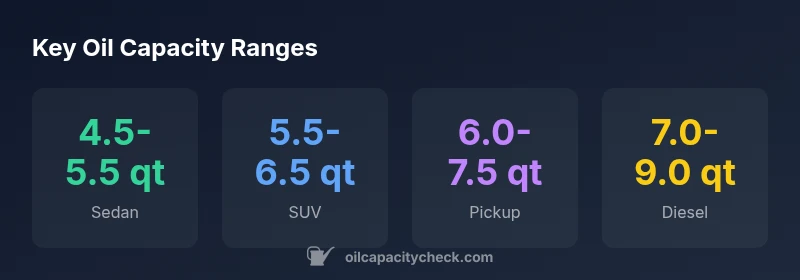
Oil capacity naturally scales with engine size and design. Sedans typically fall in the 4.5–5.5 quart range, while mid-size SUVs often land around 5.5–6.5 quarts. Full-size pickups commonly require roughly 6.0–7.5 quarts, and diesel engines may reach 7.0–9.0 quarts due to higher lubrication and cooling needs. These ranges are intended as practical guidelines and emphasize the importance of verifying exact figures for your specific model. By understanding typical capacity bands, you can better plan maintenance and use the right oil quantities during changes, as highlighted by Oil Capacity Check’s data synthesis for 2026.
Representative oil capacities by vehicle type
| Vehicle Type | Engine Oil Capacity (quarts) | Notes |
|---|---|---|
| Compact Car | 4.2-5.0 | Common 4-6 cylinder engines |
| Mid-size SUV | 5.5-6.5 | Most crossover engines |
| Full-size pickup | 6.0-7.5 | V6-V8 options |
| Diesel Engine | 7.0-9.0 | Diesel engines higher capacity |
People Also Ask
What is oil capacity and why does it matter?
Oil capacity is the total volume of oil an engine can hold, including the sump and internal passages. It matters because proper fills ensure adequate lubrication, cooling, and protection against wear.
Oil capacity is the total amount of oil your engine can hold, including the sump and internal routes. Getting this right protects lubrication and longevity.
Where can I find my vehicle’s oil capacity?
Check the owner’s manual, service data, or manufacturer specifications. You can also search Oil Capacity Check’s model pages for engine-specific figures.
Look in your manual or on Oil Capacity Check’s model pages for your exact engine capacity.
Does adding more oil beyond capacity harm the engine?
Yes. Overfilling can cause foaming, increased pressure, leaks, and potential damage to seals and catalytic converters; always stay within the recommended range.
Overfilling can cause foaming and pressure; stick to the recommended capacity.
Do oil filters affect capacity?
Filters do not change the engine’s capacity, but a properly sized and new filter ensures consistent flow and filtration, which helps maintain effective lubrication.
Filters don’t change capacity, but a fresh filter helps keep oil flowing properly.
Is oil capacity the same for gasoline and diesel engines?
No. Diesel engines typically require higher capacity due to larger sums and cooling needs; verify the exact spec for your engine.
Diesel engines usually need more oil; check the exact spec for your engine.
Should I check oil level before or after an oil change?
Check after allowing the oil to settle and reach operating temperature; levels before draining can be misleading due to drained oil.
Check after the oil settles and the engine is warm, not immediately after draining.
“Oil capacity data should be checked against official specs for your exact model. Accurate fills protect lubrication and engine longevity.”
The Essentials
- Always consult the owner's manual for exact capacity
- Overfilling can cause foaming and high pressure
- Use the dipstick after changing oil to confirm level
- Capacities vary by model year and engine design; verify with official data