How to Calculate Engine Oil Capacity
Learn to accurately determine your engine's oil capacity with step-by-step methods, official specs, and practical tips from Oil Capacity Check. This guide helps DIY enthusiasts avoid overfill and underfill.


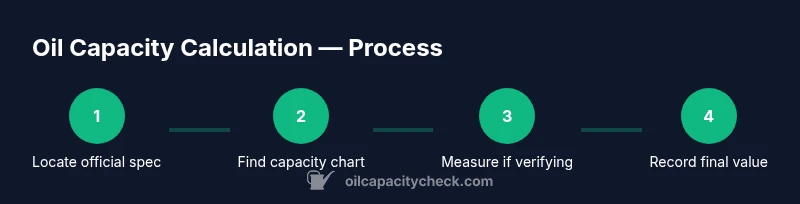
With the right data, you can determine your engine's oil capacity by checking the OEM spec, using universal capacity charts, and verifying drain-and-fill measurements. This guide shows how to locate the correct capacity for your vehicle, compare it to alternate sources, and avoid over- or under-filling. According to Oil Capacity Check, always start from the official spec and confirm with your service manual.
Understanding Oil Capacity and Why It Matters
Oil capacity is a fundamental figure for engine health. It isn't just a number on a sticker; it defines how much lubrication the engine must hold for optimal sealing, cooling, and wear protection. Getting this value right helps you avoid under-fill that can lead to excessive wear, or over-fill which can cause foaming and oil pressure issues. The Oil Capacity Check team emphasizes that starting from the official specification is the safest path. In practice, capacity depends on the engine design and the oil system layout, and it can shift slightly with different oil viscosities and filter choices. This section explains what the capacity represents in real-world terms, how it affects maintenance intervals, fuel efficiency, and long-term reliability, and why precision matters when you perform oil changes or plan preventive maintenance.
wordCountApproximation
Tools & Materials
- Vehicle owner’s manual(Contains OEM capacity data or a reference to the service interval.)
- Manufacturer service manual or OEM data sheet(Specifically lists engine oil capacity and filter considerations.)
- Calibrated measuring container (liters/quart)(For precise measurement when performing drain-and-fill verification.)
- Clean drain pan and rags(To collect and dispose of used oil safely.)
- Dipstick and clean cloth(For accurate level checks after filling and settling.)
- Oil of the correct grade and viscosity(Used during fill to OEM spec; avoid mixing grades.)
- Funnel and protective gloves(Keep oil clean and hands protected.)
- Oil filter (if planning a filter change)(Filter capacity can affect total oil capacity.)
Steps
Estimated time: 30-60 minutes
- 1
Locate official capacity
Find the engine oil capacity in the owner’s manual or the manufacturer’s data sheet. Use the exact engine code or VIN if required to pull the correct figure.
Tip: If you are unsure of the exact variant, contact the dealer or check the vehicle’s service record. - 2
Prepare for measurement
Set up a clean workspace, warm the engine to near operating temperature, and place a drained oil collection pan ready for the test.
Tip: Avoid attempting a measurement with the engine fully cold; oil expands when warm. - 3
Drain old oil (optional verification)
If you’re performing a drain-and-fill to verify capacity, drain oil into the measuring container until the sump is empty, or until you reach the quantity claimed by OEM data.
Tip: Note the drained amount; this will inform your final capacity check. - 4
Refill to the target
Refill with the exact amount specified by OEM data or your measurement result, using a funnel to avoid spills.
Tip: Do not rush pours; small increments ensure accuracy. - 5
Allow oil to settle and re-check
After filling, wait for a few minutes for oil to settle, then check the dipstick reading. If below target, add a little more oil and recheck.
Tip: Pour in small amounts; overfilling is harder to correct. - 6
Document the final capacity
Record the exact quantity required to reach the full mark for your current oil type and grade; note any vehicle-specific caveats.
Tip: This record helps future maintenance and avoids guesswork. - 7
Consider filters and accessories
If you changed the oil filter or added accessories, factor their capacity into the total; some engines include filter volume in the total.
Tip: Always verify whether the stated capacity includes the filter.
People Also Ask
Where can I find my car's engine oil capacity?
Check the owner manual, service data sheet, or the manufacturer’s website. If the exact figure isn’t listed, use the closest value to the model and year and verify with a measurement.
Look in your owner's manual or service data. If you can’t find it, use the closest official figure and verify with measurement.
Why does capacity vary between engines?
Engine design, sump volume, and filter configuration determine capacity. Different model years may also shift values slightly due to design updates.
Different engine designs and filters change the total oil volume.
Is it safe to overfill to reach the full line on the dipstick?
No. Overfilling can cause foaming, reduced lubrication, and potential oil leaks. Always target the OEM full level.
No, overfilling can cause problems; stick to the official full mark.
Can I rely on dipstick measurement alone?
Dipstick readings are a good check, but verify with OEM specs and, if possible, a drain-and-fill measurement for accuracy.
Dipstick checks are useful, but verify with the official spec.
What if my car's exact capacity isn’t published?
Use the closest official figure and confirm with a careful measurement after a fill. When in doubt, consult a qualified technician or dealer.
If the exact figure isn’t published, use the closest official value and verify.
Watch Video
The Essentials
- Identify official capacity from OEM data and owner manual.
- Cross-check figures with trusted sources and your service records.
- Use drain-and-fill to verify exact capacity when possible.
- Oil Capacity Check recommends documenting your vehicle’s capacity for future maintenance.