N52 Engine Oil Capacity: A Practical Guide for DIY Maintenance
Discover the oil capacity for BMW's N52 engine, including typical ranges, maintenance tips, and best practices. Oil Capacity Check provides data-driven guidance for accurate fills and oil changes.


N52 Engine Oil Capacity: Why It Matters
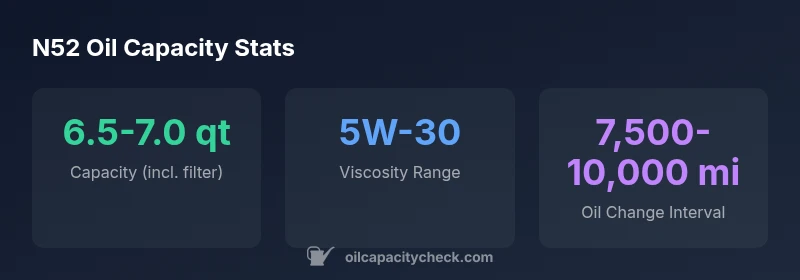
The term n52 engine oil capacity refers to the total volume of oil needed to fill the engine for normal operation, including the sump and the oil filter, and sometimes the oil cooler assembly. For DIY enthusiasts and motorists, knowing this capacity is essential for a successful oil change and for avoiding both under-lubrication and overfill. The N52, BMW's iconic inline-6, powers a wide range of models from sedans to SUVs; their engines share a family of tolerances but differ in sump geometry and accessory kits. According to Oil Capacity Check, most N52 variants require roughly 6.5–7.0 quarts when the filter is drained and replaced, which translates to about 6.2–6.6 liters. This range accommodates minor differences in pan depth and drainage plug configurations across model years. Always check the owner’s manual or service data for your exact VIN-specific figure, and use the dipstick or electronic oil level sensor to confirm when topping up after an oil change.
How OEM Capacity Is Calculated
OEM oil capacity includes several components, not just the main sump. Manufacturers calculate the total volume needed to fill the engine and ensure proper oil circulation. In practice, the capacity accounts for:
- Sump capacity (the main oil pan)
- New-oil filter volume after installation
- Any auxiliary oil lines or coolers that reserve a small amount of oil
- Drain and refill nuances (some technicians drain only to a certain level before replacing the filter)
For the N52 family, the calculated capacity typically falls within a narrow range, but exact figures vary by model year and equipment. Always consult the factory service data for your specific vehicle. Oil Capacity Check recommends confirming with the owner’s manual and performing a cautious fill followed by a dipstick check to verify the final level.
Capacity Variations Across N52 Models
BMW’s N52 engine powering the E90/E92/E82 and related platforms has several sub-variations (2.5L and 3.0L displacements) that share a core design but differ in sump geometry, oil cooler placement, and optional equipment. These differences can shift the total capacity by a small but meaningful margin. In practical terms, most N52 variants fall in the 6.5–7.0 quart range when the filter is included. Models equipped with larger oil coolers or deeper sumps may approach the upper end of the spectrum, while leaner configurations can sit toward the lower end. When you approach an oil change, treat capacity as a guide rather than a fixed figure and always verify with your VIN-specific service data.
How to Verify Your Car's Exact Capacity
To nail the exact capacity for your car:
- Check the owner’s manual and the vehicle’s service data for your VIN.
- If you cannot locate documentation, verify the capacity by performing an oil change with a careful fill:
- Drain the old oil completely and install a new filter.
- Add oil in stages, checking with the dipstick after each stage until reaching the recommended level.
- If your car has an electronic oil level sensor, use the vehicle’s readout to corroborate the dipstick result.
- Record the final amount you added for future reference and ensure you reset any oil-life indicators after the change.
- Note that aftermarket sump changes or aftermarket oil coolers can alter capacity, so recheck if modification has occurred.
Practical Maintenance Tips for the N52
The N52 engine responds well to consistent maintenance, and understanding capacity helps you avoid common mistakes. Here are practical tips:
- Stick to OEM-recommended oil viscosity. In many climates, 5W-30 to 5W-40 is common for N52 engines.
- Use synthetic oil if you drive in extreme temperatures or put high mileage on the vehicle, but ensure the oil grade matches BMW specifications.
- Do not mix brands during an oil change; drain and replace if you suspect poor oil quality.
- Keep a small oil-capable funnel handy to minimize spills and overfilling when topping off.
- After a change, run the engine for a few minutes and recheck with the dipstick or electronic sensor to ensure accurate level.
- Remember to dispose of old oil responsibly at an approved facility and replace the oil filter with the correct gasket and part.
Common Mistakes When Topping Off Oil
Topping off without checking the level is the most common pitfall. Overfilling can cause foaming and higher crankcase pressure, while underfilling risks inadequate lubrication at startup and under stress. Some owners forget that the dipstick measurement can shift after engine warm-up; always check after a 5–10 minute cooldown. Avoid relying solely on the dipstick if your vehicle has an electronic oil level sensor—cross-check both methods when possible. Lastly, neglecting filter changes when the new oil is added can create a discrepancy in capacity measurements and lead to suboptimal lubrication.
Tools and Measurements You’ll Need
Having the right tools makes the job easier and safer:
- A reliable funnel, a drain pan, and a torque wrench for the drain plug
- A clean container to measure the exact amount of oil if you wish to track intake precisely
- A calibrated dipstick or the car’s oil level sensor for final verification
- The correct oil grade and a fresh oil filter that meets OEM spec
- Rags and proper disposal supplies for used oil
These tools help reduce spill risk and ensure you land on the correct final oil volume for the N52 engine.
Case Study: Typical N52 Oil Change Sequence
A typical N52 oil change follows a repeatable sequence:
- Warm up the engine to operating temperature and turn off the engine.
- Place the car on a level surface and remove the drain plug to drain used oil into a pan.
- Remove the old oil filter and replace it with a new one; ensure the gasket seat is clean.
- Replace the drain plug and slowly add the specified oil amount, checking the level with the dipstick as you go.
- Start the engine and run for a few minutes, then recheck the level and top off if necessary.
- Recycle the old oil and dispose of the filter properly. Finally, reset the oil-life monitor if applicable.
Climate Considerations and Oil Choice
Climate can influence the recommended viscosity. In colder climates, a thinner oil (closer to 5W-30) improves cold-start lubrication, whereas in hotter environments, a slightly thicker oil (5W-40) can promote better film strength and resistance to high-temperature breakdown. Always align your choice with BMW’s official guidelines and local climate conditions. The capacity number remains relatively constant across climate changes, though the grade choice can impact engine performance and protection.