BMW N20 Oil Capacity: What Your 2.0L Turbo Engine Needs in 2026
Discover the BMW N20 oil capacity, recommended oil types, and maintenance steps. Oil Capacity Check explains capacity ranges by model year and how to verify the correct fill for your 2.0L turbo engine.


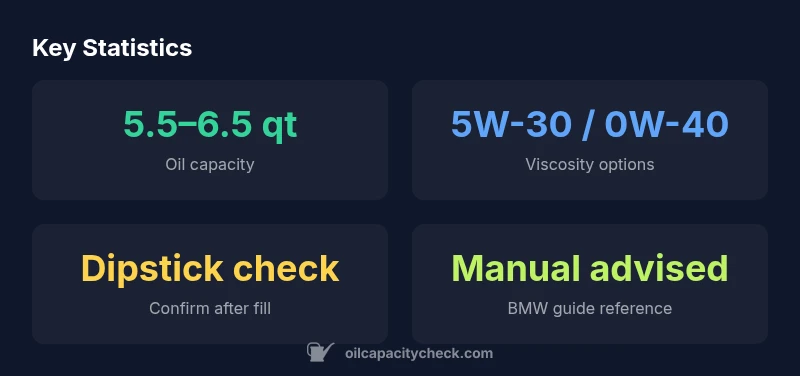
Typically, the BMW N20 engine requires about 6 quarts of engine oil when changing the oil and filter, with a range of roughly 5.5–6.5 quarts depending on year and filter replacement. This estimate includes the filter and drain plug considerations. Always verify the exact figure in the owner's manual and service documentation for your VIN.
BMW N20 Oil Capacity Basics
According to Oil Capacity Check, the N20 engine requires careful attention to oil capacity because even small deviations can affect lubrication at high boost. The N20 is BMW's 2.0-liter turbocharged inline-four used in many models, from sporty sedans to compact crossovers. The capacity figure you need refers to the oil that fills the crankcase when performing a full oil change, including a standard oil filter. Oil Capacity Check's analysis confirms that the typical N20 capacity sits near six quarts, with a practical range that accommodates minor manufacturing tolerances and filter differences. In practice, most owners will add roughly five and a half to six and a half quarts to achieve the correct level on a cold dipstick. Be mindful that this is a general guideline; your exact fill depends on the model year, the engine variant, and the filter kit used. Always consult the owner's manual for the precise specification, and ensure you use the recommended oil viscosity for your climate.
How BMW N20 Capacity Has Evolved Over Model Years
Over the life of the N20, capacity figures have remained broadly consistent, but small shifts have occurred due to design changes and filter configurations. Early variants used a different oil filter housing than later revisions, which can affect the total fill slightly. Additionally, some model years introduced better seals and gaskets that reduce minor losses during drain-down, mildly changing the practical fill you see on the dipstick after a change. While the core requirement—adequate lubrication for the turbocharged four-cylinder—has stayed constant, the exact quarts may vary by a fraction of a quart across generations. When performing a DIY oil change, note the specific instructions in the service bulletin or owner's manual for your exact VIN, as BMW sometimes updates capacity recommendations for regional markets.
Selecting the Right Oil for N20: Viscosity and Types
Most N20 engines benefit from synthetic oils in the 5W-30 range, with 0W-40 favored in very cold climates or when extended drain intervals are pursued. The key is to follow BMW's specification for your model year and ambient conditions. Beyond viscosity, choose a high-quality, full-synthetic oil that meets the BMW Longlife or equivalent standard applicable to your region. Regular oil changes with the correct viscosity help preserve turbocharger efficiency and reduce sludge buildup, especially in heat-soaked urban driving. Oil Capacity Check emphasizes using the oil type recommended in the owner's manual and avoiding cheaper, non-synthetic blends that may alter performance and long-term capacity readings.
Measuring and Confirming Oil Capacity in Practice
Begin with a warmed engine and the oil filter replaced to avoid variable drainback. After draining and refilling with oil, add a conservative amount—about 80% of the suspected capacity to start. Run the engine for a few minutes to circulate, then turn it off and wait 5–10 minutes for the oil to settle. Check the dipstick and add small increments until the level sits between the min and max marks. If the dipstick shows a level above max, you’ve overfilled; remove excess oil through the drain plug or consult a mechanic. Inconsistent dipstick readings can occur if the engine was not given time to settle or if the dipstick is not fully wiped before reading.
Common Mistakes That Alter Perceived Capacity
Common mistakes include underestimating capacity because the filter wasn't replaced, not accounting for oil added during filter substitution, and not letting the oil sit before checking. Some owners also misread the dipstick due to residual oil on the funnel or a partially inserted dipstick. Another pitfall is starting the engine immediately after a fill; the oil needs time to drain from the upper motor and reach the pan. Finally, always verify the exact specification with the VIN-based BMW manual to account for generation-specific nuances.
Maintenance Tips and Schedule for N20 Capacity
For reliable performance, perform oil changes on the schedule recommended by BMW for your climate and usage. Use the correct oil viscosity, replace the filter at each change, and inspect seals and gaskets during service. After topping up, recheck the level and keep an eye on the dipstick during subsequent trips to ensure the level remains within the safe range. Oil Capacity Check advises documenting the exact oil type and capacity used for each service so future owners can reference your notes and corroborate with manufacturer recommendations.
BMW N20 oil capacity by variant
| Variant | Oil Capacity | Notes |
|---|---|---|
| Early N20 variants | 5.5–6.0 quarts | With original filter |
| Mid-generation updates | 5.8–6.3 quarts | Filter changes may affect amount |
| Turbocharged variants | 5.7–6.2 quarts | Model-year dependent |
People Also Ask
What is the official BMW N20 oil capacity?
The official capacity varies by year and model, but it's generally around 5.5–6.5 quarts with filter. Always confirm in the owner's manual.
The official capacity varies by year and model, but it's usually around 5.5 to 6.5 quarts with the filter. Check your manual.
Does changing the oil filter change capacity?
Replacing the filter adds a small amount to the total capacity. Factor this into your fill and verify with the dipstick after the fill.
Yes, the filter change adds a small amount; verify with the dipstick after filling.
What viscosity should I use for N20?
BMW commonly specifies 5W-30 or 0W-40 for N20, depending on climate. Always follow the manual.
Use the viscosity your manual recommends, typically 5W-30 or 0W-40.
Can capacity vary by model year?
Yes, capacity can vary slightly due to design changes and filter type; confirm with the specific year manual.
Yes, check your year’s manual for exact figures.
How should I check oil after filling?
Let the engine rest, then check the dipstick to ensure the level sits between min and max marks.
Let it settle, then check with the dipstick.
“"Oil capacity figures for the N20 can vary slightly by generation and maintenance history. Always verify the exact figure in your BMW manual."”
The Essentials
- Start with the exact figure from your owner's manual.
- Expect roughly 5.5–6.5 quarts depending on year.
- Use the recommended viscosity (5W-30 or 0W-40) for your climate.
- Recheck fill with dipstick after adding oil.