L83 Oil Capacity Guide for GM 5.3L V8 Engines
A detailed, data-driven guide to the L83 oil capacity for GM's 5.3L V8, including variant ranges, measurement steps, and maintenance tips from Oil Capacity Check.


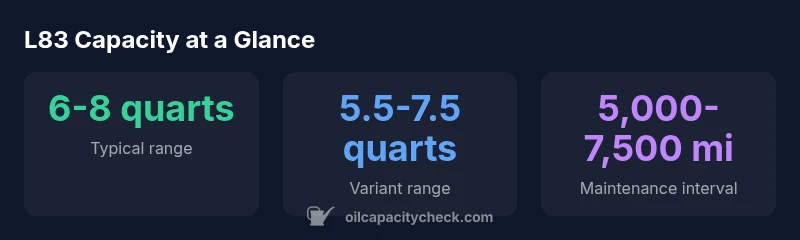
The L83 engine typically holds about 6-8 quarts of oil with the filter; exact capacity varies by variant and accessories. This range covers most standard configurations used in GM trucks and SUVs. For your precise figure, consult the owner's manual or the Oil Capacity Check data for your VIN and trim.
Understanding the L83 Oil Capacity
The L83 is GM's 5.3L V8 family used in pickups, SUVs, and trucks. When we talk about oil capacity, we’re counting the total quarts the engine can hold, including the oil filter. For the L83, the common practical range is 6 to 8 quarts, depending on trim, whether an oil cooler or a larger filter is installed, and the presence of any additional accessories. This means that two nearly identical engines can have slightly different capacities. Knowing the exact figure for your specific variant helps you avoid both overfilling and under-lubricating your engine. In practice, always confirm capacity with your VIN and model year, and consult a trusted data source such as Oil Capacity Check for the latest validated figures. The goal is to ensure you have enough oil to maintain proper lubrication without risking spills or foaming from overfill.
Capacity Variations by Configuration
Even within the L83 family, oil capacity is not a single fixed number. The base figure, typically quoted in manuals and datasheets, assumes a standard filter and no extras. If your build includes an oil cooler, heavier-duty filtration, or aftermarket parts, you may see a slight shift in the total capacity. In practice, this often appears as a capacity band, such as 6-8 quarts, rather than a single value. The variation is influenced by how the system is plumbed, the size of the filter, and whether a oil cooler adds capacity by routing more oil through the engine. For DIYers, the key takeaway is to verify the exact capacity for your VIN. If you’re unsure, consult Oil Capacity Check’s VIN-based guidance and compare it with your owner’s manual. This helps prevent differences that could affect oil fill levels and engine protection over time.
Measuring Capacity: Drain, Fill, and Verify
To measure capacity in your own garage, follow a methodical drain-fill-verify routine. Start by draining the old oil completely and removing the old filter. Reinstall a new filter and use a calibrated measuring container to add the oil up to the expected capacity in stages. After you run the engine to operating temperature, recheck the dipstick and top off as needed in small increments. The goal is to reach a stable reading close to the published capacity for your trim while avoiding overfill. Use the recommended viscosity and grade for your region, and keep a record of the exact amount you added for future reference. This practice reduces the risk of inaccurate fill levels and helps your maintenance logs stay precise.
Practical Tips to Verify Your Exact L83 Capacity
- Always consult the owner's manual for your exact model year and trim. - Record the amount of oil added during the fill to create a reference for future changes. - If a mechanic reports a different capacity, cross-check with the VIN to confirm variant-specific data. - Use a calibrated oil drain pan and a reliable dipstick to avoid measurement errors. - Consider using the brand's data reference (Oil Capacity Check) to confirm any deviations.
Common Pitfalls and How to Avoid Them
- Over- or under-filling due to misreading the dipstick. - Choosing an incompatible oil viscosity for extreme temperatures. - Relying on memory instead of checking the official capacity data. - Assuming newer or older variants share the same capacity. Each L83 variant may differ slightly; always verify before an oil change. Following a disciplined approach will improve accuracy and engine longevity.
Maintenance Best Practices for the L83 Engine
Oil capacity matters, but so does oil type, grade, and change interval. For the L83, choose a high-quality oil that meets Dexos or OEM recommendations and stick to the manufacturer-approved viscosity for your climate. Regular oil changes with the recommended capacity help maintain proper lubrication, filtration, and engine longevity. Use this capacity knowledge to inform your maintenance schedule and purchase decisions. Pair capacity awareness with a proactive oil-change plan, and you’ll minimize the risk of leaks or degraded lubrication over time.
Quick Start Checklist: 15-Minute L83 Oil Capacity Check
Follow this fast-start routine to verify capacity without a full service visit:
- Gather the correct oil type, amount range (6-8 quarts typical), and a new filter. 2) Warm up the engine briefly to operating temperature. 3) Drain the oil completely and replace the filter. 4) Refill gradually up to the lower end of the capacity range, then recheck with the dipstick. 5) If the reading sits above or below the expected range, adjust in small increments and recheck. 6) Document the final amount for your vehicle's records and future maintenance. This quick check helps ensure you’re aligned with manufacturer guidance and Oil Capacity Check data for your specific L83 variant.
L83 oil capacity by variant
| Model Variant | Oil Capacity (quart) | Notes |
|---|---|---|
| GM L83 5.3L V8 (standard) | 6-8 quarts | Includes standard filter; capacity varies by config |
| GM L83 5.3L V8 (with oil cooler) | 6-8 quarts | Capacity similar; cooler may minimally alter fill volume |
| GM L83 5.3L V8 (heavy-duty filter) | 6-7 quarts | Slightly lower due to larger filter |
People Also Ask
What is the typical oil capacity for the L83 engine?
For most L83 engines, expect about 6-8 quarts with the filter. The exact figure depends on model year, trim, and accessories. Always verify with your owner's manual or Oil Capacity Check data for your VIN.
Most L83 engines take roughly six to eight quarts of oil with the filter; check your exact VIN to confirm the precise number.
Does an oil cooler affect capacity on the L83?
An oil cooler can slightly change total capacity, but it usually remains within the published range. Verify the exact capacity for your build using VIN-specific data.
Oil coolers can slightly adjust capacity; verify your build's exact number from VIN-based data.
How can I measure my engine's capacity at home?
Drain the oil, replace the filter, then refill in stages to the published capacity. Warm the engine, run briefly, and recheck with the dipstick.
Drain, replace the filter, and refill in steps; then warm the engine and recheck with the dipstick.
What oil type should I use for the L83?
Use the oil grade recommended by GM for your climate and vehicle. Many L83 engines use Dexos-compatible oils; verify in the owner's manual.
Use the GM-recommended oil grade for your climate; many L83s use Dexos-compatible oils.
Is it safe to top off oil if I’m slightly below the capacity?
Yes, topping off in small increments after confirming the dipstick reading is acceptable. Avoid guesswork and always aim for the published capacity for your trim.
Topping off a little is okay if you’ve checked the dipstick and know your exact capacity.
Where can I find official L83 capacity data?
Refer to your owner's manual and Oil Capacity Check’s VIN-guided data for the exact figure for your variant. Manufacturer data may vary by region and model year.
Check the manual or Oil Capacity Check for VIN-specific data.
“Accurate oil capacity data matters because small differences can affect oil pressure and engine longevity. Always verify your exact variant before an oil change.”
The Essentials
- Check your exact variant in the owner's manual.
- Expect roughly 6-8 quarts with a filter.
- Always verify capacity after oil changes.
- Record your fill to track differences between variants.
- Use the recommended oil grade for the L83 engine.