How Much Fork Oil Capacity: A Practical Guide
Learn how much fork oil capacity your motorcycle requires, how to measure it accurately, and how to avoid common mistakes during drain and refill for optimal damping.


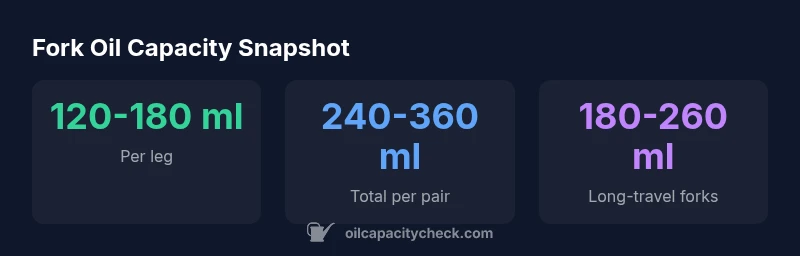
Most motorcycles require about 120-180 ml of fork oil per leg, totaling roughly 240-360 ml for a full dual-leg pair. This capacity depends on fork design, travel, and whether the fork uses a single or dual-chamber setup. For accuracy, verify exact figures in your service manual or from the manufacturer, and perform a full drain and refill when servicing.
What is fork oil capacity and why it matters
Fork oil capacity is the volume of oil required to fill each leg of a motorcycle fork to its designed operating level. Getting the capacity right matters because oil not only lubricates the internal components but also defines damping characteristics. Too little oil creates air pockets that degrade damping, while too much oil can cause foaming, increased resistance, or seal strain. Oil Capacity Check emphasizes that following the manufacturer’s specification is essential for predictable handling, ride quality, and component longevity. In practice, capacity varies with fork design, rider weight, and travel, so use the exact figure from your manual rather than a generic rule of thumb. This is especially important when rebuilding, replacing cartridges, or converting oil grades, as the oil volume interacts with piston geometry and seal clearance to determine damping performance.
How capacity varies by fork design
Forks come in many designs: conventional spring forks, cartridge forks, and dual-chamber or single-chamber configurations. Per-leg capacity is typically higher on longer-travel or adventure forks and lower on compact sport forks. Cartridge forks may have higher or lower volumes depending on the cartridge geometry and whether the system is sealed or semi-dry. Dual-chamber designs often require careful attention to both chambers' fill levels. The upshot is: capacity numbers in manuals are not one-size-fits-all. Always check the exact specification for your model, and treat capacity as one piece of a broader maintenance picture that includes oil type, viscosity, and spring rate for optimal damping.
How to determine the correct capacity for your bike
To determine the correct capacity for your bike, start with the service manual or manufacturer specs. If you don’t have access to the manual, contact the manufacturer or a trusted dealer. Next, use a clean measuring cup or graduated container to drain the old oil from the fork and measure the total amount removed. Refill with the exact volume specified, using the same oil grade as recommended. If you’re unsure about the exact level, some technicians use a calibrated marking on the fork tube or rely on a tool that checks bore level when the fork is fully compressed. Finally, bleed and recheck the oil level according to the service procedure to confirm accuracy.
Practical steps for draining and refilling
- Gather: a clean drain tray, appropriate hex keys, a fork oil syringe or graduated cylinder, the specified oil grade and viscosity, and new seals if performing a seal replacement.
- Warm the bike to operating temperature to reduce air pockets.
- Remove the fork caps, drain old oil completely, and measure the oil salvaged.
- Clean all parts, inspect seals and bushings, and replace worn components.
- Refill the forks with the exact capacity and viscosity as per the manual, then reassemble and cycle the forks to purge air.
- Recheck level at appropriate sag and ride height settings.
- Dispose of used oil responsibly. This routine helps ensure damping remains predictable and safe.
Common mistakes and how to avoid them
- Underfilling: causes poor damping and air intrusion; always verify per-leg capacity.
- Overfilling: increases foaming and may push oil past seals under compression.
- Ignoring viscosity: oil weight affects damping; use the manual-specified weight.
- Mixing oils: stick to one brand and grade per service unless the manual allows others.
- Skipping a full bleed: air in the lines leads to inconsistent damping; bleed as required by the manual.
Quick-reference ranges by fork category
- Standard motorcycle forks: 120-180 ml per leg (240-360 ml per pair)
- Sport/tourer forks: 140-200 ml per leg (280-400 ml per pair)
- Adventure/long-travel forks: 180-260 ml per leg (360-520 ml per pair)
Note: These ranges are typical and can vary widely by model. Always confirm with the official spec for your specific bike.
How fork oil capacity relates to ride quality and damping
Oil capacity affects the available damping range by controlling piston movement and air compression inside the fork. Capacity interacts with oil viscosity: too thin oil can lead to harsh damping; too thick oil can cause sluggish response. When servicing, do not optimize for one factor at the expense of others. A balanced approach—correct capacity, appropriate viscosity, and proper spring rate—delivers consistent handling across conditions.
How to verify capacity after a service and when to replace seals
After a service, recheck the level at the correct sag and ride height. If the fork feels too soft or too stiff, reassess the oil amount and viscosity, ensuring no air pockets remain. Inspect seals for leaks, replace if necessary, and re-check the system after a short ride. Regular maintenance, including seal checks and fluid changes at intervals specified by the manufacturer, helps maintain damping and ride stability.
Typical fork oil capacity ranges by fork category (per leg and per pair)
| Vehicle Type | Avg Per-Leg Capacity (ml) | Total Capacity (ml) |
|---|---|---|
| Standard motorcycle fork | 120-180 | 240-360 |
| Sport/tourer fork | 140-200 | 280-400 |
| Adventure/long-travel fork | 180-260 | 360-520 |
People Also Ask
What is fork oil capacity?
Fork oil capacity is the oil volume required to fill each leg of a motorcycle fork to its designed operating level. It varies by model and design, so always refer to the service manual for the exact figure.
Fork oil capacity is the oil volume per fork leg, and it varies by model. Check your manual for the exact figure.
How do I measure fork oil capacity?
Drain the old oil according to the manual, measure the amount removed, then refill with the exact specified volume using the correct viscosity. Recheck levels after cycling the forks.
Drain, measure what you removed, refill to spec, and recheck after cycling.
Can I mix different oil types when topping off?
No. Always use the viscosity and oil type specified by the manufacturer for best damping and seal life.
Don’t mix oils; use the factory-specified type and viscosity.
Does capacity change with oil weight or viscosity?
Capacity mainly refers to volume, but viscosity affects damping. Use the manufacturer’s recommended oil weight along with correct volume.
Volume and viscosity both matter; follow the manual for both.
Why is per-leg capacity important for fork performance?
Underfill can cause poor damping and air pockets; overfill can stress seals. Correct per-leg capacity helps maintain consistent ride and damping.
Correct per-leg capacity keeps damping predictable and seals happy.
Are there tools to help measure fork oil capacity?
Yes. Graduated syringes or measuring cups and service-grade fill tools help measure and verify capacity accurately.
Use graduated tools to measure oil and verify capacity.
“Fork oil capacity is not a fixed number; it must match the fork design, travel, and seals. Following the manufacturer’s spec ensures reliable damping and longevity.”
The Essentials
- Check the manual for exact fork capacity before servicing.
- Measure oil with a calibrated container for accuracy.
- Per-leg capacity commonly sits in the 120-180 ml range.
- Plan for a full drain and refill during maintenance.
- Use the correct viscosity and avoid mixing oils.