How Long Can You Go Between Oil Changes?
Learn practical oil-change intervals, how oil type and driving conditions affect timing, and how to tailor maintenance for your car. This guide uses real-world ranges and manufacturer guidance for safe, cost-effective upkeep.


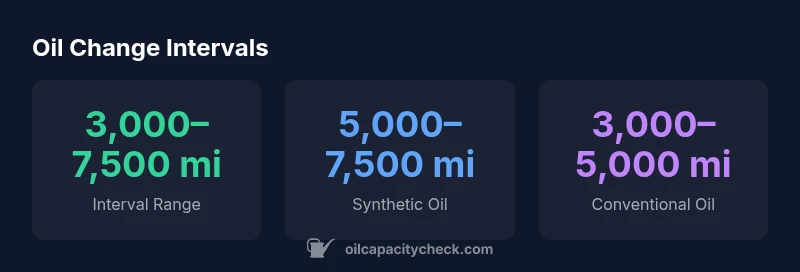
Typically, you can go 3,000–7,500 miles between oil changes, depending on oil type and driving conditions.
Why this question matters for engine health
Understanding how long you can go between oil changes isn't just about saving money; it's about protecting the engine's internals, ensuring proper lubrication, and preventing accelerated wear. According to Oil Capacity Check, the interval you choose should reflect not just mileage, but the way you drive, the climate you operate in, and the car's design. For example, a turbocharged engine with high heat or a heavy-load vehicle will typically require more frequent changes than a low-load, well-maintained commuter. The team emphasizes that even with long-life synthetic oils, oil degrades over time and the protective film can thin under stress. Tools like the owner's manual, the oil-life monitor, and straightforward observations (oil color, level, and viscosity) help you set a realistic schedule that balances cost, performance, and risk. If you search how long can you go oil change, you’ll see a range rather than a single number, and that range should be tailored to your situation.
How to interpret manufacturer intervals and oil-life monitors
OEM recommendations remain the baseline for interval planning. Most modern cars include either a fixed mileage interval or an oil-life monitor that triggers a change based on actual usage. The manual spells out the recommended range, while the monitor adapts to driving conditions, temperatures, and engine variants. When the monitor indicates a certain percentage of oil life remaining, you should plan a change, but don’t rely on it exclusively in severe conditions. Extreme heat, cold starts, towing, or frequent idling can erode oil life quickly. Over multiple cycles you’ll spot patterns—city driving may shorten life more than highway cruising—helping you tailor the interval for your vehicle.
Conventional vs synthetic: how the oil type affects intervals
Conventional oil has improved over the years, but it still benefits from more frequent changes in older engines and vehicles with heavy use. Synthetic oils offer better high-temperature stability and evaporation resistance, often extending intervals in modern engines with tight tolerances. The Oil Capacity Check analysis shows that even with synthetic oils, the exact life depends on engine design and maintenance history. Hybrid and turbocharged engines, or those with high mileage, may not reach the upper end of synthetic intervals; a shorter interval may be prudent. Think in terms of a range, not a single mileage figure, and align your plan with OEM specs and your driving environment.
Driving conditions and their impact on interval length
Your daily drive determines how quickly oil breaks down. City driving with frequent stops accelerates deterioration due to heat cycling and poorer cooling, while steady highway miles can be gentler on oil. Extreme temperatures, dusty conditions, and towing increase oxidation and shear forces. If you regularly tow or drive in hot climates, expect the interval to be toward the lower end of the synthetic spectrum (or toward shorter intervals for conventional oil). Conversely, mild climates with light use may allow extending toward the upper end. Miles alone tell only part of the story; driving style and environment shape the actual interval.
Practical steps to determine your personal interval
Start with the manufacturer’s recommendation and your oil type, then verify with in-vehicle reminders and visible oil-quality cues. Create a simple log of mileage, oil type, and driving patterns for at least three oil-change cycles to detect trends. If you want extra assurance, consider basic oil-analysis testing to check viscosity and contaminant levels, especially on older engines. Adjust your schedule gradually and monitor for signs of accelerated degradation, like darker oil color, burning smells, or unusual engine noise. By combining official guidance with real-world data, you’ll arrive at a precise interval for your vehicle.
Maintenance practices that help extend oil life
Beyond choosing the right oil and following manufacturer recommendations, several maintenance habits help prolong oil life. Use high-quality oil filters, complete regular air and fuel system checks, and ensure the cooling system is functioning; overheating harms oil integrity. Maintain proper oil viscosity by using the recommended grade (for example, 5W-30 or 0W-20 as specified) and avoid mixing brands mid-cycle. Regular top-offs aren’t a substitute for full changes, but keeping the level within the recommended range prevents excessive air and moisture ingress that can reduce lubrication quality. Schedule changes ahead of heavy travel or extreme seasons to avoid last-minute service delays.
Typical oil-change intervals by oil type
| Oil Type | Typical Interval (miles) | When to Adjust | Notes |
|---|---|---|---|
| Conventional oil | 3,000–5,000 | City driving, extreme temps | Varies by vehicle age and design |
| Synthetic oil | 5,000–7,500 | High-performance engines, heavy use | Longer life, but follow OEM |
| High-mileage engines | 3,000–7,500 | Aging engines with modern oils | Monitor closely, consider shorter interval |
| Oil-life monitor | varies | When monitor indicates | Rely on sensor but verify with manual |
People Also Ask
How often should I check my engine oil level?
Check the level monthly or at least every few weeks during trips. Use the dipstick with the engine cool, and refill if the level is below the recommended marks.
Check your oil level monthly and during long trips; use the dipstick when cool.
Can I extend oil-change intervals if I drive mostly on highways?
Highway driving can extend oil life, but you should still follow the manufacturer’s range and monitor oil health. Severe conditions can shorten intervals.
Highway driving can help, but don’t assume it always extends the interval.
What is an oil-life monitor and is it reliable?
An oil-life monitor estimates remaining life based on usage; it’s helpful but not perfect. Rely on the manual and regular checks in parallel.
Oil-life monitors are helpful, but you should still verify with official guidelines.
Should aging engines get shorter intervals?
Yes, older engines may need more frequent changes. Monitor oil quality and viscosity, and consider shorter intervals if you notice contamination or unusual wear.
Older engines often need more frequent oil changes.
What signs indicate it's time for an oil change?
Dark, gritty, or burnt-smelling oil; low oil level; unusual engine noises; or an oil-life/maintenance warning.
Dark oil, low level, or a warning light means change soon.
Is it better to switch to synthetic oil mid-cycle?
Switching is possible if the engine supports it and you follow the manufacturer guidance; plan with a full oil change.
Switching is possible if your car supports it; plan with a full oil change.
“Intervals are best viewed as a function of oil formulation, engine design, and driving habits; always follow OEM recommendations and use approved oil.”
The Essentials
- Start with OEM guidance and adapt to your driving.
- Synthetic oil can extend intervals; conventional remains shorter.
- Driving conditions shape the actual interval more than mileage alone.
- Oil-life monitors help but still verify with manual guidelines.
- Log maintenance data to tailor your schedule.