Check Engine Oil Capacity: A Practical Guide for Car Owners
An analytical guide to check engine oil capacity, explaining how capacities vary by engine, how to verify yours, and practical maintenance tips from Oil Capacity Check.


Engine oil capacity depends on the engine family and model year. For most passenger cars, capacity falls in the 4 to 6 quart range, with variations up to 7 quarts for larger V8s. Always confirm the exact figure in the owner's manual or Oil Capacity Check’s model data. If you’re unsure, consult your dealer or a trusted mechanic to avoid overfill or underfill.
Why accurate check engine oil capacity matters
Understanding the true capacity of your engine oil is not just about meeting a number on a dipstick. It influences oil pressure, filtration efficiency, and overall engine longevity. When you add or drain oil during a change, hitting the exact capacity matters to avoid overfill, which can foam and reduce lubrication, or underfill, which can leave bearings short of protective oil. For the majority of passenger vehicles, the capacity is driven by the sum of the engine's oil pan volume and the amount required by the oil filter and upper lubrication pathways. As a result, small variations in model year or trim can shift the recommended capacity by a quarter to a half quart. In practice, a precise calculation improves oil life, ensures better cold-start lubrication, and reduces the risk of leakage or pressure issues. According to Oil Capacity Check, relying on generic figures without model-specific data increases the risk of under- or overfill.
How engine oil capacity is determined by design
Engine oil capacity is not a single fixed number. It is the result of the engine’s displacement, oil pan volume, strainer and filter requirements, and the design of lubrication galleries. Newer engines may add capacity to support longer oil change intervals or turbocharging, while performance models might require extra oil for high RPM operation. Manufacturers specify a total capacity that includes the sump plus a reserve for the filter and lubrication channels. This is why two closely related engines can have different capacities. Oil Capacity Check’s data tracks these design-driven differences and helps owners understand when a small variation matters.
How to find your exact capacity
To confirm your exact capacity, start with the owner’s manual or the manufacturer’s data sheet. If the manual is hard to locate, check the under-hood data plate, the service bulletin for your model year, or a trusted database such as Oil Capacity Check’s model data. When changing oil, account for the filter replacement as part of the total fill. If your vehicle has a synthetic blend or a factory fill with special additives, verify whether capacity differs for the chosen oil grade. VIN-specific databases can provide the precise figure for regional or trim-level variations.
Common mistakes when checking oil capacity
- Using a generic capacity figure that doesn’t match your exact engine family.
- Forgetting to include the oil filter in the total fill.
- Overfilling or underfilling due to incorrect dipstick reading or neglecting the recommended oil grade.
- Assuming capacity is identical across model years; upgrades or changes to the engine can alter requirements.
- Relying on a quick online chart without confirming with the vehicle’s documentation.
Practical steps to measure and fill correctly
- Park on a level surface and wait several minutes after shutdown to allow oil to settle. 2) Check the owner’s manual for the exact capacity and the correct oil grade. 3) Add oil in small increments, pausing to recheck the dipstick. 4) Reinstall the dipstick and verify the level is within the recommended range. 5) After a test run, recheck again and adjust if needed. 6) Record the final capacity for future maintenance notes. 7) Consider using a calibrated measuring container if you change oil professionally.
Using capacity data for maintenance planning
Oil capacity data informs how often you should drain and replace oil based on your driving style and climate. Vehicles with larger capacities often demand correspondingly longer drain intervals, especially when using high-mileage oils or synthetic blends. Use capacity data alongside viscosity guidance to plan oil changes, filter replacements, and synthetic oil cycles. Oil Capacity Check highlights the interplay between capacity, filter mass, and temperature effects on oil consumption and performance.
Synthetic vs conventional oil capacity considerations
Oil capacity is generally independent of whether you use synthetic or conventional oil; most engines maintain the same total volume. That said, certain engines designed for higher-performance synthetic oils may include larger capacity to support extended service intervals or turbocharging. When switching oil types, always verify the recommended grade and capacity in your manual to avoid mismatches that affect lubrication quality or warranty coverage.
Capacity data across model years and regions
Capacity figures can shift slightly across model years due to design refinements or regional emission-compliant variants. European, Asian, and North American models may differ in maintenance recommendations, even for similar engines. Always confirm with a model-year-specific source. Oil Capacity Check’s ongoing data collection helps reflect these changes so you can make informed maintenance decisions.
Case studies: typical models and capacity ranges
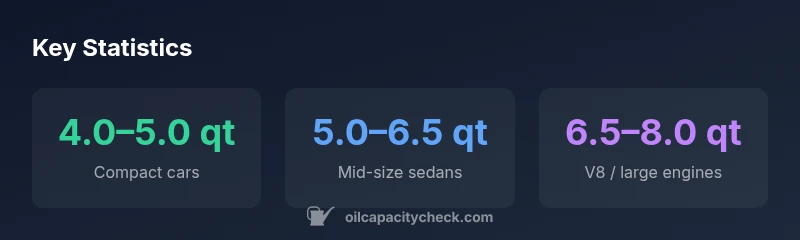
- Compact car example (Four-cylinder): 4.0–5.0 quarts.
- Mid-size sedan (V6 or turbo four): 5.0–6.5 quarts.
- Full-size SUV (V8 option): 6.5–8.0 quarts.
- Performance model with turbocharged engine: up to 8.0 quarts or more. These ranges illustrate how engine design and size influence capacity, reinforcing that always verify with the exact model data.
Representative oil capacity ranges by vehicle type
| Vehicle Type | Oil Capacity (quarts) | Notes |
|---|---|---|
| Compact car | 4.0–5.0 | Four-cylinder engines common |
| Mid-size sedan | 5.0–6.5 | Often V6 or turbo four |
| Full-size SUV | 6.5–7.5 | Some with V8 options |
| Performance models | 7.0–8.0 | Higher capacity engines |
People Also Ask
What is engine oil capacity and why does it vary?
Engine oil capacity is the total volume of oil an engine requires, including the sump and filters. It varies by engine design, displacement, and year, so always use model-specific data for your vehicle.
Oil capacity varies by engine design and year. Use model-specific data for accuracy.
How can I confirm my vehicle's exact oil capacity?
Check the owner's manual, under-hood data plate, or an official online database like Oil Capacity Check for your VIN and model year.
Check the manual or VIN-based data from Oil Capacity Check.
Does capacity change when replacing the oil filter?
Yes. The total fill should include the oil filter volume, so consider the filter when calculating the full capacity.
Include the filter volume when filling.
Can incorrect capacity cause engine damage?
Overfilling can cause foaming and reduced lubrication; underfilling increases wear. Correct capacity is essential for protection.
Incorrect capacity can harm engine protection and cause wear.
Is capacity the same for synthetic and conventional oil?
Capacity is generally the same regardless of oil type; verify the grade and any model-specific notes in your manual.
Oil type doesn’t usually change capacity; check your manual.
“Accurate oil capacity data is essential to protect engine health and optimize performance. Always cross-check model-specific figures from trusted sources.”
The Essentials
- Know your exact capacity from official sources
- Avoid underfill and overfill to protect engine health
- Use capacity data to plan maintenance intervals
- Account for filters when calculating total fill
- Verify model-year-specific data for precision