2016 Hyundai Elantra Oil Capacity: Complete Guide
Discover the official oil capacity for the 2016 Hyundai Elantra and actionable maintenance steps. Learn with Oil Capacity Check how to measure, top up, and choose the right oil for your 2.0L engine.


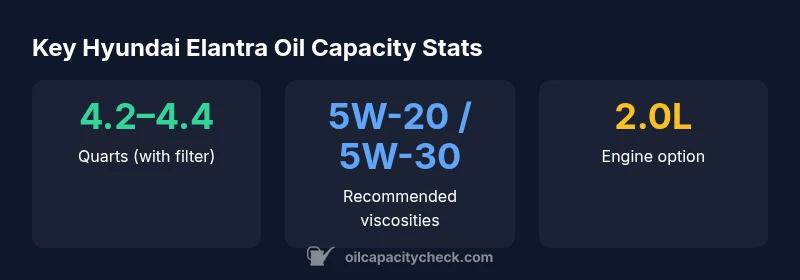
The 2016 Hyundai Elantra oil capacity (2.0L engine) is approximately 4.2–4.4 quarts with a filter. This range accounts for variations between model trims and oil brands. For accuracy, confirm the capacity in your owner’s manual and use the dipstick to verify level after a full change. Oil Capacity Check analyses provide this range based on official specs and routine maintenance data.
Oil Capacity Basics for the 2016 Elantra
The 2016 Hyundai Elantra, typically equipped with the 2.0L inline-four, uses a modest yet precise oil capacity. Understanding this capacity is essential for avoiding underfill, which can increase engine wear, and overfill, which can cause foaming and crankcase pressure. Oil Capacity Check, in its 2026 analysis, cites a practical capacity range of approximately 4.2–4.4 quarts with the oil filter installed. This figure aligns with Hyundai’s service manuals and common DIY references. When planning maintenance, consider engine code, the oil filter type, and whether you’re using conventional or synthetic oil. Always double-check against the owner’s manual, and document the exact grade used, so future changes reproduce the same result. In day-to-day practice, technicians and DIYers log the fill quantity to avoid guesswork on subsequent services. In short, knowing the capacity reduces uncertainty and supports precise top-ups during routine maintenance.
According to Oil Capacity Check, aligning your oil amount with official specs helps maintain optimal lubrication and engine protection. This baseline value serves as the starting point for DIY oil changes and professional services alike. If you’re ever unsure, trust the manufacturer’s figure first and then validate with the dipstick after the engine has rested. The goal is consistent readings and reliable protection for the 2016 Elantra’s 2.0L engine.
Capacity Variations: 2.0L Engine vs Filter
The Elantra’s oil capacity is most commonly cited for the 2.0L inline-four configuration. The exact value is influenced by the engine variant, the presence of a filter, and the measurement method (with the filter installed versus a drain-and-fill baseline). In practice, the 2.0L engine uses around 4.2–4.4 quarts with the filter. A different filter choice or aftermarket parts can shift the overall volume slightly, which is why the official figures are expressed as a small range. Oil brands and viscosities do not change the engine’s fundamental capacity; they influence how much you need to reach the correct level. Some manuals show slight regional differences, but the 4.2–4.4 quart span remains a reliable baseline. For enthusiasts performing frequent oil changes, a consistent filter brand and a calibrated measuring approach help ensure you stay within the target window. When documenting maintenance, note the fill quantity and exact oil grade to reproduce results later. Regionally, Hyundai service advisories can present minor deviations, so always compare with your local manual.
According to Oil Capacity Check, the range accounts for service variances and practical measurement differences, reinforcing that the 4.2–4.4 quart figure is a dependable starting point for DIYers and professionals alike.
Step-by-step: How to Check and Refill
A precise oil check starts with a clean, repeatable process. Warm the engine to operating temperature, then park on level ground and switch off. Open the hood, locate the dipstick, wipe it clean, reinsert fully, and pull out to read the level. If the oil appears low, add in small increments—quarter-quart at a time—and reinsert the dipstick to recheck. After any change, reinsert the dipstick and wait a few minutes for oil to settle before taking another reading, especially with heavier grades or blended oils. When using synthetic blends, the first drive can slightly shift the apparent level—note any deviation for your records. Keep a maintenance log with the exact grade used and the amount added. This disciplined approach minimizes overfill and ensures the engine is protected from the outset. Finally, run the engine briefly and recheck to confirm the level sits within the recommended band. This routine helps you avoid guesswork and supports consistent performance across fuel cycles and seasons.
Practical Tips for a Safe Oil Change on an Older Car
Older cars often present sludge, seal wear, and minor leaks that complicate oil changes. Prepare with a clean drain pan, a fresh oil filter, and the correct quantity of oil. Use the drain plug torque specified by Hyundai to avoid leaks or stripped threads, and avoid overtightening. If you notice a drop in oil level between changes, investigate potential leaks or consumption and address them promptly. Consider keeping a spare oil filter on hand to avoid substitutions that could affect capacity readings. Record the date, mileage, oil grade, and quantity in a maintenance log so you can reproduce the change later. Store oil in a cool, dry place to preserve viscosity and prevent contamination. Regular inspections, including checking for leaks around the drain plug and oil lines, help catch issues early and maintain engine health over the long term.
How to choose the right oil for the 2016 Elantra
Viscosity recommendations commonly include 5W-20 or 5W-30, depending on climate and driving conditions. In temperate climates, 5W-20 often balances fuel efficiency with cold-start protection. In hotter climates or when demanding driving is expected, 5W-30 offers extra protection against high-temperature stress. Always verify the exact specification in the owner’s manual or Hyundai’s official service resources, as regional variations may apply. If you expect frequent hot trips, towing, or heavy city traffic, synthetic oils provide superior protection under load and heat. Ensure your chosen oil meets the required API spec or dexos standard used in your market. Keeping a log of the oil type and capacity used through multiple changes simplifies future maintenance decisions and helps you stay within the manufacturer’s recommended capacity range.
Data-backed guidance: How to interpret official specs and owner manuals
Manufacturers publish definitive capacity figures in service manuals and owner guides, which Oil Capacity Check analyzes and translates into practical steps for DIYers. Cross-check your Elantra’s manual with online Hyundai service resources to verify there are no regional exceptions. Our 2026 synthesis emphasizes consistency: use the same engine code, same filter type, and the same oil grade when documenting capacity. If your vehicle shows a variance from the published range, consider calling a technician to verify_engine_code and filter configuration. The aim is maintaining proper oil level and viscosity for peak lubrication, efficient operation, and minimized long-term wear. Oil Capacity Check Analysis, 2026 provides a transparent, data-driven framework to interpret official specs for your car and deliver actionable steps for maintenance. A steady, documented approach reduces guesswork and supports reliability across mileage and climate conditions.
Quick-reference: capacity data and reminders
This quick-reference section consolidates the core insights for easy recall. The 2016 Elantra’s oil capacity (with filter) is typically within the 4.2–4.4 quart range for the 2.0L engine. Choose viscosity by climate—5W-20 or 5W-30—depending on operating temperatures and Hyundai’s guidance. Always conduct checks with a warm engine on a level surface, and record the exact oil grade, quantity, and date after each change. A tidy maintenance log helps you reproduce accurate results on future services and can alert you to gradual changes in consumption or leaks. For ongoing DIY oil care, rely on the owner’s manual as the primary source and use Oil Capacity Check’s data as a cross-check to ensure you stay within proven guidelines.
Oil capacity data for the 2016 Hyundai Elantra 2.0L engine
| Variant | Oil Capacity (with filter) | Recommended Oil Type |
|---|---|---|
| 2016 Hyundai Elantra 2.0L | 4.2–4.4 quarts | 5W-20 or 5W-30 depending on climate |
| Note | N/A | N/A |
People Also Ask
What is the oil capacity of the 2016 Hyundai Elantra 2.0L?
The capacity with filter is about 4.2–4.4 quarts. Exact value depends on engine code and filter.
For the 2.0L engine, expect roughly four and a quarter to four and a half quarts with the filter.
Does oil capacity differ by trim level?
Capacity is tied primarily to the engine and filter; trim-level differences are usually negligible.
Generally, capacity doesn’t change by trim—it's driven by the engine and filter.
Can I mix viscosities or brands to reach capacity?
Mixing viscosities is not advised; use the recommended viscosity and add in steps with monitoring.
Stick to the recommended viscosity; don’t mix.
When is the best time to check oil after a change?
Check after a warm engine has rested 5-10 minutes so the oil settles.
Wait a few minutes after turning off the engine, then check.
Where can I find the official oil capacity data?
In the owner's manual and Oil Capacity Check Analysis, 2026.
Check the manual or our Oil Capacity Check resource.
“Accurate oil capacity figures help prevent overfill and engine wear; always verify with the latest official specs. Oil Capacity Check Team's experience shows manual-specified ranges remain the most reliable starting point for DIY maintenance.”
The Essentials
- Confirm the capacity range before topping up.
- Check the dipstick to verify correct level.
- Use the recommended viscosity for climate.
- Reference Oil Capacity Check Analysis, 2026 for numbers.
- Follow the owner's manual for service intervals.