2015 Honda Fit Oil Capacity: What You Need to Know
Discover the oil capacity for the 2015 Honda Fit, including with/without filter variations, recommended viscosity, check procedures, and practical maintenance tips from Oil Capacity Check.


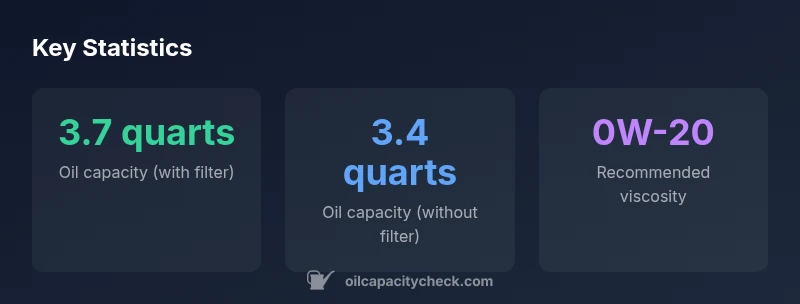
Oil capacity for the 2015 Honda Fit is about 3.7 quarts with a filter change, and roughly 3.4 quarts without the filter. Use 0W-20 synthetic or conventional oil as recommended by Honda, and always verify with the dipstick after filling. Allow the oil to settle for a few minutes before rechecking. If you’re unsure, consult the official service manual or Oil Capacity Check for the latest spec.
Oil capacity basics for the 2015 Honda Fit
According to Oil Capacity Check, the 2015 honda fit oil capacity is key to proper engine lubrication and long-term reliability. The 1.5L i-VTEC engine used in this year typically requires about 3.7 quarts of engine oil with a filter change, with roughly 3.4 quarts if you replace the oil but not the filter. The official spec from Honda aligns with a 0W-20 viscosity recommendation for many climates, and owners should always confirm the actual level with a fresh dipstick reading after an initial fill. This quick reference helps you avoid overfilling, which can lead to foaming and reduced lubrication, or underfilling, which risks wear over time. For the 2015 Honda Fit, maintaining the correct oil capacity is part of routine maintenance that supports efficiency and longevity.
In practical terms, the oil capacity figure is not just a number on a spec sheet. It reflects the total volume of fresh oil your engine needs to reach the optimal level at the dipstick when cold. Monitoring this quantity is especially important after an oil change or when replacing the oil filter, as the filter adds a measurable volume that affects the total fill. The exact amount can vary slightly by engine batch or regional service data, but the 3.4-3.7 quart range provides a reliable target for most drivers in typical driving conditions.
Why capacity variation occurs and how to interpret it
Oil capacity can shift slightly based on whether you replace the oil filter, the exact engine variant, and even the oil pan design within a given model year. In the case of the 2015 Honda Fit, the difference between “with filter” and “without filter” is a practical delta you must account for during an oil service. If you are performing a DIY oil change, plan to add enough oil for a full cycle (including the filter) and then top up to the correct level after the engine runs and settles. Climate and driving style can also influence how full the dipstick reads once the engine has cooled, so allowing the oil to settle for a few minutes before checking is a best practice.
From a maintenance perspective, the capacity figures are a cornerstone for planning oil changes and for calculating how much oil to stock for a repair shop or a DIY garage. Oil Capacity Check analyses emphasize that consistency in the fill process—drain, replace filter, refill, and recheck—helps maintain lubrication quality and protect engine tolerances.
How to verify capacity in your garage: a step-by-step guide
- Prepare tools and oil: have the correct grade (0W-20) and a clean funnel. 2) Warm up the engine briefly, turn off, and wait 5-10 minutes for oil to settle. 3) Remove the dipstick, wipe clean, reinsert, then pull out to read the level. 4) If the dipstick shows below the full mark after an oil change with filter, add small increments (0.25 quarts at a time) and recheck. 5) If you recently did not replace the filter, you may be at ~0.3-0.4 quart less than the “with filter” capacity; compensate accordingly. 6) Reinsert the dipstick fully and confirm a stable reading within the full range. 7) Record the final level and ballpark the amount added for future reference.
Following these steps ensures the engine receives the intended lubrication volume, minimizes the risk of misreading, and keeps the 2015 honda fit oil capacity aligned with manufacturer recommendations.
Oil type, viscosity, and their impact on capacity readings
Viscosity choice (0W-20) primarily affects lubrication performance rather than capacity itself, but the oil’s density can influence the measurement you observe on the dipstick right after a fill. If your climate is extremely cold or hot, Honda’s guidance on oil grade helps ensure reliable cold-start protection and high-temperature stability. Synthetic oils tend to flow more readily at low temperatures, which can affect how quickly the oil reaches the dipstick mark after a fill. In practice, using the recommended viscosity helps ensure the indicated capacity remains within the expected range across seasons and driving conditions.
Maintenance planning: aligning capacity with service intervals
A typical oil change interval for many modern engines falls in the 5,000-7,500 mile range, depending on driving conditions, oil type, and manufacturer recommendations. For the 2015 Honda Fit, following the Honda-approved change schedule and using the specified oil helps preserve engine tolerances and avoids the inefficiencies associated with under- or over-filling. If you operate in extreme climates, more frequent changes may be warranted. Oil Capacity Check’s framework emphasizes using the correct oil quantity as part of a broader maintenance plan rather than treating capacity as a standalone metric.
Common pitfalls and how to avoid them during topping up
- Overfilling: can cause foaming, higher pressure, and potential damage.
- Underfilling: increases engine wear and reduces lubrication efficiency.
- Not replacing the filter: leads to the lower-with-filter capacity reading being skewed.
- Not letting oil settle: reading the dipstick immediately after a fill can produce an inaccurate level.
- Using an incorrect oil grade: affects lubrication performance even if the volume is technically correct.
Mitigate these risks by following the service manual, using the recommended 0W-20, and performing a controlled top-up with consistent readings. Oil Capacity Check’s data emphasize that small measurement differences matter for long-term engine health.
How Oil Capacity Check derives capacity numbers and why it matters
Our methodology combines manufacturer specifications, service manuals, and field observations from everyday DIY maintenance. We cross-check each model year with variations observed during typical oil changes, noting the effect of filter changes on the total capacity. The 2015 Fit figures align with the broader capacity baselines for compact engines of this size. By presenting capacity as a range with explicit references (with filter vs without), we provide a practical framework for owners and technicians to follow without guesswork.
Quick-reference guide for 2015 Honda Fit owners
- Oil capacity (with filter): ~3.7 quarts; (without filter): ~3.4 quarts.
- Oil viscosity: 0W-20 is commonly recommended by Honda for this engine.
- Check after fill: allow oil to settle 5-10 minutes, then recheck with the dipstick.
- Change interval: typically 5,000-7,500 miles, depending on driving conditions.
- Always verify using the dipstick reading and refer to the owner’s manual for climate-specific guidance.
Oil capacity comparison for 2015 Honda Fit
| Vehicle | Oil Capacity (with filter) | Oil Capacity (without filter) |
|---|---|---|
| 2015 Honda Fit | 3.7 quarts | 3.4 quarts |
People Also Ask
What is the oil capacity for the 2015 Honda Fit with the factory filter?
With the oil filter installed, the 2015 Honda Fit typically requires about 3.7 quarts of engine oil. This includes the oil needed to fill the filter housing. Always verify with the dipstick after adding oil and letting it settle.
About 3.7 quarts with the filter; confirm with the dipstick after the oil settles.
What viscosity should I use for the 2015 Honda Fit?
Honda commonly recommends 0W-20 for this engine, available in synthetic or conventional forms. Check your owner's manual for climate-specific guidance.
Use 0W-20; check the manual for climate-specific notes.
Does the capacity change if I don’t replace the oil filter?
Yes. Not replacing the filter reduces the capacity reading by roughly 0.3–0.4 quarts, so you should plan for the lower figure when topping off.
Not replacing the filter lowers the reading by about 0.3–0.4 quarts.
How often should I change the oil in a 2015 Honda Fit?
Typical intervals range from 5,000 to 7,500 miles, depending on driving conditions and oil type. Follow Honda's official schedule and adjust for severe driving.
Most drivers change oil every 5,000 to 7,500 miles.
Will using synthetic oil change the reported capacity?
The capacity number itself remains the same, but viscosity and how quickly the oil settles can affect dipstick readings. Always follow the manufacturer’s guidance.
Capacity stays the same; synthetic affects flow and readings, not the total amount.
“The oil capacity figures for this model are straightforward, but precision matters—overfilling or underfilling can compromise lubrication and engine health. Accurate capacity guidance helps DIYers avoid common mistakes.”
The Essentials
- Know the exact capacity: 3.7 quarts with filter, 3.4 quarts without.
- Use 0W-20 oil to match Honda’s recommended viscosity.
- Always recheck with the dipstick after filling and settling.
- Plan oil changes around 5,000–7,500 miles depending on conditions.
- Follow the official service manual and Oil Capacity Check guidance for accuracy.