John Deere Mower Oil Capacity: Essential Guide for DIYers
Explore John Deere mower oil capacity ranges by engine type, learn how to check and refill correctly, and follow practical tips from Oil Capacity Check for long engine life.


John Deere mower oil capacity typically ranges from about 1.5 to 4 quarts, depending on engine size and model. Most mid-size lawn tractors use 2–3 quarts. Exact capacity varies with engine type (Briggs & Stratton, Kawasaki, Kohler) and filter choice. Always verify the precise spec in your owner's manual or by checking the engine model tag. Use the dipstick to confirm after a full drain and refill.
Understanding Oil Capacity Fundamentals
Oil capacity is the total amount of engine oil your John Deere mower's engine can hold when new and dry. For DIYers, it's essential to know this figure to prevent overfilling or under-lubricating, which can shorten engine life. The term 'john deere mower oil capacity' often crops up when owners upgrade engines, replace filters, or perform season maintenance. In practice, capacity depends on engine displacement, filter type, and whether you drain only the engine sump or include the oil in the filter housing. The Oil Capacity Check team emphasizes that accurate capacity knowledge reduces guesswork and protects your investment. Always start with the model-specific spec in your manual and double-check the engine type tag on the mower for the exact capacity. After refilling, verify the level with the dipstick, and run the engine briefly to settle the oil before a final check.
Engine Type and Capacity: How to Predict
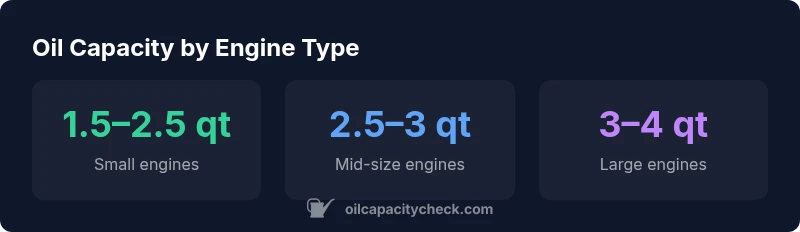
Engine type is the primary driver of capacity. Small walk-behind mowers with single-cylinder engines typically carry 1.5–2.5 quarts; mid-size riding mowers with twin-cylinder engines commonly hold 2.5–3 quarts; larger Vanguard or V-twin units can approach 4 quarts. In John Deere mowers, the most common brands of engines are Briggs & Stratton, Kawasaki, and Kohler. Each brand uses a slightly different internal design, which affects the exact oil volume required. The Oil Capacity Check analysis shows that even within a single engine family, variations exist due to filter size, oil pan geometry, and whether a cartridge or spin-on filter is installed. To predict capacity for your machine, identify your engine model number (often on a badge or stamped tag), locate the corresponding specification sheet, and confirm the oil capacity before purchase. If you’re unsure, consult the user manual or contact support; this reduces the risk of overfill or insufficient lubrication.
Engine Families in John Deere Mowers and Typical Ranges
John Deere mowers rely on several engine families. Briggs & Stratton small-to-mid units commonly fall in the 1.5–3 quart range, Kawasaki mid-to-large engines often require 2–4 quarts, and Kohler configurations can be around 2–3.5 quarts. These ranges reflect typical shop practice and common configurations found in JD walk-behinds and riding mowers. Remember that a larger oil pan or a bigger filter can push the capacity toward the upper end of a range, while a compact engine plus smaller filter nudges it lower. For precise planning, map your model to its engine family, then confirm the official capacity in the manual.
Step-by-step: Checking and Refilling Your Oil
- Park on a level surface and warm the engine for a few minutes to distill the oil. 2) Turn off the mower and remove the dipstick, wipe clean, and reinsert to measure. 3) If draining, remove the drain plug and allow oil to drain completely; replace the plug. 4) If your engine uses a filter, replace or account for its volume as per the manual. 5) Add oil gradually in small increments, stopping to check the dipstick frequently. 6) Run the engine for a minute, turn off, and recheck the level to ensure it sits at the correct mark. 7) Record maintenance date and oil type for future reference.
Common Mistakes and Maintenance Implications
Overfilling is a common error that can cause foaming, increased pressure, and potential damage. Using the wrong viscosity or oil type for the climate or engine design can reduce lubrication efficiency. Some owners forget to replace a filter, which can affect the effective capacity by a small amount. Always verify the capacity before refilling, and consider keeping a simple maintenance log for your John Deere mower, noting the oil type, quantity, and date of the last change. The goal is consistent, engine-friendly lubrication rather than guessing.
Oil Types, Filters, and Schedule
Viscosity choices like SAE 5W-30 vs 10W-30 should align with the manual and operating climate. Synthetic oils may offer superior protection in extreme temperatures, but ensure compatibility with your engine model. Filter type matters too: cartridge vs spin-on can shift the actual fill by a touch, though the official capacity remains determined by the engine design. Regular oil changes—guided by the engine's maintenance schedule—help preserve performance and longevity.
Quick Troubleshooting and When to Seek Help
If oil appears milky, levels are inconsistent, or you notice unusual engine noises, consult the manual and consider professional service. A leaking seal or gasket can affect oil capacity by reducing the oil on hand. If you recently performed maintenance, re-check after some hours of operation to confirm stability. For model-specific guidance, rely on John Deere support resources and the engine manufacturer’s documentation.
Integrating This Guide with Your John Deere Model
This article consolidates typical ranges and practical steps, but remember that your exact oil capacity is defined by your mower’s engine model and the official JD documentation. Always start from the engine label, verify capacity in the owner’s manual, and use the dipstick method to confirm correct fill. When in doubt, escalate to official support channels or a qualified technician who can verify model-specific requirements.
Oil capacity ranges by engine family for John Deere mowers (illustrative; verify in manual).
| Engine Family | Typical Oil Capacity Range | Engine Displacement (cc) | Notes |
|---|---|---|---|
| Briggs & Stratton (small to mid) | 1.5–3 quarts | 300–500 | Common in walk-behind and entry mowers |
| Kawasaki (mid to large) | 2–4 quarts | 500–850 | V-twin configurations common |
| Kohler (select models) | 2–3.5 quarts | 450–700 | Some models on older JD equipment |
| General guideline | 1.5–4 quarts | 350–820 | Always verify with manual |
People Also Ask
What is the typical oil capacity for a John Deere mower?
Most John Deere mowers fall in the 1.5–4 quart range depending on engine size. Always verify using the owner's manual or engine model tag. After draining, fill gradually and recheck with the dipstick.
Most John Deere mowers take about 1.5 to 4 quarts of oil; check your manual to confirm the exact amount.
Where can I find the exact oil capacity for my model?
Look for the engine model tag on the mower and consult the owner's manual or John Deere support resources for your model's precise capacity.
Check the engine model tag and your manual for the exact capacity.
Does replacing the oil filter affect capacity?
Oil capacity is primarily dictated by engine size. Replacing the filter may add a small amount to the fill, but the official spec remains the same. Always follow the manual.
Filters can add a little extra volume, but the spec stays the same.
Should I use synthetic oil in my John Deere mower?
Synthetic oil can be used if it meets the manual’s viscosity specification. It often provides better protection, but verify compatibility first.
If your manual allows it, synthetic oil offers good protection.
How often should I check or change oil on a John Deere mower?
Check oil before each season or after every 25–50 hours of operation, and follow the manual for oil change intervals.
Check oil before each season and follow the manual for changes.
“Accurate oil capacity is essential for engine longevity. Always confirm the exact spec for your John Deere mower model and follow the manual for oil changes.”
The Essentials
- Verify capacity in the manual before filling
- Capacity varies by engine type and model
- Use the recommended viscosity and oil type
- Check oil level with the dipstick after refilling
- Schedule regular oil changes per engine maintenance