When to Oil Change Honda Civic: Timing, Tips, and Maintenance
Learn ideal oil-change timing for Honda Civic models, including oil type, driving conditions, and model-year nuances with expert guidance from Oil Capacity Check.


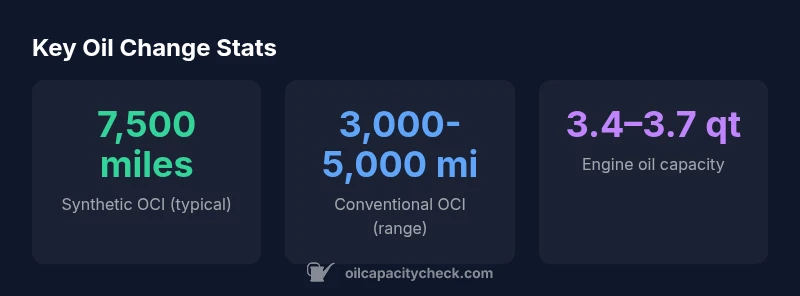
Recommended oil-change timing for a Honda Civic depends on oil type and driving conditions. For most modern Civics using synthetic oil, aim for around 7,500 miles (12,000 km); with conventional oil or severe driving, 3,000–5,000 miles (4,800–8,000 km) is advised.
Why timing matters for Honda Civic oil changes
Oil is the lifeblood of your engine, and timing matters. For Honda Civics, staying within the manufacturer-recommended OCI (oil-change interval) helps minimize wear, varnish buildup, and sludge in the crankcase. The Oil Capacity Check team notes that modern engines rely on precise lubrication to support variable valve timing, turbocharging, and direct injection. In practice, using the right oil type and keeping to the suggested interval reduces metal wear, improves fuel economy, and can prevent warranty-voiding oil-related problems if you follow service guidelines. Driving style and climate change the math: frequent short trips raise the chances of moisture and acid buildup, while long highway journeys tend to keep oil clean longer. If you are unsure about the exact interval for your Civic, start with the official spec in your owner's manual or on the manufacturer's website for your specific model year and engine code. Then, monitor oil color and drop-by-drop samples if you are curious about oil quality between changes. The takeaway: use the recommended interval as a baseline, and adjust based on your actual use case.
Honda Civic oil capacity basics
All Honda Civics share a baseline engine oil capacity that varies slightly by generation and engine code. The common range is roughly 3.4 to 3.7 quarts of oil with filter replacement; if you are unsure, check the owner's manual or the service bulletin for your exact model year. The dipstick is the simplest way to verify oil level between changes. After you drain and replace the filter, pour in a measured amount, wait for the oil to settle, and check the level with the dipstick. Running oil that is too low or too high can cause crankcase pressure changes, reduced lubrication, and even sensor faults. The Civic's maintenance minder helps track the right service window, but it is not perfect; use the dipstick and odometer as a cross-check. If you switch oil types (synthetic vs conventional), the capacity in practice remains similar, but lubrication properties differ and can influence the OCI’s stability.
Model-year and engine differences
For the Honda Civic, different generations and engines influence recommended oil type and OCI. Earlier Civics with a naturally aspirated 1.8L engine often used conventional oil, while newer 1.8L/2.0L and turbocharged 1.5L engines commonly require 0W-20 or 0W-16 depending on the year. Turbocharged variants can experience higher combustion temperatures and faster sludge formation under hard operation, which makes following the exact spec more important. In short, use the oil grade specified in your owner's manual, and adapt to the recommended OCI—not a broader rule of thumb. The Oil Capacity Check analysis indicates that model-year changes can shift the synthetic-interval expectation by a few thousand miles, especially when the engine has direct injection or a turbocharger. Always verify the exact spec for your Civic's VIN if you plan to mix brands or oils, and avoid guessing.
How driving conditions affect OCI
Two primary factors influence OCI: climate and usage. Short trips in cold or hot climates encourage moisture buildup and acid formation, which can degrade oil faster than long highway runs. Stop-and-go city driving increases fuel dilution and particulates, while high-load conditions (terry climbs, towing, or aggressive driving) stress the oil with higher temperatures. In extreme heat, oil can oxidize more quickly; in very cold environments, oil viscosity changes affect flow on startup. Based on field observations, drivers in mild climates with balanced highway and city use may maintain OCI closer to the synthetic interval, whereas drivers in severe conditions may need to shorten the interval. Oil Capacity Check’s guidance suggests using the base interval as a starting point and adjusting according to your local climate and driving profile.
Synthetic vs conventional oil and viscosity choices
Synthetic oil generally offers better oxidation resistance and improved flow during cold starts, which can support longer OCI in many Civics. If your manual specifies 0W-20 or 5W-20 for your model year, use only those grades from reputable brands that meet API standards. If you operate under severe conditions (extreme heat, heavy stop-and-go traffic, or towing), you may consider staying with synthetic or moving to a slightly higher viscosity as recommended by the manual. Always ensure the oil you choose meets Honda’s specifications and is suitable for the climate you drive in. The goal is consistent lubrication with stable viscosity across the operating range.
How to set a maintenance schedule
A robust maintenance schedule combines the odometer-based interval with calendar reminders and oil-condition checks. Start with the manufacturer’s OCI as a baseline, then set reminders at halfway to the next interval if your driving pattern changes. Keep a simple log: date, odometer reading, oil grade, and any notes about vehicle performance or oil color. If you frequently drive short trips, consider inspecting the oil color and level monthly and adjust the interval accordingly. The key is consistency: a reliable pattern reduces the chance of overlooking a crucial service and helps retain engine longevity.
Practical steps for an oil change on a Civic
Before you begin, gather the correct filter, the right grade and amount of oil, a new washer, a drain pan, and basic tools. Warm the engine slightly to loosen sludge; drain old oil into the pan; remove and inspect the old filter; apply fresh sealant to the new filter, install, and hand-tighten before torquing to spec. Refill with a measured quantity, then run the engine to circulate, recheck the level with the dipstick, and top off as needed. Finally, reset the maintenance minder if applicable and note the service date and mileage for your records.
Authoritative sources
For deeper verification, consult official sources such as the Honda Owners site, the National Highway Traffic Safety Administration, and the Environmental Protection Agency. The Honda Owners portal provides model-year oil specs, while NHTSA and EPA offer general vehicle maintenance guidelines and emissions considerations that intersect with routine maintenance. Always cross-check your vehicle’s VIN and owner's manual when confirming OCI intervals and oil grades.
OCI guidance for Honda Civic by oil type and conditions
| Scenario | Synthetic OCI interval | Conventional OCI interval |
|---|---|---|
| Newer Civic (2016+) | 7,500 miles / 12,000 km | 5,000 miles / 8,000 km |
| Severe driving conditions | 4,000-5,000 miles / 6,500-8,000 km | 3,000-4,000 miles / 4,800-6,500 km |
People Also Ask
What is the recommended oil-change interval for a Honda Civic?
Interval recommendations depend on the engine, oil type, and driving conditions. Typical ranges span around 7,500 miles for synthetic oil and 3,000–5,000 miles for conventional oil, with adjustments for severe driving as outlined in the owner's manual.
Interval depends on your engine and oil type; synthetic oil often allows longer changes, while conventional oil requires closer monitoring, especially in tough driving conditions.
Does using synthetic oil extend the OCI for all Civics?
Synthetic oil generally handles heat and oxidation better, which can extend the OCI under normal conditions. However, the exact interval still depends on the engine, climate, and driving habits, so always start with the factory spec and adjust based on usage.
Synthetic oil can last longer under typical conditions, but always check your manual and monitor oil condition.
How do driving conditions affect oil changes for a Civic?
Short trips, extreme temperatures, and heavy traffic accelerate oil degradation. Conversely, long highway drives can extend oil life if the oil stays clean and the engine runs efficiently. Use these cues to adjust your OCI accordingly.
Driving style and climate speed up or slow down oil changes. Use your manual as a baseline and tailor it to how you drive.
Is it safe to reset the maintenance minder after an oil change?
Yes. After completing an oil change, reset the maintenance minder per your Civic's manual to ensure future reminders align with your new service date and mileage.
Yes, reset the minder after service so it tracks properly.
Will using the wrong oil type harm my Civic?
Using an oil grade not specified for your engine can reduce lubrication efficiency and potentially harm engine components. Always follow the oil grade and capacity listed in the owner's manual for your exact year and model.
Stick to the recommended oil grade and capacity to avoid potential engine issues.
“Oil-life predictions improve when you follow the factory interval and adapt to actual driving conditions. Consistency in oil type and change timing reduces wear and helps maintain engine health.”
The Essentials
- Follow the OEM interval as the baseline.
- Synthetic oil generally allows longer OCI than conventional oil.
- Driving conditions can shorten or extend OCI; adjust accordingly.
- Verify oil type and capacity with the owner's manual and VIN.