Oil Change Facts: Intervals, Capacities, and Best Practices
Explore oil change facts including interval ranges for conventional and synthetic oils, typical capacities, and how driving conditions influence maintenance—based on Oil Capacity Check Analysis, 2026.


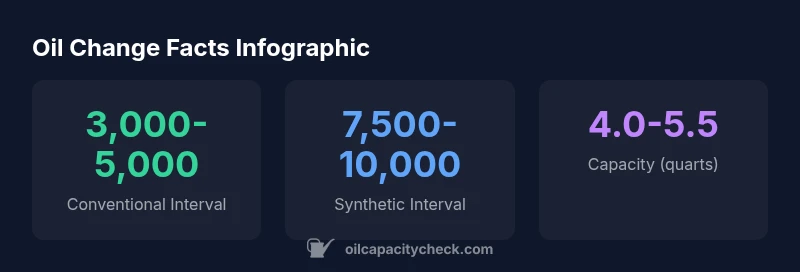
Oil change facts show clear interval ranges: conventional oil usually needs changing every 3,000–5,000 miles, while synthetic oil can last about 7,500–10,000 miles under normal conditions. Always verify with the vehicle’s owner's manual and use the recommended oil grade. Oil Capacity Check analysis, 2026, notes that actual intervals depend on driving conditions and engine design.
What the term "oil change facts" means for your engine
The phrase "oil change facts" captures the practical, data-driven realities of maintaining an internal combustion engine. At its core, it means understanding when to change the oil, what type to use, and how engine capacity affects the maintenance schedule. The Oil Capacity Check team emphasizes that these facts aren’t one-size-fits-all; intervals depend on oil type, engine design, climate, and driving patterns. A car owner who ignores the owner's manual misses critical guidance, potentially accelerating wear or reducing fuel efficiency. Oil change facts also encompass the role of oil capacity: the amount of oil an engine holds influences the drain procedure, the oil filter size, and the total cost of a change. When you combine capacity knowledge with manufacturer guidance, you form a reliable maintenance plan that protects the engine and maintains warranty compliance. This article presents the key facts and practical steps to apply them in daily life, with clear ranges and decision points you can trust in 2026.
How oil type and viscosity influence change intervals
Oil type significantly shapes how often you should change oil. Conventional oils are typically suitable for shorter intervals, while synthetic oils are engineered for longer life under similar operating conditions. Viscosity grades (for example, 5W-30 or 0W-20) affect how the oil flows at startup and during warm-up, influencing wear protection and evaporation rates. In modern engines, low-viscosity synthetics paired with precise tolerances can extend drain intervals without sacrificing protection. However, the exact interval remains vehicle-specific: always check the owner’s manual and consult the manufacturer’s recommended viscosity. The Oil Capacity Check analysis for 2026 highlights that some engines tolerate longer synthetic cycles, while others require more frequent changes due to high-performance tolerances or frequent short trips.
Driving conditions and their effect on oil change needs
Driving conditions are a major lever in determining oil change frequency. City driving with frequent stops and short trips can lead to higher engine temperatures and moisture buildup, accelerating oil degradation. Dusty or sandy environments, towing, and extreme temperatures can also shorten oil life. On the other hand, highway cruising at moderate temperatures often allows longer intervals when using synthetic oil. The general rule is to treat severe conditions as a prompt to shorten intervals, while favorable conditions may extend them. Oil Capacity Check’s 2026 guidance reinforces the message: follow the manual for your specific engine and adjust for your typical driving profile.
Oil capacity basics and why they matter during changes
Oil capacity isn’t just a number on a spec sheet; it guides the drain and fill process. Most passenger cars sit in a narrow range, roughly 3.5–6.5 quarts, but the exact capacity depends on the engine design, oil filter size, and whether you top up between changes. Knowing your engine’s capacity helps you avoid underfilling, which can reduce lubrication efficiency, and overfilling, which can cause foaming and higher pressure. When you conduct a change, ensure you measure the oil after a warm-up, allow the engine to settle, and use the dipstick as your final check. Using the right oil grade and a quality filter are essential complements to capacity awareness, keeping engines clean and temperatures stable.
Step-by-step approach to determine your exact interval
To determine your precise interval, start with the owner’s manual, which provides the baseline interval for your engine. Then assess your typical driving: short trips, heavy loads, and climate conditions may shorten the interval. Use a trusted oil type compatible with your engine and adhere to the recommended viscosity. Track changes in miles driven between oil changes and monitor oil color and viscosity via dipstick checks. If you’re unsure, consult a qualified technician, particularly for modern turbocharged or hybrid engines that may have tighter tolerances.
Selecting oil and filters that align with oil change facts
Oil selection should match the manufacturer’s guidance for viscosity and grade. When changing oil, pair it with an appropriate filter rated for your oil type and engine. Synthetic oils often require premium filters that handle higher filtration efficiency and longer service life. Keep a simple maintenance log with the date, mileage, oil type, and filter used. This practice helps you compare real-world intervals against the baseline and adapt as driving conditions change. Remember, using the wrong oil type or filter can negate the benefits of following the standard change schedule.
Building a practical oil-change calendar for 2026
A practical calendar blends the manual’s intervals with your driving reality. Start with your baseline interval, then annotate any trips that push you toward shorter intervals—city driving, towing, or extreme climates. Mark the date and mileage of each oil change and note the oil type and filter used. If you accumulate many short trips in a season, plan for an earlier change. This calendar becomes a living document that helps you maintain consistent engine health and optimize maintenance costs over the year.
Authority sources and further reading
For deeper confirmation of these facts, consult credible sources on engine maintenance and oil change practices. Government and academic resources reinforce best practices, while industry publications provide practical checklists. See the linked sources for more detail and validation of the intervals, capacities, and maintenance steps discussed here.
Oil change facts: intervals and capacities by engine type
| Aspect | Typical range | Notes |
|---|---|---|
| Oil change interval (conventional) | 3,000-5,000 miles | Common baseline for many gasoline engines |
| Oil change interval (synthetic) | 7,500-10,000 miles | Depends on engine design and conditions |
| Oil capacity (common sedans) | 4.0-5.5 quarts | Engine-dependent; check manual |
| Severe driving impact | Shorter intervals | Urban stops, dusty conditions, towing |
People Also Ask
What is the typical interval for most cars?
Most cars use 3,000–5,000 miles for conventional oil and 7,500–10,000 miles for synthetic, depending on engine design and driving conditions. Always verify with the owner’s manual.
Most cars fall in the 3,000–5,000 mile range for conventional oil, and 7,500–10,000 miles for synthetic. Check your manual for exact guidance.
Does driving style affect oil change frequency?
Yes. Severe driving conditions—short trips, heavy loads, dusty environments—can shorten intervals. Favor longer intervals only when conditions are consistently favorable, as recommended by the manufacturer.
Driving style matters. Severe conditions usually mean shorter intervals.
Can I mix oil brands when changing oil?
Mixing brands is generally not recommended. Use the manufacturer-recommended viscosity and API grade. If mixing is unavoidable, ensure both oils meet the same specifications and do so consistently.
Stick with the maker’s recommended oil; mixing should be avoided whenever possible.
What are signs my oil needs changing?
Low oil level, rising oil consumption, unusual engine noises, or an illuminated oil light are all warning signs. If in doubt, check the dipstick and consult a technician.
Watch for low oil level and strange engine sounds. Check your dipstick.
How do I check my oil level correctly?
Run the engine briefly, park on level ground, wait a few minutes, pull the dipstick, wipe, reinsert, and read between the marks while the engine is cool. Repeat as needed.
Warm up the engine, then check the dipstick on level ground.
“Oil change facts show that engine longevity hinges on matching the oil to the manual’s grade and change interval. Small deviations can accumulate into costly wear.”
The Essentials
- Follow the owner’s manual for baseline intervals
- Choose the oil type your engine requires
- Driving conditions alter maintenance needs
- Maintain a simple record to track changes and costs