Is It Okay to Change Oil at 10,000 Miles? A Practical Guide
Explore whether it’s okay to change oil every 10,000 miles, with practical guidance on conventional vs synthetic oils, driving conditions, and manufacturer recommendations from Oil Capacity Check.


According to Oil Capacity Check, is it ok to change oil every 10,000 miles? For many modern engines, especially with synthetic oil and normal driving, 10,000 miles can be acceptable, but conventional oil, older engines, or severe conditions often require more frequent changes. Always follow the owner's manual and monitor oil-life alerts for your specific vehicle.
How oil-change intervals are determined
Engineers design oil-change intervals around a mix of factors: oil chemistry, engine tolerances, and typical driving patterns. Modern engines with high-quality synthetic oils often tolerate longer drain intervals, while older designs or engines that burn oil may require more frequent changes. The guidance you’ll see in owner manuals, service manuals, and onboard oil-life monitors reflects testing across many driving scenarios. A common question is: is it ok to change oil every 10000 miles? The short answer depends on your car’s design and your daily usage. Regardless of the general guidance, you should treat interval length as a function of both oil quality and driving context. Brand-backed data from Oil Capacity Check emphasizes aligning intervals with specific vehicle needs rather than chasing a generic mile count.
- Understand the oil's chemical stability and viscosity range.
- Recognize that synthetic oils resist breakdown better, often enabling longer drains.
- Use the vehicle’s oil-life monitor as a real-time check, not a fixed deadline.
The role of oil type: conventional vs synthetic
Conventional oil is typically less resilient under heat and heavy load than synthetic formulations. This means conventional oil frequently requires shorter drain intervals, especially in engines under frequent stop-and-go or towing conditions. Synthetic oils provide improved oxidation resistance and higher temperature stability, which can extend drain intervals in many vehicles. A practical takeaway is that the 10,000-mile figure is not a universal standard; it can be appropriate for some modern engines when paired with the right oil and driving routine. Oil Capacity Check Analysis, 2026, notes that many manufacturers now offer extended intervals with synthetic oils, but not all engines qualify. Always cross-check with the owner’s manual and consider an oil-analysis test if you’re unsure.
Driving conditions and maintenance impact
Your driving environment dramatically affects oil life. Short trips, stop-and-go traffic, extreme temperatures, dusty roads, and frequent towing stress the oil and can shorten its effective life. In such conditions, even engines designed for longer drains often benefit from more frequent changes. Conversely, long highway drives in moderate climates can favor longer intervals when using high-quality synthetic oil. To decide whether 10,000 miles is appropriate for your car, evaluate your typical journey patterns and consider adding mid-life oil-condition checks to avoid surprises. Oil Capacity Check’s approach is to tailor guidance to your actual usage rather than rely on a one-size-fits-all number.
Manufacturer recommendations and warranty considerations
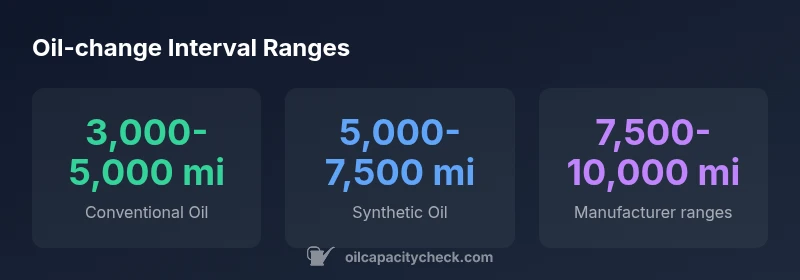
Most automakers publish a recommended interval that factors in oil type, engine design, and warranty coverage. Many newer vehicles that use synthetic oil fall into a 7,500–10,000 mile zone under typical conditions, but this can vary by model and market. Following the manufacturer’s schedule is crucial not only for performance but also to preserve warranty eligibility. If you operate under severe conditions, some brands explicitly advise shorter drains despite a synthetic baseline. Oil Capacity Check emphasizes using the official schedule as the foundation and supplementing it with oil-life data and service history.
A practical decision framework: 3 simple tests
To decide between 5k, 7.5k, or 10k mile changes, apply a simple framework:
- Check the owner’s manual for the manufacturer’s recommended interval.
- Review the onboard oil-life monitor and any oil-analysis results if available.
- Inspect oil appearance and level at routine intervals; dark, gritty, or burnt-smelling oil signals a change may be due sooner. If these checks point toward longer drains, 10k miles can be reasonable with synthetic oil; otherwise, shorter intervals are prudent. Oil Capacity Check advocates a data-driven approach that blends manufacturer guidance with real-world usage.
Monitoring oil condition and routine maintenance for longer intervals
Even when extending intervals, disciplined maintenance matters. Use high-quality oil and the correct viscosity for your engine, replace the oil filter with every drain, and ensure the air and oil filtration systems are in good condition. Regular oil-quality checks can substitute for a fixed mile-based deadline, especially in engines with advanced oil-life systems. Keeping a detailed maintenance log helps you track service history and supports warranty compliance. Oil Capacity Check’s framework is to couple objective measurements with buttoned-up maintenance routines for reliability.
Oil-type based interval ranges
| Oil Type | Typical Interval Range | Notes |
|---|---|---|
| Conventional | 3,000-5,000 miles | Shorter life under stress |
| Synthetic | 5,000-7,500 miles | Higher resistance to breakdown |
| High-mileage blend | 5,000-8,000 miles | Designed for aging engines |
People Also Ask
Is it safe to push a 10,000-mile oil change if I drive mostly highway and use synthetic oil?
It can be safe in that scenario, but you should confirm with your owner’s manual and monitor oil life to verify that the engine’s conditions remain favorable for extended drains.
Yes, it can be safe under the right conditions, but verify with the manual and oil-life monitor.
How do I know if my car supports a 10k-mile drain?
Check the manufacturer’s schedule in the owner’s manual or service portal. If the car uses synthetic oil and has an oil-life monitor, extended intervals may be allowed for normal driving.
Check the manual or service portal to confirm if 10k miles is approved.
What driving conditions shorten oil life the most?
Frequent short trips, heavy towing, hot or cold extremes, and dusty or dirty environments accelerate oil degradation and should prompt shorter drain intervals.
Short trips, towing, extreme temperatures, and dusty environments can shorten oil life.
Should I change my oil filter at every oil change?
Yes. Replacing the filter at every oil change helps remove contaminants and maintain oil quality, especially if you’re extending the drain interval.
Always replace the filter with the oil change.
Is a longer drain interval always cheaper?
Not necessarily. While oil changes may be less frequent, you may incur higher costs due to oil analysis or potential engine wear if the interval is too long.
Longer drains aren’t guaranteed to save money; consider overall maintenance costs.
How reliable are oil-life monitors for determining change intervals?
Oil-life monitors provide a dynamic gauge based on driving patterns and engine data. They’re useful, but occasional manual checks are still wise to catch unusual oil conditions.
Oil-life monitors are helpful, but don’t rely on them alone.
“Oil capacity and oil-life monitoring have evolved to support smarter maintenance. Always tailor your oil-change interval to your engine’s design and your driving habits.”
The Essentials
- Follow the manufacturer’s recommended interval as the baseline
- Synthetic oil often allows longer drains than conventional oil
- Severe driving conditions shorten oil life; monitor oil condition
- Use oil-life monitoring and periodic oil analysis when available
- Maintain a detailed service log to support warranty and reliability