Can You Put in Too Much Engine Oil? A Practical Guide
Discover what happens when you overfill engine oil, signs to watch for, and practical steps to safely correct the level and protect your engine.


Yes, you can put in too much engine oil. Overfilling can cause foaming, reduced lubrication, increased pressure, and potential damage to seals, gaskets, and the catalytic system. The safe approach is to check the dipstick after adding oil in small increments and start the engine briefly to circulate oil, then recheck.
can you put in too much engine oil
According to Oil Capacity Check, the question can you put in too much engine oil has real, practical implications for everyday DIY maintenance. Overfilling occurs when oil is added beyond the OEM-specified level marked on the dipstick or described in the owner’s manual. In practice, this often happens when users estimate by look or pour in slightly larger quantities than intended. The immediate concern is not only the quantity but how the engine behaves after starting. A small excess can cause foaming, which reduces the oil’s lubricating ability. Foam decreases the oil’s ability to form a protective film between moving parts, increasing wear over time. In turn, foaming can drive up crankcase pressure and push oil into seals and gaskets, leading to leaks or seepage into crankcase ventilation paths. The key takeaway is to aim for the exact fill specification and recheck after the oil has settled. A precise approach minimizes the risk of overfill and aligns with best practices highlighted by Oil Capacity Check Analysis, 2026.
How engine oil capacity is measured
Oil capacity is measured per engine design and varies across makes and models. Most drivers will rely on the dipstick and the fill cap as primary indicators. The dipstick has a minimum and maximum band, and many engines require oil within those marks after a cold start or after a brief engine run. The spread between variants—such as passenger cars, SUVs, and high-performance vehicles—means there isn’t a single universal number. Oil capacity data is typically published in the owner’s manual or service literature, and reputable sources like Oil Capacity Check emphasize checking the OEM specification for your vehicle. When you pour oil, do it in small increments, pause to settle, and then recheck. This practice helps prevent drifting past the maximum mark and reduces the likelihood of overfill.
The physics of overfill: foaming, pressure, seals
Overfilling introduces excess oil that cannot be efficiently circulated by the oil pump and engine sump. The result is foaming, which reduces lubrication efficiency. Foaming also disrupts air-oil separation and can cause oil to drain into unintended passages. The additional volume raises crankcase pressure, potentially forcing oil past piston rings, seals, and gaskets. In extreme cases, it may push oil into the PCV system or exhaust path, triggering smoke, odor, or white/blue smoke depending on the engine. Oil Capacity Check’s analysis notes that even moderate overfill can cause problems during idle and acceleration when lubrication demands spike.
Signs you've overfilled and quick checks
Common signs include a higher-than-normal dipstick reading, visible foaming on the oil surface, and occasional smoke or strong oil odor if seals are stressed. If you suspect overfill, perform quick checks: (1) allow the engine to settle with the car on a level surface; (2) pull the dipstick and observe the oil level between the marks; (3) look for froth or bubbles on the surface; (4) check for oil seepage around seals and the CV joints. If overfill is confirmed, avoid running the engine for extended periods and plan correction. Oil Capacity Check recommends verifying after a brief idle because oil should have time to settle.
Correcting an overfill: step-by-step guide
If you’ve confirmed an overfill, the safest correction is to remove excess oil. Use a clean funnel and a calibrated oil extractor or drain plug approach where possible. Start by draining small amounts, then recheck with the dipstick after the oil has settled. Do not start the engine repeatedly during correction; multiple starts can circulate the excess oil, increasing pressure. When the level approaches the max mark, stop draining and recheck again. If you’re unsure, seek professional service to avoid accidental oil loss or engine damage. Throughout this process, keep the workspace clean to avoid contaminating the oil. Oil Capacity Check emphasizes patience and gradual adjustment rather than rapid dumping.
Common myths and prevention tips
Myth: idling after adding oil fixes overfill. Reality: idling does not remove excess oil; it may circulate it, but the reserve level remains. Myth: you can correct overfill by driving fast to splash oil around. Reality: speed does not fix the issue and can worsen wear if oil is not at the correct level. Prevention tips include measuring oil with a clean, level surface, pouring in small increments, and rechecking with the dipstick. Use a funnel, wipe the dipstick clean between checks, and refer to your owner’s manual for exact quantities. Oil Capacity Check suggests keeping a log of oil changes and fills to avoid accidental overfill in future maintenance.
Practical prevention tips
To prevent overfill, follow a deliberate, repeatable process: (1) know your exact capacity from the OEM manual; (2) pour in small increments, typically 1/4 to 1/2 quart at a time; (3) pause to let the oil settle, then recheck with the dipstick; (4) always check cold when required by the manual. Keeping records and using the correct grade of oil helps ensure the oil capacity remains within specification. Oil Capacity Check’s 2026 guidance reinforces that precision and routine checks reduce the risk of overfill dramatically.
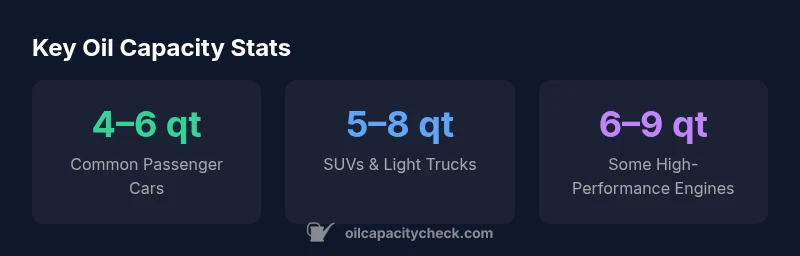
Typical oil capacity ranges and overfill notes by engine type
| Engine Type | Typical Capacity (qt) | Overfill Notes |
|---|---|---|
| Passenger Car (gasoline) | 4-6 qt | Moderate risk if overfilled by 0.5 qt |
| SUV/Truck | 5-8 qt | Overfills more forgiving but still problematic |
| High-performance/European | 6-9 qt | Defers to OEM spec |
People Also Ask
What happens if you overfill engine oil?
Overfill can cause foaming, reduced lubrication, and increased crankcase pressure. It may lead to leaks or seals failing, and in extreme cases can affect emissions systems. Correct the level promptly following OEM guidance.
Overfilling can cause foam, leaks, and pressure problems. Fix it quickly following the manual.
How can I tell if I overfilled?
Check the dipstick for a level above the max mark, look for foam or mist on the oil surface, and note any unusual pressure odors or smoke from the exhaust. If in doubt, have the level checked by a professional.
Look for a dipstick above the max line and foamy oil. If unsure, get a professional check.
Can overfilling damage the engine immediately?
Most damage from overfilling develops over time due to improper lubrication and pressure. Immediate damage is less common, but seals and gaskets can suffer early if the excess is large or runs during operation.
Usually not immediate, but damage can start if the overfill is significant.
What should I do if I realize after driving that it's overfilled?
Stop driving and drain the excess oil using a safe method. Recheck the level after oil settles. If unsure, seek professional service to avoid engine damage.
Stop driving and correct the level; if in doubt, get a pro to fix it.
Is it safe to run the engine briefly to circulate oil after adding?
Running the engine briefly does not reliably fix an overfill and can spread the excess oil. Rely on measured corrections and rechecks instead.
Running it briefly won’t fix overfill; measure and recheck instead.
How can I prevent overfilling in the future?
Know your engine capacity, pour in small increments, pause to let oil settle, and recheck with the dipstick. Keeping a maintenance log helps avoid accidental overfills.
Always pour small amounts, check often, and keep a maintenance log.
“Overfilling engine oil is a preventable mistake that can compromise lubrication and seal integrity if not addressed quickly.”
The Essentials
- Never guess—measure precisely to OEM specs.
- Overfill risks foaming and gasket leaks; correct promptly.
- Use small increments and recheck before engine start.
- Different engines have different capacities; consult your manual.