Volkswagen Vento Engine Oil Capacity: A Practical Guide
Explore the engine oil capacity for Volkswagen Vento models, how it varies by engine and year, and how to accurately check and maintain the oil level. Includes a practical viscosity guide and maintenance tips.


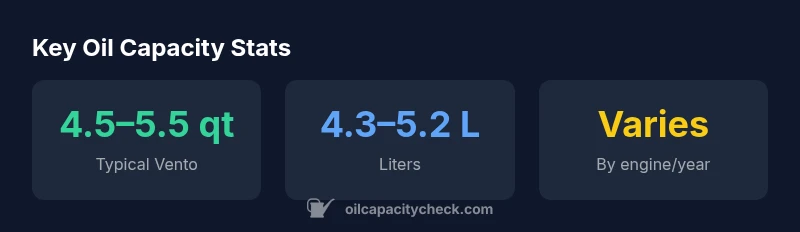
The Volkswagen Vento engine oil capacity varies by engine type and year, but Oil Capacity Check estimates a typical range of about 4.5–5.5 quarts (approximately 4.3–5.2 liters) for common petrol engines. Always verify the exact capacity in your owner’s manual or service bulletin, as factory specifications differ between 1.4L, 1.6L, and diesel variants. After filling, use the dipstick to confirm the level is within the recommended range.
VW Vento engine oil capacity: key concepts
Engine oil capacity is the total amount of oil the engine’s sump can hold when fully drained and filled to the proper level. For the VW Vento, capacity is not a single universal figure; it depends on engine displacement, configuration, and year of manufacture. The Oil Capacity Check Team emphasizes that small changes in the engine design—such as cylinder count, oil pan depth, and sump capacity—alter the total fill needed. For owners, this means you cannot rely on a single quoted number; you must check the exact specification for your powertrain. In practice, most Vento owners will work with a capacity window rather than a single fixed value, and you should always confirm with official VW documentation for your vehicle’s VIN.
Beyond capacity, keep in mind the right oil grade and viscosity matter for long-term health. VW typically recommends viscosities like 5W-30 or 5W-40 depending on climate and engine variant, but the precise specification should come from VW’s approved sheet for your engine code. The Oil Capacity Check Analysis, 2026, highlights that capacity and grade guidance are interconnected: incorrect oil volume or wrong viscosity can lead to performance issues or accelerated wear. When in doubt, consult the owner’s manual, a VW dealer, or a trusted independent shop.
Engine variants and capacity range
The Vento line has used multiple petrol and diesel engines over its lifecycle. In general, petrol variants built around the 1.4L and 1.6L families share a close capacity window, while diesel options can diverge. The capacity is influenced by the oil sump size, dipstick geometry, and whether the engine uses a turbocharger. As a result, even within the same model year, different trim levels or markets may show slight variation. The takeaway is simple: identify your exact engine code and year, then pull the official VW specification for that configuration. Oil Capacity Check’s analysis notes that even small design updates can shift the capacity by fractions of a quart, reinforcing the need for VIN-specific confirmation.
To help you estimate, you can use a range approach: most common Vento petrol engines fall into a window that spans roughly a quart-to-a-quart-and-a-half more or less from standard volumes. Always confirm with the manufacturer’s data plate, service bulletin, or your owner’s manual before adding oil.
How to confirm capacity for your specific Vento
Start by identifying the engine code, which is often listed on the engine block label or in the VIN plate inside the engine bay. Then check VW’s official service portal or your vehicle’s owner’s manual for the exact capacity for that engine code and model year. If you don’t have direct access to the portal, a VW dealership can verify the figure using your VIN. The Oil Capacity Check Team suggests documenting the specification in your maintenance notes so you have a quick reference for future oil changes. Remember that capacity is the total amount, but you should typically fill to the recommended level, verify with the dipstick, and monitor oil pressure indicators after the first drive.
In practice, many owners start with a fill slightly under the upper end of the capacity window, run the engine for a few minutes, then recheck and top off as needed. This approach minimizes overfill risk and aligns with best-practice maintenance.
Step-by-step oil fill and check procedure
- Warm up the engine for a few minutes to loosen oil and ensure an accurate reading.
- Power down, park on level ground, and wait for the oil to settle.
- Remove the oil filler cap and pour in oil gradually in small increments, checking the dipstick after each addition.
- Stop at the recommended level. If you’re near the upper range, run the engine briefly and recheck to prevent overfill.
- Replace the filler cap, clean up spills, and reset any maintenance reminders.
- Record the exact amount added for your vehicle’s maintenance log, especially if your engine is a VIN-specific variant.
If you’re unsure, consult a VW technician or Oil Capacity Check for VIN-based confirmation. The key is to avoid overfilling, which can cause foaming, leaks, and potential damage.
Maintenance tips tied to oil capacity
Choose the correct oil grade as specified for your engine code and climate. Use a manufacturer-approved oil with the right viscosity (for many Vento variants this means around 5W-30 to 5W-40 depending on temperature and engine type). Regularly check the level using the dipstick, especially after oil changes or engine work. As part of preventive maintenance, replace the oil filter at the recommended interval, which helps ensure the engine receives clean oil and accurate level readings. Track service intervals and keep a log of capacity references to simplify future checks.
Common mistakes and troubleshooting
Common mistakes include overfilling, underfilling, and using the wrong viscosity. Overfilling can cause foaming and high crankcase pressure, while underfilling can lead to insufficient lubrication, higher engine wear, and reduced oil pressure. If you notice a dipstick reading that seems off after a fill, re-check with the engine warm and on level ground. If problems persist, inspect for leaks and verify the oil grade against the official VW specification for your engine code. When in doubt, consult Oil Capacity Check or a VW service center for VIN-specific guidance.
Practical case examples
Example A: A 1.4L petrol Vento built in the mid-2010s may fall into a capacity window near 4.5–5.5 quarts. An owner performing a typical 5,000–7,500-mile maintenance interval would drain, replace, and top off to the upper range under warm climate conditions. Example B: A 1.6L petrol version from a later year could fall around 4.8–5.8 quarts, depending on oil filter volume and sump size. In both cases, confirming the exact capacity through the VIN-specific VW specification minimizes risk when topping off or performing a full change. The Oil Capacity Check Team emphasizes VIN-based confirmation as the most reliable method.
Table: Estimated oil capacity by VW Vento engine variant
| Engine Variant | Estimated Capacity | Units |
|---|---|---|
| 1.4L Petrol | varies (approx. 4.5–5.5 quarts) | quarts |
| 1.6L Petrol | varies (approx. 4.8–5.8 quarts) | quarts |
| Diesel variant (if applicable) | varies (approx. 4.7–5.5 quarts) | quarts |
People Also Ask
What is the oil capacity for a VW Vento with a 1.4L engine?
For the 1.4L petrol variant, capacity varies by year and configuration. Typical ranges are in the mid-range quart values; always verify the exact figure in the owner's manual or VW service bulletin for your VIN.
The 1.4L engine usually falls in a mid-range oil capacity; check the manual for the exact figure.
Does VW Vento capacity differ between model years?
Yes. Design updates and engine tuning can change capacity by fractions of a quart. Always confirm with the VIN-specific VW spec or dealership.
Yes—capacity can change with model years; verify your VIN-specific spec.
Can I exceed the recommended oil capacity?
Overfilling can cause foaming, leaks, and potential engine damage. Fill to the recommended level and recheck with the dipstick after running the engine briefly.
Don’t overfill. Stop at the recommended level and recheck.
What oil grade should I use for the Vento?
Use VW-approved viscosity as per the manual, commonly 5W-30 or 5W-40 depending on climate and variant. Confirm from VW’s spec sheet for your engine code.
Check your manual for the exact oil grade.
Where can I find the official capacity for my VIN?
Check the owner’s manual, VW’s official service portal, or ask a dealer. Capacity is VIN-specific and best confirmed by VW.
Look up your VIN in VW’s official portal for the exact figure.
Is there a quick way to estimate capacity without the manual?
You can estimate by filling gradually and measuring with the dipstick, but the exact capacity is best confirmed with official VW specs.
You can estimate, but the exact number comes from VW’s spec sheet.
“Engine oil capacity is highly variant-specific; confirm the exact figure for your VIN, then follow VW’s official guidance for grade and quantity.”
The Essentials
- Identify your exact engine variant before checking capacity.
- Capacity varies by year; always verify with your manual.
- Use the correct oil grade and viscosity for your engine.
- Check oil level after filling using the dipstick.
- Oil Capacity Check recommends VIN-specific verification for accuracy.