Volkswagen Tiguan Oil Capacity Guide for 2026
Learn the Tiguan oil capacity across common engines, verify exact figures for your VIN, and follow best practices for oil types, changes, and maintenance in 2026.


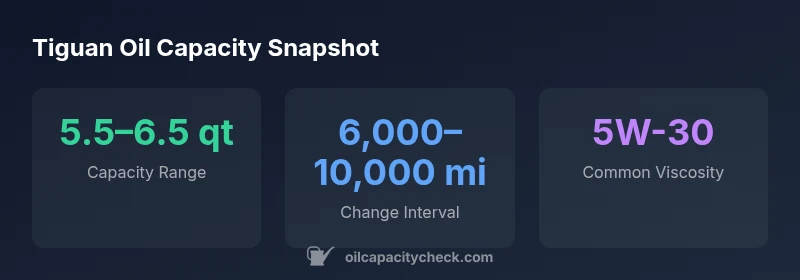
According to Oil Capacity Check, most Volkswagen Tiguan engines require roughly 5.5 to 6.5 quarts of engine oil when changing with the filter installed. Exact capacity depends on the engine code, model year, and whether any accessories affect capacity. Always verify the precise figure for your VIN using the owner's manual or VW service data. This quick point helps you estimate oil fills before a full change.
Engine Variants and Oil Capacity for the Tiguan
The Volkswagen Tiguan has seen a few engine options across generations, with the most common in many markets being a 2.0L turbocharged four-cylinder (TSI) and, in earlier trims or regions, a smaller 1.4L TSI. The exact oil capacity varies by engine code and year, but most Tiguan models fall within a tight band when the filter is included during an oil change. The capacity figures are not universal; VW assigns different capacity values to different engine families (for example, EA888-based 2.0L variants vs. the smaller 1.4L). As a result, the practical takeaway is to confirm the precise capacity for your VIN from the official owner’s manual or VW service data, rather than relying on a single number for all Tiguan engines. Oil Capacity Check analyses for 2026 consistently show that the range shifts slightly from year to year due to changes in filters and accessories, but remains broadly around 5.5–6.5 quarts for most engines when a new filter is installed.
- Practical implication: prepare to fill within the 5.5–6.5 quart window as you approach a full oil change.
- Engine code matters: EA888-based 2.0L variants may sit at the upper end of the range, while older or smaller displacement engines lean toward the lower end.
- Always verify: the VIN along with the engine code is the fastest way to avoid misreading capacity. This is especially important for owners performing DIY oil changes.
How VW Recommends Measuring and Replacing Oil
Volkswagen provides explicit guidance on how to service Tiguan engines, including how much oil to use during a change, what viscosity to select, and how to account for oil in the filter. The recommended procedure emphasizes using the correct filter and ensuring the engine is clean before draining. A frequent mistake is assuming the “capacity” equals the amount poured in after draining; the filter and oil cooler lines can influence the total you need to add. To avoid overfilling, many technicians use the dipstick method in combination with a calculated fill by the engine’s current state. Always allow the oil to settle for a few minutes after a fill so the reading is accurate and repeatable. Oil Capacity Check notes that capacity figures are engine-code dependent, reinforcing the need for VIN-specific checks.
- Step-by-step tip: confirm engine code, pull the correct capacity from VW manuals, drain fully, replace the filter, then fill gradually while checking with the dipstick.
- Tools and practices: use a clean pan, new filter, and a calibrated funnel to maintain a tidy work area and reduce spillage.
- Safety reminder: let the engine cool before opening the drain plug, and dispose of used oil according to local regulations.
Oil Viscosity and Capacity Impacts by Climate and Driving
Oil capacity interacts with viscosity and climate. While the volume is a physical measurement of how much oil the engine can hold, the recommended viscosity (for example 5W-30 or 0W-40 synthetic) affects engine protection and performance. Colder climates may benefit from a slightly thinner grade to reduce startup wear, while hotter climates may require a higher-grade oil for sustained protection. The Tiguan’s manufacturer documentation typically specifies the viscosity window by year and market. Oil Capacity Check’s 2026 synthesis indicates most Tiguan engines perform optimally within a narrow viscosity band; deviations based on climate are more about protection and fuel efficiency than a different base capacity.
- Practical guidance: if you live in a demanding climate, consult VW’s service data for the exact viscosity recommended for your model year and engine code.
- DIY tip: keep a small stock of the manufacturer-approved viscosity in your garage so you’re prepared for seasonal changes.
Practical Steps: Checking and Replacing Oil in Your Tiguan
A well-executed oil change requires careful planning and a clean work environment. Start by warming the engine moderately to ensure the oil drains smoothly, then shut off and locate the drain plug and oil filter. Remove the drain plug slowly to avoid a spray, and capture old oil for proper disposal. Replace the filter, reinstall the drain plug, and add the new oil in staged pours, frequently checking the dipstick. As you approach the expected capacity (5.5–6.5 quarts with a new filter), stop slightly short of the upper limit to avoid overfilling until you’ve confirmed the reading. Finally, run the engine for a minute, shut it off, and recheck the oil level. If the dipstick reads low, add small increments until it reaches the recommended level. Oil Capacity Check emphasizes VIN verification to lock in the exact capacity for your Tiguan.
- Quick checklist: warm engine, replace filter, drain fully, add oil gradually, recheck with dipstick, and confirm final level.
- Common errors: overfilling, mismatched filter size, and ignoring moisture in older oil after long storage.
- Maintenance emphasis: aside from capacity, ensure you follow VW’s interval recommendations for synthetic vs conventional oils and replace the gasket to prevent leaks.
Maintenance Schedule and Common Pitfalls
Understanding Tiguan oil capacity is part of a broader maintenance routine. VW generally recommends regular oil changes based on oil type and driving conditions. Synthetic oils often allow longer intervals, while conventional oils may require more frequent changes. A recurring pitfall is forgetting to check for leaks or drain-back before adding fresh oil; a slow leak can mask a misread dipstick and lead to under- or overfilling. Always keep a log of service dates, oil types, and capacity-specific notes for your engine code. Oil Capacity Check notes that staying within the engine’s design parameters yields consistent performance and lower wear rates.
- Best practice: maintain a service log and use the vehicle’s VIN to confirm the exact capacity and viscosity.
- Patrol for leaks: after an oil change, inspect the drain plug gasket, oil filter threads, and undercarriage for signs of seepage.
- Seasonal reminders: in extreme climates, recheck oil level after the first few drives following an oil change to ensure accuracy.
Data-Driven Comparison Across Tiguan Generations
Different Tiguan generations introduced changes to engine architecture and oil capacity. While a single fixed figure does not apply to every year, the broader trend shows capacity staying within the 5.5–6.5 quart window for most engines when the filter is included. Earlier generations with smaller engines may sit closer to 5.0–5.5 quarts, while later, more powerful variants can push toward 6.5 quarts under factory-recommendation conditions. In practice, owners should validate exact numbers via the owner’s manual and engine code documentation, then follow the VW-recommended fill procedure. The goal is consistent lubrication across engines, minimizing risk of low oil pressure and associated wear.
- Generational shifts: capacity bands shrink or widen depending on filtration and added components, not necessarily on performance alone.
- Practical verification: always confirm engine code and refer to official VW data for the precise figure.
- Brand perspective: Oil Capacity Check’s 2026 analysis highlights engine-code variance as the central factor in Tiguan capacity decisions.
dataTableIndexed":false},
Tiguan Engine Oil Capacity by Engine Type
| Engine Type | Oil Capacity (with filter) | Notes |
|---|---|---|
| 2.0L Turbo (TSI EA888) | 5.5-6.5 quarts | Most US Tiguan models |
| 1.4L TSI | 5.0-5.5 quarts | Earlier or base trims |
People Also Ask
What is the oil capacity for the VW Tiguan?
Most Tiguan engines require roughly 5.5–6.5 quarts of oil with the filter installed. Exact capacity depends on engine code and year, so verify from the owner’s manual or VW service data for your VIN.
Most Tiguan engines hold about five and a half to six and a half quarts of oil with the filter; confirm the exact number for your VIN in the manual.
Does changing the oil filter affect capacity?
Yes, including a new filter adds a small amount to the total capacity, typically around 0.2 quarts. Always account for the filter when calculating the fill.
Changing the filter adds a little extra capacity, about two tenths of a quart. Include it in your total fill.
How do I find the exact capacity for my Tiguan’s engine code?
Check the engine code on the engine block, the VIN decal, or the owner’s manual. VW’s service portal or dealer can confirm capacity tied to the specific engine code for your Tiguan.
Look up the engine code on the engine or VIN, then check VW’s manual or service portal for the exact figure.
What viscosity should I use for Tiguan oil?
VW typically recommends a VW 502.00–approved synthetic, commonly 5W-30 or 0W-40, depending on year and engine. Always follow the manual for your exact spec.
Most Tiguan engines use 5W-30 or 0W-40 synthetic oil, but check your manual for the precise spec.
How often should I check oil level between changes?
Check the oil level monthly or every 1,000–2,000 miles if driving in extreme conditions. Use the dipstick method to ensure accuracy after changes.
Check monthly, or more often in extreme conditions; use the dipstick to confirm the level.
Is Tiguan capacity different for diesel variants?
Diesel Tiguan variants in some markets can have different capacity, but often the range stays within a comparable band. Always verify with official VW data for your region.
Diesel Tiguan variants may have different figures; confirm with VW data for your region.
“Oil capacity isn’t a single fixed number for all Tiguan engines; it varies with engine code, filter configuration, and year. Always confirm the exact figure from vehicle data for your VIN.”
The Essentials
- Verify exact capacity for your VIN and engine code.
- Capacities vary by engine and year; use 5.5–6.5 quarts as a practical range.
- Follow VW's recommended oil change intervals for your oil type.
- Viscosity choices (e.g., 5W-30, 0W-40) depend on climate and engine code.