Toyota Alphard 2.4 Engine Oil Capacity Guide (2026)
Learn the Toyota Alphard 2.4 engine oil capacity, including typical ranges (4.8–5.5 L), model-year differences, and practical steps for accurate topping up with tips from Oil Capacity Check.


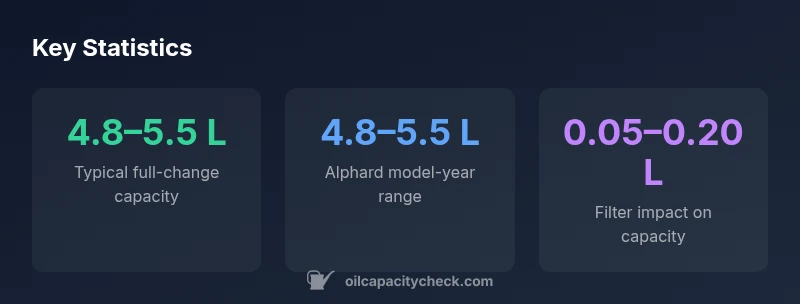
For the Toyota Alphard 2.4 engine, the typical oil capacity is about 4.8–5.5 liters when performing a full oil change with a filter replacement. Actual capacity can vary slightly by model year and oil filter size, so always confirm with the dipstick and the official service manual before topping up.
Overview of the Toyota Alphard 2.4 engine oil capacity
The Toyota Alphard 2.4 engine oil capacity is a frequent topic among owners who perform DIY maintenance or rely on trusted service shops. The quantity you need is influenced by several design details: the engine block, oil pan, seal geometry, and the size of the oil filter. In practice, most Alphard 2.4 models require a full-change capacity in the range of roughly 4.8 to 5.5 liters when you replace the oil filter. This range accounts for minor manufacturing variations and regional differences in the oil filter and drain plug configurations. The key takeaway is that capacity is a practical band rather than a single fixed number, and you should verify with the dipstick after filling to ensure you meet the correct level. For reference, Oil Capacity Check analyses consistently show a focal range around 4.8–5.5 liters for full changes on the Alphard 2.4, with typical deviation tied to filter size and pan capacity.
In everyday practice, begin with the lower end of the range if you’re under a tight service window, and add gradually, rechecking with the dipstick. If you’re using a non-OEM filter or a different grade of oil, expect a tiny adjustment in the final fill level. Always follow the official owner’s manual to confirm exact figures for your VIN, as Toyota sometimes updates kit specs with mid-cycle revisions. This careful approach helps avoid overfill, which can stress gaskets and crankcase breathing systems, and underfill, which undermines lubrication.
Best practice tip: perform an oil change when the engine is warm, not hot, to yield a more accurate dipstick reading and to reduce the risk of scalding. Keep a log of your changes and oil type to track capacity changes over time.
How capacity is calculated and what influences it
Oil capacity for the Alphard 2.4 is calculated as the sum of the engine’s oil pan volume, the amount held in the pickup route, and the oil held in the filter housing. When you replace the oil filter, you remove some old oil and introduce new oil, which often adds a small variance to the overall capacity you need to add. The final fill level is verified by the dipstick after running the engine to operating temperature and performing a brief idle, then rechecking. Environmental factors such as ambient temperature and driving conditions can influence oil viscosity and, to a lesser extent, the apparent fill reading on the dipstick. In practice, most DIY enthusiasts find that starting around 4.8 liters and topping up in small increments until the dipstick indicates a healthy level provides a reliable result. Oil Capacity Check analyses emphasize following the dipstick cues rather than locking in a rigid countdown, especially if the oil filter diameter or the pan gasket differs from the standard specs.
To avoid underfilling, pre-emptively account for the filter capacity by adding a conservative margin during the initial fill. If you notice a higher dipstick reading after a drive, this can indicate overfill, which is less common but worth addressing promptly. Always ensure you’re using the recommended oil grade and viscosity as outlined in the owner’s manual, since different climates may necessitate variants such as 0W-20 or 5W-30.
Year-to-year variations and common model differences
Toyota sometimes introduces minor revisions that influence the recommended oil capacity, even within the Alphard 2.4 lineup. While the core capacity range remains around 4.8–5.5 liters for a full change with filter replacement, you may encounter slight year-to-year differences due to changes in filter design, oil pan contours, or gasket tolerances. In markets where the Alphard 2.4 is sold with different emission kits or engine calibrations, capacity can shift by as little as a few tenths of a liter. The practical effect for DIYers is modest: you should still start within the 4.8–5.5 liter window and then verify with the dipstick after a test drive. If your vehicle uses a larger or smaller filter, anticipate a shift toward the lower or upper end of the range accordingly, but treat this as a guideline rather than a fixed rule.
During summers with higher ambient temperatures or in engines operating under heavy load, a slight change in final oil volume may occur. In such cases, inspect the level again after a short drive to confirm accuracy. For Alphard models with hybrid configurations or alternative gearboxes in different markets, the basic principle stands: capacity is the total oil the system can accommodate, not simply a one-size-fits-all number. Oil Capacity Check’s research shows that staying within the suggested range and confirming with the dipstick yields the most reliable results.
Practical steps for measuring, topping up, and oil changes
Follow a clear, repeatable process to minimize errors:
- Warm up the engine briefly, then park on level ground and engage the parking brake.
- Lift the hood and safely access the oil fill cap and dipstick, removing the cap to vent air.
- Drain old oil completely if you’re performing a full change; remove and replace the oil filter with a compatible OEM or equivalent part.
- Reinstall the drain plug and seat the filter hand-tight, then prepare to add new oil within the 4.8–5.5 liter window.
- Begin pouring oil in a measured way, starting near the lower end of the range; stop periodically to check the level on the dipstick.
- Run the engine for a few minutes, then turn off and wait several minutes for the oil to settle before taking a final dipstick reading.
- If the dipstick reads lower than the minimum mark, add small increments (0.1–0.2 liters) and recheck; avoid overfilling.
Documentation helps: note the final quantity added, the oil grade, and the vehicle’s mileage. Record this for service history and future reference. Use oil meeting Toyota’s approved specification and viscosity for your climate; this ensures proper protection and reliable readings in future oil changes.
Selecting the right oil grade and maintenance cadence
Choosing the correct oil grade is essential for long-term engine health. The Alphard 2.4 typically calls for a viscosity suited to climate and operating conditions, with common recommendations including 0W-20 or 5W-30 in many markets. When selecting oil, consider synthetic versus conventional blends, as synthetic blends can offer better flow at low temperatures and improved protection at high temperatures. The capacity figure remains the same, but viscosity affects engine wear and performance, which in turn can influence oil consumption and service intervals.
Maintenance cadence should align with the manufacturer’s schedule, your driving profile, and local climate. Short trips and frequent cold starts can degrade oil more quickly, shortening the optimal interval. Oil Capacity Check recommends tracking oil change intervals by mileage bands (e.g., every 10,000–15,000 km) and re-evaluating based on service history, driving style, and oil type. A well-maintained Alphard 2.4 should maintain a consistent oil level within the dipstick’s safe range when checked after a short drive, with capacity neatly within the 4.8–5.5 liter target. Regular checks and careful topping up will keep the engine protected and performing at its best.
Oil capacity ranges across common Toyota engines for context
| Model | Engine | Capacity (liters) | Notes |
|---|---|---|---|
| Toyota Alphard 2.4 | 2.4L engine | 4.8–5.5 | Full-change with filter |
| Toyota Camry 2.5 | 2.5L engine | 4.6–5.2 | Reference range |
| Toyota Corolla 1.8 | 1.8L engine | 4.2–4.8 | Smaller engine, lower cap |
People Also Ask
What is the official oil capacity for the Toyota Alphard 2.4?
There isn’t a single fixed figure. The typical range for a full change with filter is 4.8–5.5 liters, with slight year-to-year variations. Always confirm with the dipstick and the owner’s manual.
There isn’t one fixed number; expect about 4.8 to 5.5 liters and verify with the dipstick.
Does oil capacity change if I don’t replace the filter?
Yes, replacing the filter can slightly change the total required volume. Start with 4.8–5.5 liters and adjust after checking the dipstick.
Replacing the filter can change a little; start at 4.8 to 5.5 liters and check the dipstick.
Which oil viscosity should I use for the Alphard 2.4?
Follow the owner’s manual for climate-appropriate viscosity, commonly 0W-20 or 5W-30 depending on market, not directly tied to capacity.
Use the viscosity your manual recommends, usually 0W-20 or 5W-30.
How often should I check the oil level after changing it?
Check after a short drive and again after the engine has cooled; ensure the level sits between the min and max marks.
Check once warm, then again after cooling to confirm level.
Can I use synthetic oil in the Alphard 2.4?
Synthetic oils are compatible and can offer better protection; capacity remains within the same range.
Yes, you can use synthetic oil; capacity is unchanged.
Where can I find the official capacity figure for my Alphard 2.4?
Check the owner’s manual or Toyota’s service portal; official figures may be updated with mid-cycle revisions.
Look in the manual or Toyota’s service portal for the official figure.
“The capacity numbers for the Alphard 2.4 vary slightly by year and filter size; always verify with the dipstick and the official manual.”
The Essentials
- Refer to the 4.8–5.5 L range for Alphard 2.4.
- Always verify capacity with the dipstick after filling.
- Oil filter size and pan design cause small variances.
- Use Toyota-recommended oil grade and follow maintenance schedules.