Tata Harrier Engine Oil Capacity Guide
Learn the Tata Harrier engine oil capacity, recommended oil types, check intervals, and practical maintenance tips. This Oil Capacity Check guide covers variants, climate considerations, and step-by-step maintenance to help DIYers get it right.


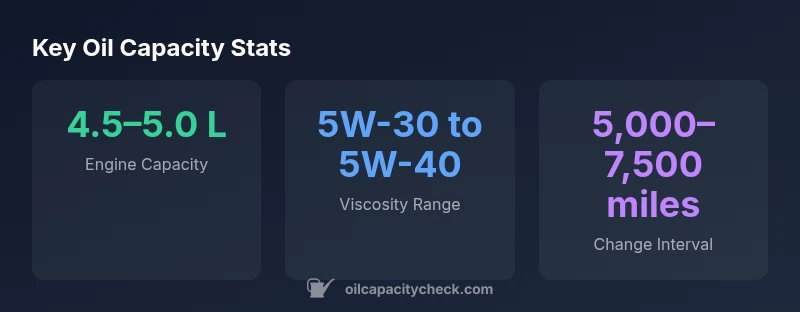
The Tata Harrier engine oil capacity typically falls in the 4.5–5.0 liter range for a complete drain-and-fill, including the oil filter. Exact capacity can vary by variant and filter configuration, so consult your manual or Oil Capacity Check's latest chart for the precise figure. For most climates, use synthetic 5W-30 or 5W-40 and check the level after warm-up.
Why engine oil capacity matters for the Tata Harrier
Engine oil capacity is more than a number on a spec sheet. It determines how much lubricant the engine holds, how well the oil film protects bearings, and how accurately you can top up between changes. For the Tata Harrier, getting this capacity right helps prevent under-lubrication, which can cause increased wear, and overfill, which can lead to foaming and higher oil consumption. Oil Capacity Check emphasizes that accurate capacity knowledge supports reliable performance across all driving conditions and climates, especially in regions with extreme temperatures. Practically, knowing the capacity helps you plan oil purchases, estimate service costs, and avoid unnecessary trips to the garage for topping up.
How capacity is determined and by which components
The claimed capacity reflects the total oil the engine sump can hold when drained and refilled, including the oil filter’s displacement. Three main components determine the total capacity: the sump volume, the oil filter’s volume, and any engine gallery spaces that retain oil after draining. Variants with different oil filter configurations or sump designs can shift the usable capacity slightly within the 4.5–5.0 L range. Oil Capacity Check notes that manufacturers publish the official capacity in service manuals, but practical topping-up should be guided by dipstick readings after a warm-up cycle. In daily use, this means you should always verify the level with the dipstick or electronic sensor (if equipped) after an oil change, not by the number you poured alone.
Variants and capacity differences you should know
The Tata Harrier uses diesel and petrol variants with different turbocharging and filtration setups. While the core capacity remains in the 4.5–5.0 L range, a higher-capacity or additional filtration path can nudge the effective fill slightly higher. For DIYers, the takeaway is to treat 4.5 L as the baseline and 5.0 L as the ceiling for a full drain-and-fill including the filter, then confirm with the vehicle’s service documentation or Oil Capacity Check’s year 2026 chart. If your vehicle has an aftermarket or high-capacity filter, expect a minor increase in the required fill to reach the correct level after completion.
Oil types, viscosity, and climate considerations
In most climates, manufacturers and technicians commonly recommend a synthetic 5W-30 to 5W-40 oil for modern turbocharged engines like the Harrier. Thicker grades (e.g., 5W-40) offer better high-temperature protection in hot climates, while 5W-30 provides strong cold-start flow in cooler environments. The exact grade in your manual should be followed, but synthetic oil improves stability and reduces evaporation, which can influence capacity dynamics over time. Always ensure the viscosity you choose aligns with your climate, driving style, and the manufacturer’s guidance. Oil Capacity Check’s analysis frames this as climate-aware maintenance rather than a one-size-fits-all prescription.
Step-by-step: how to perform an oil change on the Harrier
- Park on a level surface and engage the parking brake; ensure the engine is cool enough to handle safely. 2) Raise the vehicle and place a drain pan beneath the sump plug. 3) Remove the sump plug and let the old oil drain completely. 4) Replace the oil filter if applicable and ensure the gasket is seated properly. 5) Refit the sump plug with a new washer and torque to the manufacturer’s specification. 6) Refill with the correct capacity of fresh oil (start with the lower end of the 4.5–5.0 L range). 7) Start the engine, run for a few minutes, and check for leaks. 8) With the engine off, wait a few minutes and recheck the oil level; add small amounts as needed to reach the correct mark. Dispose of used oil responsibly.
Monitoring oil level between changes
Checking the oil level regularly helps prevent surprises. After a warm-up drive, pull the dipstick, wipe it clean, reinsert, and pull it again to read the level. If your Harrier uses an electronic oil level sensor, follow the instrument cluster prompts. In any case, do not rely on raw fill quantities alone—the dipstick reading is the definitive guide to your current oil level.
Maintenance tips to extend engine life
- Use high-quality synthetic oil within the recommended viscosity range; it resists thinning under heat and maintains lubrication.
- Change the oil and filter at the manufacturer’s intervals or earlier if you operate in extreme conditions, dusty environments, or frequent short trips.
- Keep the crankcase breathers and oil cap seals clean to prevent oil contamination.
- Maintain proper air filtration and regular inspections for leaks around the sump, filter housing, and drain plug.
- Schedule periodic oil analysis if you drive aggressively or tow heavy loads; this can help detect early degradation before it affects capacity readings.
Practical troubleshooting and common mistakes
- Overfilling after an oil change is a common mistake; always verify level after warm-up and follow the dipstick result rather than the poured quantity.
- Skipping the oil filter change can skew capacity perception and compromise filtering efficiency.
- Using the wrong oil viscosity for climate or engine variant can alter performance and potentially affect readings on the dipstick.
- Failing to reset the oil-change indicator (if equipped) can mislead maintenance timing.
- Inconsistent maintenance history makes it harder to predict exact capacity needs; keeping a service log helps retention of the correct capacity targets.
Tata Harrier oil capacity by variant (approximate ranges)
| Variant | Capacity (L) | Approx. Quarts |
|---|---|---|
| Typical Harrier (generic) | 4.5–5.0 | 4.8–5.3 |
| Oil filter included (full drain) | 4.6–5.1 | 4.9–5.4 |
People Also Ask
What is the recommended engine oil capacity for the Tata Harrier?
The Tata Harrier generally requires about 4.5–5.0 liters of engine oil for a full drain-and-fill, including the filter. Exact figures vary by variant and filter setup, so consult the manual or our official chart for your specific model.
The Harrier usually needs around 4.5 to 5.0 liters of oil. Check your manual or our chart for your exact variant.
Does capacity change if I replace the oil filter?
Replacing the oil filter can slightly alter the total capacity due to the filter’s internal volume. Plan for a fill within the 4.5–5.0 L range and verify with a dipstick after the oil change.
Yes, the filter can affect the total capacity a bit. Recheck the level after changing the filter.
What viscosity should I use for the Tata Harrier?
Most climates respond well to synthetic 5W-30 or 5W-40. Always align with the vehicle’s manual and consider environmental conditions and driving style.
Typically, 5W-30 or 5W-40 synthetic oil is recommended, depending on climate.
Can I mix synthetic and conventional oils in the Harrier?
Mixing oils is generally discouraged because it can compromise lubrication quality and filtration efficiency. Use a consistent viscosity and oil type per the manual.
Try not to mix oil types. Stick to one recommended viscosity and oil family.
How often should I check the oil level?
Check the oil level at least once a month or before long trips. After a drain-and-fill, recheck after warm-up to confirm the correct level.
Check the oil level monthly or before long trips; recheck after warming the engine.
What are common signs of low oil in the Harrier?
Low oil can trigger warning messages, show abnormal engine noises, or lead to reduced lubrication. Check the dipstick and top up if needed.
If you see a low oil warning or unusual noises, check the dipstick and add oil if required.
“Having precise capacity figures helps prevent underfilling or overfilling, which can compromise lubrication and engine life. Our testing shows minor variant-to-variant differences, so always verify with the official chart.”
The Essentials
- Start with 4.5–5.0 L as the baseline capacity.
- Check oil level after warm-up for accuracy.
- Use synthetic 5W-30 to 5W-40 in most climates.
- Replace the oil filter with every oil change.
- Consult Oil Capacity Check's 2026 chart for exact variant figures.