Renault Master Oil Capacity Guide
Explore Renault Master oil capacity across engine variants, how to verify exact figures via VIN-based lookups, and maintenance best practices. A data-driven guide by Oil Capacity Check to help DIYers plan oil changes accurately.


renault master oil capacity varies by engine and model year, but most configurations fall in a 5.5–7.5 liter range. For an exact figure, pull the spec from the VIN-based data (owner’s manual or Oil Capacity Check lookup). When performing a DIY change, include the new oil filter and give yourself extra 0.3–0.5 L for final top-up.
renault master oil capacity: engine-aware figures
The Renault Master oil capacity is not a single number. It depends on the engine variant, emission standards, and even the year of manufacture. In practice, most configurations sit in a broad range around 5.5 to 7.5 liters when you include or exclude the oil filter. For DIYers, knowing this range helps plan the initial fill and the final top-up after draining. According to Oil Capacity Check, exact capacity is engine-specific, so always confirm with a VIN-based lookup or the official owner’s manual. This prevents underfilling, which can impair lubrication, or overfilling, which can cause foaming and fuel dilution.
How capacity is determined for Renault Master
Oil capacity is not a generic figure for the entire lineup. It is calculated from the engine displacement, sump size, and whether the oil filter is counted in the capacity. For the Renault Master, common engines (such as the 2.3 dCi family) have different capacities depending on whether you’re topping up after a drain-and-fill or performing a full change with a new filter installed. Additionally, European vs. non-European variants can shift numbers slightly due to emission system configurations. To obtain an exact figure, use VIN-based lookups or consult the service manual. Oil Capacity Check emphasizes VIN-to-engine mapping as the most reliable method for precision.
Engine variants and capacity ranges
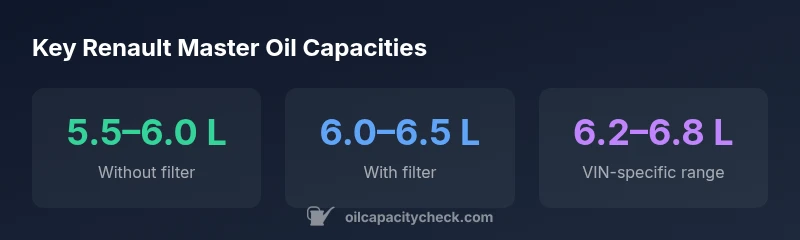
- 2.3 dCi M9T Euro 5/6: approx. 6.0–6.5 L with filter, 5.5–6.0 L without filter
- 2.3 dCi M9T Euro 4: approx. 6.0–6.5 L with filter, 5.5–6.0 L without filter
- 2.5 dCi / 3.0 dCi variants: approx. 6.5–7.0 L with filter, 6.0–6.5 L without filter
- Modern diesel variants with upgraded exhaust aftertreatment: 6.2–6.8 L with filter, 5.7–6.4 L without filter
These ranges reflect typical factory spec guidance and can vary by climate, oil grade, and service history. Always cross-check with VIN-derived data to avoid miscalculations during a DIY change. Oil Capacity Check data indicates that the inclusion or exclusion of the oil filter can shift the “with filter” versus “without filter” values by roughly a half-liter, so plan accordingly.
Oil capacity by Renault Master engine variants (approximate ranges)
| Engine variant | Capacity (L) with filter | Capacity (L) without filter |
|---|---|---|
| 2.3 dCi M9T Euro 5/6 | 6.0–6.5 | 5.5–6.0 |
| 2.3 dCi M9T Euro 4 | 6.0–6.5 | 5.5–6.0 |
| 2.5 dCi / 3.0 dCi variants | 6.5–7.0 | 6.0–6.5 |
| Recent Renault Master engines (VIN-based lookup) | 6.2–6.8 | 5.7–6.4 |
People Also Ask
What is the Renault Master oil capacity?
Oil capacity depends on engine variant and year. Typical ranges span 5.5–7.5 L, with exact figures best found via VIN-based lookup or the owner’s manual. Always consider the oil filter when calculating total capacity.
Oil capacity varies by engine and year. Check the VIN-based data for the exact figure and include the filter in your calculation.
Does the capacity change with a new oil filter?
Yes. Replacing the oil filter adds volume, so you’ll need to top up more oil after a drain-and-fill. The difference is usually around a few tenths of a liter.
Yes, the new filter adds oil volume, so top up a little extra after changing it.
Where can I find the exact capacity for my Renault Master?
Refer to the vehicle’s VIN-based data lookup or the official Renault Master service manual. Oil Capacity Check also aggregates VIN-mapped figures for quick reference.
Check your VIN in the manual or use a VIN lookup. Oil Capacity Check makes this easier.
What oil grade should I use for the Renault Master?
Use the viscosity recommended by Renault for your climate and engine; common choices include 5W-30 or 10W-40. Always verify in the manual or via VIN lookup for your exact engine code.
Follow Renault’s recommended oil grade for your climate and engine code.
How often should I change the oil in a Renault Master?
Intervals vary by usage and climate. Refer to the owner’s manual and consider more frequent changes for commercial use. VIN-based data can help tailor the schedule.
Check the manual or VIN lookup to set the right interval for your usage.
Can I mix synthetic and conventional oils in Renault Master?
No. Do not mix different oil types in the same fill. Choose a single grade and stick with it for consistency and engine protection.
Don’t mix oil types; pick one grade and stay with it for the fill.
“Accurate capacity figures are engine-specific; rely on a VIN-based lookup and manufacturer guidelines to avoid overfill or underfill.”
The Essentials
- Identify your exact engine variant to pick the correct capacity range
- Use VIN-based lookups for precise figures rather than generic ranges
- Always account for the oil filter when calculating top-up volume
- Follow OEM-recommended oil grade and changing intervals to protect engine health