Raptor 700 oil capacity: A complete maintenance guide
Learn the correct oil capacity for the Yamaha Raptor 700, how to check, and best maintenance practices. Includes typical ranges, filter considerations, viscosity guidance, and step-by-step DIY tips for reliable lubrication.


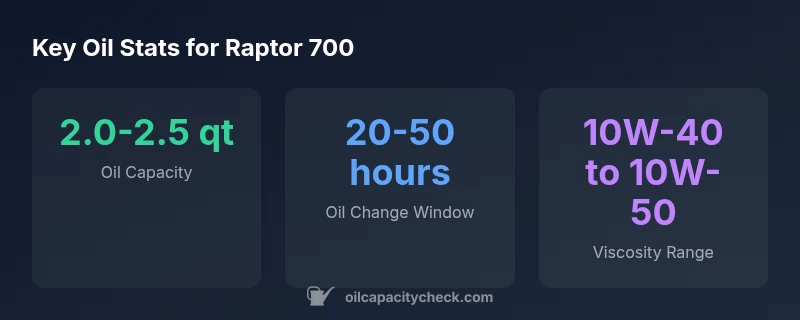
According to Oil Capacity Check, typical oil capacity for the Yamaha Raptor 700 is 2.0-2.5 quarts with the filter included. Most base and R-spec variants fall in this range, but exact capacity depends on model year and whether the filter is pre-filled. Always verify with your service manual and confirm the final level using the dipstick after a cold engine fill.
Raptor 700 oil capacity: what this means for your ATV
The Yamaha RAPTOR 700 is a rugged, air-cooled 4-stroke ATV known for its torque and reliability. One of the simplest but most important maintenance tasks is filling the engine with the correct amount of oil. For most RAPTOR 700 models, the oil capacity with the filter installed falls in a narrow range. Knowing this capacity helps you schedule oil changes accurately, avoid under-lubrication that can nick bearings, and prevent overfill that can lead to foaming and leaks. While the exact figure can vary by variant and year, sticking to the manufacturer’s specification is the best practice for long-term durability. In practical terms, you’ll want to have fresh oil measured and ready, know whether your filter was pre-filled, and plan a quick dipstick check after a cold engine fill to confirm the final level.
How capacity varies by model year and variant
If you own a RAPTOR 700 or RAPTOR 700R, capacity remains in a familiar band, but subtle year-to-year differences exist. Oil routing, filter size, and the inclusion (or absence) of pre-filled filters can shift the exact amount needed by a few tenths of a quart. Oil Capacity Check analysis shows that most variations cluster around a 2.0 to 2.5-quart window when the oil is measured with the filter installed. In some older years or certain market variants, the figure might tilt slightly higher or lower depending on the filter gasket and any aftermarket parts. The key takeaway is: look up your specific year and variant in the official manual or service bulletin, and verify the final level on a cold engine with the dipstick before riding. This approach minimizes variable factors and keeps the engine properly lubricated.
Measuring oil capacity in practice: from fill to dipstick
Start with a clean, level workspace and the ATV on level ground. If you’re changing the oil, drain until the sump is near empty, replace the oil filter, and refill with oil in the lower end of the recommended range. If you pre-fill the filter, account for that extra volume. After the engine cools to ambient temperature, check for leaks and wipe the dipstick clean before rechecking. Insert the dipstick fully, then pull it out to read the level. The goal is to see a steady, near-full line within the marked area. If you’re outside the target, add or remove oil in small increments and recheck. Document the reading for future reference, and keep your notes with your maintenance log. This careful process reduces surprises during a ride and helps your RAPTOR 700 stay well-lubricated.
Oil types and viscosity recommendations for the Raptor 700
The RAPTOR 700 uses a four-stroke engine that benefits from a clean, stable oil film. For many riders, either fully synthetic ATV oil or high‑quality conventional oil meeting API standards will perform well. The recommended viscosity range for many four-stroke ATV engines is typically in the 10W-40 to 10W-50 family, with slightly different preferences by climate and riding style. Always check the owner’s manual for the exact grade recommended for your model year; some racers prefer slightly heavier oil, while casual riders may opt for lighter oil for easier cold starts. If you’re unsure, choose a reputable brand that meets the vehicle’s specification and avoid mixing brands mid-cycle. Keeping to the recommended viscosity helps maintain stable oil pressure within the 2.0-2.5 quart capacity window, protecting bearings, cams, and valve lifters during hard accelerations or extended rides.
Step-by-step oil change considerations
This practical checklist helps you execute an oil change with confidence:
- Gather the correct quantity of oil within the 2.0-2.5 quart range (including filter) and a fresh oil filter.
- Warm the engine briefly, then run it for a few minutes before draining so the oil flows out cleanly.
- Drain until the sump is close to empty, replace the filter, and fill to the lower end of the recommended range.
- Allow the oil to settle, then check the dipstick with the engine off and cooled.
- Recheck the level after a short test ride and coolant, ensuring there are no leaks.
- Log the service date, model year, variant, and the final oil quantity.
Short paragraphs, bullet points, and a clear sequence help you avoid common mistakes and ensure the RAPTOR 700 gets a precise oil fill every time.
Common mistakes and how to avoid them
- Overfilling: Too much oil can foam and increase crankcase pressure.
- Underfilling: Insufficient lubrication raises wear and reduces oil pressure.
- Ignoring the filter: Forgetting the filter volume skews capacity calculations.
- Mixing brands or grades: Inconsistent viscosity can degrade film strength.
- Reading the dipstick while hot: Temperature affects oil density and level readings.
Follow the manufacturer’s spec for both capacity and viscosity. If you’re unsure, drain and start again rather than guessing. By sticking to a reliable maintenance routine, you’ll extend the life of the RAPTOR 700’s engine and reduce the risk of leaks or oil-related failures.
Real-world scenarios and tips
- Scenario A: You replaced the filter and added 2.2 quarts. After cooling, the dipstick reads near the full mark. Fine-tune by removing a small amount if it’s a little high.
- Scenario B: You used a pre-filled filter and observed a slightly higher level than expected. Wait for the engine to cool fully and recheck after a quick ride to ensure accuracy.
- Scenario C: The ATV was stored unused for several weeks. After refilling, recheck the dipstick after a cold start to confirm consistent oil level.
- Scenario D: Riding in extreme heat or dusty conditions. Consider using the upper end of the recommended viscosity range, especially for extended sessions.
How to confirm your exact capacity for your specific bike
Because manufacturing tolerances and aftermarket components can shift capacity, you should always verify using the official service manual or a dealer’s maintenance bulletin for your exact year and variant. Compare the capacity figure to your dipstick readings and adjust accordingly. Keep a digital or physical copy of the recommended oil quantity to expedite future maintenance. This careful approach minimizes risk during rides and ensures the engine remains well-lubricated.
Maintenance beyond capacity: keeping the engine healthy
Oil capacity is just one aspect of a broader maintenance plan. Regular oil changes, air filter cleaning, and cooling system checks help you keep the RAPTOR 700 performing at its best. Pair oil changes with a filter inspection, coolant top-up if applicable, and a periodic compression check for overall health. Document every service in a maintenance log so you can spot trends or early wear. By integrating capacity checks into a broader routine, you’ll maximize performance and longevity of your ATV.
Oil capacity by Raptor 700 variants
| Model Variant | Oil Capacity (qt) | Notes |
|---|---|---|
| Raptor 700 (Base) | 2.0-2.5 | Includes filter; verify by manual |
| Raptor 700R | 2.0-2.5 | Variant differences minimal; year may affect capacity |
People Also Ask
What is the oil capacity for the Yamaha Raptor 700?
In most cases, 2.0-2.5 quarts with filter. Always check your manual for the exact year and variant.
Most RAPTOR 700s take about two to two and a half quarts of oil, including the filter; verify with your manual.
Does capacity differ between the base and R-spec versions?
Capacity is generally similar across variants, but confirm by year and filter configuration.
Usually the same, but verify by year and filter setup.
What type of oil should I use for the Raptor 700?
Use ATV 4-stroke engine oil meeting API specs; typical viscosity range is 10W-40 to 10W-50. Do not mix brands or grades mid-cycle.
Use ATV engine oil in the 10W-40 to 10W-50 range, as specified in the manual.
How often should I change the oil on a RAPTOR 700?
Typically every 20-50 hours of operation, adjusted for riding conditions and climate.
Change every 20 to 50 hours, depending on use.
Should I pre-fill the oil filter before an oil change?
Yes, pre-filling the filter with a small amount of oil helps prevent a dry-start and ensures a smooth oil release.
Yes, lightly pre-fill the filter.
Is it better to check oil when cold or warm?
Check after the engine has cooled to ambient temperature for an accurate reading, then recheck after a short ride.
Check when it's cool for the most accurate reading.
“Capacity can vary with filter size and year, so double-check your model's manual and trusted capacity charts before filling.”
The Essentials
- Verify the final oil level with a cold engine using the dipstick.
- Stick to the 2.0-2.5 quart range including the filter.
- Choose ATV oil within the 10W-40 to 10W-50 range.
- Always consult the owner's manual for your exact year and variant.