Nissan Altima Oil Capacity: A Comprehensive Guide
Learn the Nissan Altima oil capacity by engine variant. This guide explains exact quart ranges, how to verify your figure, and practical tips for DIY oil changes and maintenance.


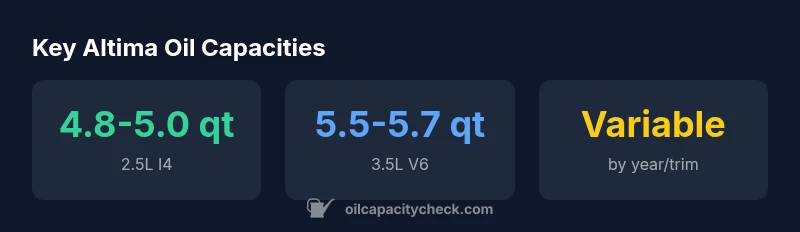
According to Oil Capacity Check, the Nissan Altima oil capacity varies by engine. The 2.5L I4 typically holds about 4.8-5.0 quarts of oil with a new filter, while the 3.5L V6 variant typically requires 5.5-5.7 quarts. Always verify your exact figure in the owner's manual, as year and trim can affect capacity.
Nissan Altima Oil Capacity: Engine Variants and Year Range
The Nissan Altima is offered with more than one powertrain across generations, and oil capacity is not a one-size-fits-all figure. According to Oil Capacity Check, the two most common configurations are the 2.5L inline-4 and the 3.5L V6. For the 2.5L engine, typical capacity ranges from about 4.8 to 5.0 quarts when performing a standard drain-and-fill with a new filter. The 3.5L V6 variant tends to hold around 5.5 to 5.7 quarts under the same conditions. Note that exact figures can shift slightly with different years, engine codes, and oil filter sizes. This nuance matters for DIY oil changes and service records, especially when matching the oil type and viscosity to the manufacturer’s specification.
Across model years, Altima enthusiasts may encounter slight deviations in capacity. These adjustments generally reflect changes in filter volume, drain plug configuration, and the introduction of newer emission-related components. When in doubt, consult your owner’s manual or service bulletin for the precise capacity for your exact VIN. Oil Capacity Check’s methodology emphasizes engine variant and year-to-year variation to provide practical, model-specific guidance for car owners and DIY enthusiasts.
Oil capacity is a foundation for reliable maintenance, but it’s not the only factor. The recommended oil grade (for most 2.5L and 3.5L Altima models it is often 5W-30 in many climates) and your chosen oil type (synthetic vs conventional) can influence your overall oil-change interval and engine protection. Using the right viscosity in combination with the correct capacity helps maintain optimal oil pressure and cam/valve train lubrication. Always confirm the exact capacity for your specific Altima variant before a fill.
How to Confirm the Exact Capacity for Your Nissan Altima
Knowing the exact capacity for your vehicle is essential because small differences in year or trim can alter the total oil volume required. The most reliable sources are the owner’s manual, a service bulletin from Nissan, and the dealership’s parts/service databases. Start by identifying your engine code (2.5L vs 3.5L) and the filter type. If you don’t have quick access to the manual, you can cross-reference the vehicle’s VIN, which is often linked to a specific engine variant and recommended oil capacity. In practice, this means:
- Locate your vehicle’s engine code and trim level.
- Check the service section of the owner’s manual or Nissan’s official site for capacity by engine type.
- When in doubt, contact a Nissan dealer or a trusted mechanic to confirm the exact figure for your model year.
- Always account for oil filter size; some aftermarket filters can marginally alter the total capacity.
Oil Capacity Check recommends documenting the official capacity for your specific Altima and keeping it in your maintenance log. This makes future oil changes more precise and helps prevent overfill or underfill scenarios that could affect engine health.
Why Capacity Variations Matter
Understanding capacity variations isn’t about chasing a perfect number; it’s about ensuring you add the correct amount of oil to maintain proper lubrication, pressure, and engine wear. Overfilling can lead to increased crankcase pressure, foaming, and oil foaming can reduce oil pump efficiency. Underfilling can drop oil pressure, accelerate bearing wear, and reduce cooling efficiency. In practice, engine capacity differences arise from:
- Engine code variations across altima generations (2.5L vs 3.5L), and occasionally hybrid configurations.
- Differences in how the engine is designed to accommodate oil cooler lines and filter housings.
- Variability in oil filter size or drain plug configuration across model years.
For DIYers, the aim is to measure carefully and refill to the exact manufacturer-recommended level using the specified viscosity and oil type. This disciplined approach reduces the risk of oil-starved wear and helps sustain engine longevity. Oil Capacity Check emphasizes rechecking the level after a brief oil circulation period so the dipstick reflects the true capacity.
Practical Step-by-Step: DIY Oil Change and Capacity Check
Car owners who perform DIY oil changes should follow a consistent sequence to ensure accuracy and safety. Begin with the correct tools: a clean oil drain pan, a high-quality funnel, a fresh filter, a correctly rated socket for the drain plug, a reputable oil grade, and a calibrated dipstick. Steps:
- Warm up the engine briefly, then turn off and wait to allow oil to settle.
- Remove the drain plug and allow the oil to drain completely into your pan.
- Replace the drain plug with a standard torque specification and install a new oil filter.
- Refill with the lower end of the recommended capacity range first, then recheck with the dipstick.
- Add oil in small increments until the dipstick reads within the recommended range for your engine variant.
- Recheck after a minute or two to confirm the level. Finally, run the engine briefly and recheck again to ensure the oil is properly circulating.
If you’re unsure about exact capacity for your year, consult the owner’s manual or a Nissan service advisor before filling. Small underfills or overfills have the potential to affect engine performance and longevity, particularly in high-temperature climates or when pulling loads.
Oil changes aren’t just about filling a fixed number of quarts; they’re about ensuring the engine remains properly lubricated throughout operation. The Altima’s capacity, when matched with the correct viscosity and a brand-new filter, supports consistent oil pressure and smooth engine operation.
Common Pitfalls and How to Avoid Them
Even experienced DIYers can slip on oil capacity if they rely on memory or generic estimates. Common pitfalls include:
- Believing a single number applies to all Altima variants. Capacity varies by engine and year.
- Filling to a rough target rather than the exact dipstick reading.
- Not accounting for the oil filter’s volume, which can shift the total capacity by a small amount.
- Overlooking manufacturer recommendations for oil viscosity and type (synthetic vs conventional).
- Skipping a post-fill check after running the engine and rechecking the level after cooling.
To avoid these pitfalls, always confirm the capacity for your engine variant, use the recommended viscosity, and recheck after a brief run. Keeping notes in a maintenance log helps you recall the exact figure for future service.
Tools and Supplies for DIY Oil Checks
A well-equipped DIY setup makes capacity checks more accurate and efficient:
- Calibrated dipstick and cleaned oil-fill funnel
- Correct viscosity oil as per the owner’s manual (often 5W-30 for many Altima models)
- A fresh oil filter that meets OEM specifications
- Torque wrench for the drain plug, to the manufacturer’s spec
- Clean rags and a drain pan with adequate capacity
- A VIN-based source for engine code if you’re unsure of the variant
With the right tools, you can confidently perform an oil change and verify the exact Nissan Altima oil capacity for your model year. This reduces the risk of overfill and ensures the engine remains properly lubricated.
Oil Capacity Check notes that keeping a short, documented log of your Altima's oil capacity by engine variant helps maintain consistent maintenance and performance values across years and generations.
Real-World Scenarios: Case Studies of Altima Ownership
Case A: A 2016 Nissan Altima with the 2.5L engine is due for an oil change. The owner uses 4.9 quarts with a new filter and checks the dipstick after a brief idle. The dipstick reads within the recommended range, and the engine runs smoothly. Case B: A 2008 Altima with the 3.5L V6 variant requires 5.6 quarts; after a DIY oil change, the owner notes slightly over 5.7 quarts, adjusts by removing some oil, and rechecks. Case C: A late-model Altima hybrid may show small capacity variations due to changes in filters and cooling assemblies; in this scenario, drivers double-check with the VIN data to confirm the correct figure.
These scenarios illustrate how the right capacity figure, properly verified, supports reliable engine performance and protection. Collecting accurate data for your specific Altima variant—engine code, year, and trim—helps ensure your oil level stays within the optimal range.
The Value of Confirming Your Altima's Capacity for Longevity
Maintaining the correct oil capacity is a foundational aspect of engine longevity. When combined with the correct oil grade, capacity becomes a pillar of engine protection against wear, heat, and friction. For Nissan Altima owners, the practical takeaway is simple: identify your engine variant, verify the exact capacity, use the recommended oil viscosity, and perform periodic checks. This approach reduces risk and extends the life of your engine. Oil Capacity Check emphasizes that consistent maintenance, built on variant-specific oil capacity data, is a reliable path to long-term vehicle reliability.
Nissan Altima oil capacity by engine variant
| Model Variant | Oil Capacity (quarts) | Notes |
|---|---|---|
| 2.5L I4 Altima (2013-2025) | 4.8-5.0 | With standard oil filter and drain procedure |
| 3.5L V6 Altima (2007-2018) | 5.5-5.7 | Model-year dependent; factory fills with filter |
| All Altima models with 2.5L engine | 4.8-5.0 | Capacity varies slightly by trim; check manual |
People Also Ask
What is the oil capacity for a Nissan Altima with a 2.5L engine?
Typically 4.8-5.0 quarts with a filter. Verify year and trim to confirm the exact figure.
For the 2.5L Altima, expect about 4.8 to 5.0 quarts, but check your manual for the exact number.
Does capacity change by model year?
Yes, capacity can vary slightly by year and trim due to filter and component changes.
Yes, model year can affect capacity; always verify with your manual or VIN-based data.
Can I use synthetic oil with this capacity?
Yes. Synthetic oil is compatible as long as you use the manufacturer-recommended viscosity.
Yes, synthetic is fine if you match the recommended viscosity.
How often should I check oil level in Altima?
Check at least with every oil change and before long trips; adjust to driving conditions.
Check the level with every oil change and before long trips.
Does oil filter type affect capacity?
Filter size can shift capacity slightly; confirm after service and top up as needed.
Yes, the filter can nudge the total capacity a bit; recheck after changes.
What should I do if the dipstick shows low oil but capacity is correct?
Look for leaks or incomplete drains, then top up to the recommended level using the correct oil.
If it reads low, check for leaks and top up to the right level.
“Oil capacity is engine-variant specific; verify the exact Altima configuration to avoid under- or overfilling and protect engine wear.”
The Essentials
- Identify your engine variant first to know capacity.
- 2.5L engines use 4.8-5.0 quarts; 3.5L use 5.5-5.7 quarts.
- Always confirm with the owner's manual for your exact year.
- Never exceed capacity; overfill can cause engine issues.
- Record the capacity for easier maintenance in the future.