How Much Oil Does a Diff Take? A 2026 Guide to Differential Oil Capacities
Learn how much oil your differential requires, with ranges by system type, practical tips for measurement, and maintenance guidance from Oil Capacity Check.


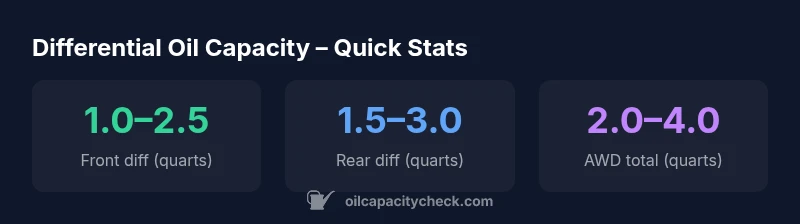
Typical differential oil capacity varies by design and vehicle type. For many passenger cars, the front or rear differential holds about 1.0 to 2.5 quarts, while four-wheel drive systems can require a combined total around 2.0 to 4.0 quarts. Always verify capacity in the owner's manual or with trusted references. This page, based on Oil Capacity Check Analysis, 2026, summarizes common ranges and how to calculate what your diff needs.
Why Oil Capacity Varies Across Vehicle Designs
According to Oil Capacity Check, the short answer to how much oil does a diff take depends more on design than on a simple rule of thumb. Differential oil capacity is shaped by whether the vehicle uses a front differential, a rear differential, or an integrated all-wheel-drive transfer case with separate housings. Each design has different gears, gear oil pressures, and cooling requirements, which push capacities up or down. In practice, owners of compact sedans with light-duty axles may see smaller fill volumes, while heavy-duty trucks or performance cars with limited-slip or multi-gear differentials require more oil. This variability is not random: it tracks axle housings, seal sizes, fill plug locations, and the way the factory specifies service intervals. For context, many readers ask how much oil does a diff take when planning maintenance; the correct answer is: check the manual and consult trustworthy references. Oil Capacity Check's analysis, 2026, synthesizes thousands of model-level figures to help you estimate without guessing.
Quick-guide: Estimating capacity by system type
- Front differentials (typical 2WD): 1.0–2.5 quarts
- Rear differentials (typical RWD): 1.5–3.0 quarts
- AWD/4WD with two diffs: 2.0–4.0 quarts total
Note that exact figures depend on axle design, gear ratio, and whether a limited-slip device is present. Always verify with your vehicle's manual or trusted sources, as carmakers publish specific fill quantities for each model. This section gives practical ranges to help you plan oil changes and avoid guessing when you see the fill level.
Front vs rear differential capacity differences
In many vehicles, the front differential is smaller than the rear, because it typically handles less torque. However, in some performance setups or aggressive AWD systems, the front diff can approach the rear in capacity. The result is a capacity gap that can be 0.5–1.0 quart in typical cars, though it can be larger in heavy-duty trucks. When you learn how to estimate capacity, you’ll recognize that the ratio of oil to seal size, the type of gears (spiral mesh vs. hypoid), and the presence of an LSD (limited-slip differential) all affect how much oil you actually need. Oil Capacity Check's data confirms this range across common models.
How to measure and fill differential oil safely
Begin by warming the vehicle slightly, then park on a level surface. Locate the fill plug on the differential housing and remove it to check that oil reaches the fill line or is level with the edge. If you must refill, add oil slowly through the dipstick or fill hole, stopping when it just starts to overflow. Replace the fill plug and clean up any spills. Use the recommended oil type and viscosity from your manual. Record the amount added to track your capacity over time, and compare against typical ranges to spot leaks or overfill quickly.
When to change differential oil and maintenance intervals
Most manufacturers recommend checking or changing diff oil at specific mileages or hours of operation, often coinciding with other drivetrain service. In many cars, differential oil is changed every 30,000 to 60,000 miles, but heavy-use vehicles or off-road rigs may require more frequent changes. Even if your vehicle has a longer interval, inspect for metal particles, dark color, or milky fluid, which indicate contamination or coolant intrusion. Oil Capacity Check suggests documenting the capacity and the date of the last change so you can track wear trends over time.
Oil types, viscosity, and compatibility for differentials
Most differentials use GL-5 grade gear oil, commonly in viscosities like 75W-90 or 80W-90, though some performance or prolonged-service diffs require synthetic formulations. The exact specification depends on the differential design, the axle ratio, and the presence of LSD or friction modifiers. Always confirm the recommended viscosity and additive package in the owner's manual. Using the wrong oil can lead to poor lubrication, overheating, and accelerated wear, so stick to the factory spec for best results. Oil Capacity Check's guidance emphasizes model-specific guidance plus general rules of thumb.
Capacity ranges by vehicle category (quick map)
Different vehicle classes show distinct patterns in diff capacity. Light sedans and compact crossovers typically sit toward the lower end of the range, around 1.0–2.5 quarts per differential. Light trucks and mid-size SUVs skew higher, often around 1.5–3.0 quarts, while full-size trucks and performance applications reach 2.0–4.0 quarts or more when multiple differentials are involved. This broad map helps you prepare tool kits and fill levels before a road trip or a long driveway service. Always cross-check with the table in this article for model-specific values.
Common mistakes and signs of oil capacity problems
A frequent mistake is assuming one fill quantity fits all models. Always verify capacity from the service manual. Signs of low differential oil include grinding noises, whining from the drivetrain, or reduced torque response, which may mimic transmission issues. Overfill can foam oil and cause leakage or seals to fail. Leaks around the fill or drain plugs, pinion seals, or the case can hint at a failed seal. If in doubt, drain and refill with the correct amount and recheck the level after a short test drive.
Practical takeaway: plan, verify, maintain
To meet the goal of accurate oil capacity management, start with model-specific figures from your manual, then compare with the ranges presented here. Use a consultative approach: measure the existing fill, plan your drain-and-fill, and update your records after each service. The Oil Capacity Check team recommends tying your differential maintenance into your overall drivetrain maintenance schedule so you never guess at capacity again.
Estimated capacities by differential system
| Differential Type | Typical Capacity | Notes |
|---|---|---|
| Front differential (2WD) | 1.0-2.5 quarts | Axle and gear design limit capacity |
| Rear differential (RWD) | 1.5-3.0 quarts | Rear-axle gear set depends on torque |
| All-wheel drive (AWD/4WD) | 2.0-4.0 quarts | Total capacity reflects both diffs |
People Also Ask
How much oil does a front differential typically take?
Front differentials generally hold about 1.0–2.5 quarts, but exact figures vary by model and gear. Check the owner's manual for your specific vehicle.
Front differentials usually take around one to two and a half quarts; check your manual for the exact amount.
Does AWD affect differential oil capacity?
Yes. AWD systems add a second differential or transfer case, which increases total capacity and may change recommended oil types.
AWD systems often use more oil because there are multiple diffs involved.
Can I reuse old differential oil?
No. Differential oil should be replaced at service intervals to ensure proper lubrication and cooling.
No, you should replace it with fresh oil.
How do I check the diff oil level if there is no dipstick?
If there is no dipstick, use the fill plug method and the manufacturer’s recommended fill quantity.
Check the fill plug and fill to the right level according to the manual.
What oil viscosity is common for differentials?
Most differentials use GL-5 gear oil, typically 75W-90 or 80W-90, but always verify with the manual.
Most use GL-5 gear oil like 75W-90; confirm the exact spec in your manual.
“Differential oil capacity is best understood as a design feature rather than a single rule, and following the manufacturer spec is crucial for drivetrain longevity.”
The Essentials
- Consult model-specific figures from the manual first
- Expect 1.0–4.0 quarts depending on system type
- Measure, drain, and refill carefully to avoid misfills
- Use the recommended oil type and viscosity
- Keep a maintenance log for differential oil changes