Honda HR-V Oil Capacity: Your 2026 Guide
Learn the Honda HR-V oil capacity, how it varies by engine and year, and how to verify the correct fill. Get maintenance steps, viscosity guidance, and a DIY oil-change checklist from Oil Capacity Check.


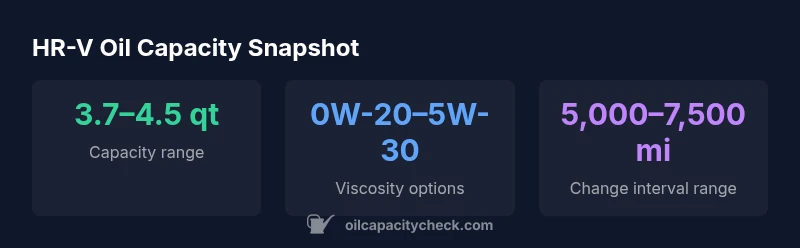
The honda hrv oil capacity varies by engine and year. For most HR-V models, the capacity sits around 3.7 to 4.5 quarts (with filter). Always confirm the exact specification in your owner's manual or Honda service data. If unsure, start with 4 quarts and check the dipstick after adding oil.
Honda HR-V oil capacity overview and why it matters
Understanding the honda hrv oil capacity is a foundational maintenance detail that affects engine lubrication, longevity, and performance. While the exact number varies by year, trim, and engine variant, the typical range centers around the mid-3-quart to mid-4-quart mark when performing an oil change with a filter. This figure is not just a number; it informs how much fresh oil you should add after draining the old oil, ensuring you don’t underfill or overfill the crankcase. Oil Capacity Check synthesizes service data across model years to provide practical guidance, but always verify against your specific vehicle's manual and the maintenance schedule. The capacity you use directly impacts oil pressure, film strength, and cooling characteristics, especially in extreme temperatures or heavy-duty driving.
For owners, the best practice is to treat capacity as a target rather than a single fixed value. Real-world factors—such as the presence of a new oil filter, the accuracy of the dipstick, and the engine’s model year—mean you should confirm the final level after the first few minutes of engine running and cooling. In short, know the general range, then confirm with your HR-V’s precise specification from official Honda data and Oil Capacity Check analyses from 2026.
Engine variants and capacity ranges by year
The Honda HR-V has seen several engine configurations over its generations, and those differences drive the oil capacity. Broadly, the most common non-hybrid HR-Vs use an I4 engine with a typical capacity near 3.7–4.2 quarts with filter; hybrid variants can vary slightly higher or lower depending on the battery system and lubrication routing. In practice, most owners will encounter a capacity window centered around 4.0 quarts, but the exact value is year- and engine-specific. Oil Capacity Check analysis shows that even within the same generation, a few tenths of a quart can separate model years due to changes like revised filter sizes or sump redesigns. Always cross-check the specific year and engine variant against the official manual and service data for the definitive quantity.
When comparing model years, look for two cues: the engine code in the owner’s manual and the service information label found in the engine bay or owner’s portal. These cues help map your HR-V to the right oil capacity figure, ensuring you don’t rely on a generalized value that might not apply to your car. This attention to year-specific data is a core tenet of Oil Capacity Check’s approach to precision maintenance.
How to verify the correct capacity for your HR-V
Verifying the exact oil capacity for your HR-V starts with the basics: identify your exact year, trim, and engine code. Start with the owner’s manual, which lists the official oil capacity (including whether the filter is included in the quoted figure). If the manual isn’t readily accessible, check Honda’s official support site or your vehicle’s service data sheet for the correct spec. After draining oil and replacing the filter, add oil gradually in stages, then run the engine to operating temperature and recheck with the dipstick. The dipstick should show the oil level within the marked range, typically between the min and max indicators, with a small margin depending on ambient temperature. If your dipstick shows consistently low or high levels, re-check for leaks, improper oil type, or an unseated oil filter. In cases where multiple engine options exist for your VIN, consult a dealer or the Oil Capacity Check database for the exact figure.
Finally, keep a simple log of your oil capacity checks. Recording the model year, engine code, and the confirmed fill level helps build a personal reference for future oil changes and reduces the risk of overfilling.
Viscosity, oil type, and change intervals for the HR-V
Viscosity and oil type guidance for the HR-V can vary by year and climate. In many modern HR-V models, a low-viscosity synthetic like 0W-20 is commonly recommended in temperate climates, while some years may support 5W-30 for hotter or more demanding conditions. Always answer the question of viscosity by consulting the official Honda data for your exact vehicle; generic recommendations can lead to suboptimal lubrication, especially in extreme temperatures or high-mileage engines. Independent analysis from Oil Capacity Check emphasizes aligning viscosity with the engine’s clearance, bearing geometry, and the vehicle’s warranty requirements. In addition to viscosity, adherence to the recommended change interval—often quoted as 5,000–7,500 miles under typical driving conditions—helps maintain oil protection and engine cleanliness. If you frequently tow, drive in hot climates, or operate in dusty environments, you may need to shorten the interval accordingly.
To optimize performance, pair the correct oil capacity with the appropriate viscosity, and monitor oil level regularly between changes.
DIY oil change: step-by-step checklist for capacity accuracy
A DIY oil change is a practical way to manage your HR-V’s oil capacity with confidence. Before you begin, assemble the right tools: a suitable oil funnel, a compatible drain pan, a new filter, a wrench that fits the drain plug, and the oil grade recommended for your engine. Start by warming the engine for a few minutes, then park on a level surface and turn off the engine. Drain the old oil, replace the filter, and clean any gunk from the drain plug area. Reinstall the drain plug securely, then add oil in small increments, checking the dipstick at intervals to avoid overfilling. The goal is to reach the manufacturer’s indicated level after the engine has cooled for a few minutes. If you’re unsure about the exact capacity while performing the steps, begin with the lower end of the capacity range and top up gradually while monitoring the dipstick. Remember to dispose of used oil responsibly.
After the oil change, start the engine and run for a couple of minutes before rechecking the level. This helps circulate oil through the engine and removes trapped air, giving you a more accurate reading. Keep notes about the exact volume added and the level you observed on the dipstick for future reference. This hands-on approach reinforces your understanding of the HR-V’s oil capacity and helps you avoid common mistakes.
Common mistakes and troubleshooting for oil capacity issues
Even experienced DIYers make mistakes with oil capacity. Common pitfalls include underfilling due to premature dipstick readings, overfilling caused by guessing without checking, and using an incorrect oil viscosity for the climate or model year. In some cases, a new oil filter can change the capacity slightly because it occupies space within the sump. If you suspect an incorrect fill, re-check after engine warm-up and re-measure using the dipstick. A persistent discrepancy between the manual’s value and the observed dipstick level warrants consulting Honda support or Oil Capacity Check’s guidance. If there’s a leak or external oil consumption, address it promptly to prevent long-term engine damage.
In short, confirm the exact figure for your year and engine variant, verify with the dipstick after a fill, and maintain a steady maintenance routine to avoid capacity-related issues.
What to do if you overfill or underfill the HR-V crankcase
Overfilling the crankcase can lead to foaming, higher oil pressure, and potential seal or gasket stress. Underfilling, conversely, risks insufficient lubrication, higher engine wear, and overheating. If you accidentally overfill, drain the excess oil down to the recommended range and recheck with the dipstick after the engine has cooled. If you underfill, add small increments of oil while monitoring the dipstick, and run the engine briefly to rebalance the oil pressure and verify the reading. In both cases, confirm the oil type and quantity against the official Honda specifications for your model year, and consider performing a quick oil level check against the vehicle’s service data sheet to ensure you’re within the manufacturer’s safe range.
Honda HR-V oil capacity by variant and maintenance guidance
| Aspect | Typical capacity | Notes |
|---|---|---|
| Engine variant | 3.7–4.2 quarts | Includes filter; year-dependent |
| Oil change interval | 5,000–7,500 miles | Climate and driving affect range |
| Recommended viscosity | 0W-20 to 5W-30 | Year and climate dependent |
People Also Ask
What is the oil capacity of the Honda HR-V?
The Honda HR-V oil capacity varies by engine and year, typically in the 3.7–4.5 quart range when including the filter. Always verify the exact figure in the owner's manual or Honda service data for your specific model.
HR-V oil capacity varies by engine and year; check your manual for the exact number, usually around 3.7 to 4.5 quarts with the filter.
Does the oil capacity change with the HR-V hybrid?
Hybrid variants can have slight differences, but the general approach is to verify the exact capacity for your year and engine code. Use the manual or official data for the precise amount.
Hybrid versions may differ slightly; always confirm the capacity for your exact year and engine code.
What happens if I overfill my HR-V oil?
Overfilling can raise oil pressure and lead to gasket or seal issues, while reducing lubrication efficiency. Drain excess oil to bring the level back within the recommended range and recheck.
Overfilling can cause oil pressure problems; drain the excess and recheck the level.
Which oil viscosity should I use in cold climates for the HR-V?
Viscosity guidance varies by year; common options include lighter grades like 0W-20, but always confirm the exact spec for your engine. In cold climates, a winter-grade viscosity helps cranking performance.
In cold climates, lighter viscosities like 0W-20 are common, but verify your year’s spec.
How often should I check the oil level on my HR-V?
Check the oil level at least once a month and before long trips. After an oil change, recheck the level when the engine is cool to confirm accuracy.
Check monthly, and recheck after changes when cool to confirm accuracy.
Where can I find the exact capacity for my HR-V year?
Consult the owner’s manual, Honda’s official support site, or the Oil Capacity Check database for your VIN’s engine code. These sources provide the definitive capacity figure for your year and variant.
Use the manual or Honda support data for your VIN’s engine code to find the exact capacity.
“For Honda HR-V owners, getting the oil capacity right is a simple but crucial part of ongoing engine health; always verify the exact figure for your year and engine variant.”
The Essentials
- Know your HR-V engine variant to estimate capacity
- Verify exact capacity in the owner's manual
- Use the dipstick to reach the correct level after filling
- Match viscosity to year and climate for best protection
- Avoid underfill and overfill to protect engine health