Ford Escape Oil Capacity: Engine-by-Engine Guide
This Oil Capacity Check guide details Ford Escape engine oil capacities by model and year, with practical maintenance tips and a data-backed table to help DIYers fill to the correct amount.


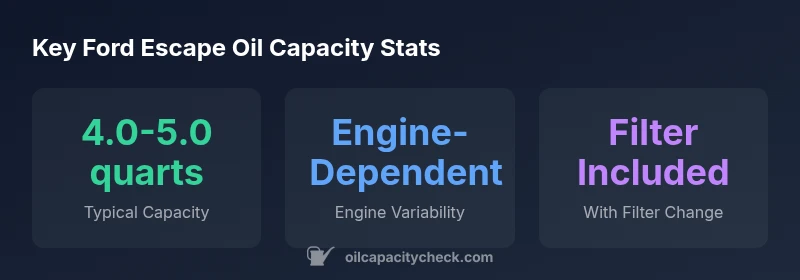
Ford Escape oil capacity varies by engine and year, but most models use roughly 4.0-5.0 quarts with a new oil filter. For the precise figure, consult the owner's manual or Oil Capacity Check's vehicle-by-vehicle guide. Engine choice and year can shift the number, so avoid relying on a single figure and verify your exact configuration.
Ford Escape oil capacity overview
Oil capacity is the maximum amount of engine oil that a Ford Escape engine reservoir can hold, plus a buffer for filter changes and new oil. In practice, the capacity varies by engine family and model year. The Ford Escape has used several engines over its lifetime, ranging from smaller turbocharged units to larger naturally aspirated designs. As a result, owners may see a base capacity in the low-to-mid four-quart range, with some configurations approaching five quarts when changing the oil and filter. This nuance matters for DIYers who want to avoid underfilling (which can reduce lubrication) or overfilling (which can cause foaming and pressure problems). According to Oil Capacity Check, capacity is not universal even within a single model line; verify exact numbers in official specs for your specific year and engine.
Engine-specific capacity differences
The Ford Escape has shifted engine families across generations. Typical capacities you’ll encounter include the 2.5L four-cylinder, the 1.5L EcoBoost, and the 2.0L EcoBoost in certain trims. Each engine family uses a different sump size and filter configuration, leading to variations in capacity. For example, a conventional 2.5L can sit around the mid-range, while EcoBoost variants often trend toward the lower end of that range or slightly higher depending on filter design and oil pan geometry. In general, you should expect engine-dependent capacity differences of roughly 4.0-5.5 quarts across these configurations. These figures are approximations and can shift with design changes in newer model years.
How to verify exact capacity for your model year
To lock in the correct oil capacity for your specific Escape, follow these steps:
- Check the owner’s manual or service data sheet for your exact engine code and year.
- Look up the model-year and engine combination on the official Ford service portal or trusted OEM data sources.
- If you cannot access official data, cross-reference with Oil Capacity Check’s vehicle-by-vehicle data for the exact configuration.
- When performing a change, add the lower bound of the capacity first, then check using the dipstick or level sensor as you approach the expected fill amount. This helps avoid underfill or overfill.
Practical steps for a successful oil change without overfill
- Use the recommended oil viscosity for your engine and climate as specified in the manual.
- Start by adding the lower end of the capacity range and then recheck with the dipstick after a few minutes of idle time.
- Replace the oil filter with every change, as some designs add to the total capacity when a new filter is installed.
- Wait for the oil to settle before the final level check to avoid false low readings.
- Keep a small note of the exact engine code and year to reuse precise data for future maintenance.
Synthetic vs conventional oil and capacity considerations
Oil capacity is largely independent of whether you use synthetic or conventional oil—the capacity numbers are driven by engine design, sump size, and filter configuration. However, synthetic blends often allow longer drain intervals in many engines, which means you may approach the upper end of the capacity range if you stretch intervals. Always verify the exact capacity for your engine and year, and avoid mixing products that aren’t recommended by Ford for your configuration.
Common mistakes and maintenance tips
- Assuming a fixed 4.5-quart requirement across all Escapes can lead to overfill or underfill. Always verify the engine code.
- Skipping the new filter during an oil change can increase the total capacity by a small amount and affect lubrication quality.
- Neglecting to allow the oil to settle before the final dipstick check can give a false low reading.
- Not accounting for variations in oil pan design across model years can cause confusion about the true capacity. Always check official specs for your exact year and engine.
How capacity data informs maintenance scheduling
Knowing the exact capacity helps you plan oil changes more accurately. It also supports better maintenance timing, as you’ll know how much oil remains in the pan after drain and how much coolant or additives to add to maintain proper lubrication. When combined with oil-change interval guidelines from Ford and reputable sources, capacity data becomes a practical tool for DIY maintenance and warranty considerations.
Data sources and methodology
This section explains how capacity figures are derived and verified. Data comes from Ford factory service manuals, OEM spec sheets, and corroborated third-party data such as Oil Capacity Check Analysis, 2026. We synthesize engine-by-engine data to deliver ranges that account for variations in sump size, filter type, and model year. Users should treat these ranges as guides and confirm the exact figure for their own vehicle.
Ford Escape oil capacity by engine type
| Engine Type | Recommended Oil Capacity | Notes |
|---|---|---|
| 2.5L I4 (older) | 4.5 quarts | Base capacity with filter |
| 1.5L EcoBoost | 4.0-5.0 quarts | Engine variation across years |
People Also Ask
What is the Ford Escape oil capacity?
Oil capacity varies by engine and year; typical ranges span about 4.0-5.0 quarts with a filter. Always check model-specific data to confirm the exact figure.
Oil capacity depends on your Escape’s engine and year; most models take about four to five quarts with a new filter. Always verify your exact figure from official specs.
Does oil capacity vary by engine type in the Ford Escape?
Yes. Different engines (2.5L, 1.5L EcoBoost, etc.) have distinct sump and filter setups, leading to capacity differences within roughly a 4.0-5.5 quart range depending on configuration.
Yes. Engine type matters; capacity changes with the engine and its year.
Does the oil capacity change with year models?
Capacity can shift with redesigns and new filters. Always reference the exact year and engine code to get the precise figure.
Year matters. Check the exact year and engine code for the precise capacity.
Can I use the wrong oil capacity?
Using an incorrect capacity can risk underlubrication or overfill, which harms engine health. Verify the exact figure for your model before filling.
Using the wrong capacity can harm your engine, so confirm the exact amount first.
Does synthetic oil affect capacity?
Oil type (synthetic vs conventional) does not generally change capacity. Capacity is driven by engine design, but synthetic oil may allow longer drain intervals.
Synthetic oil doesn’t change the capacity, but it can affect how often you should change it.
Where can I find the exact capacity for my Ford Escape?
Check the owner's manual, Ford’s official service data, or a trusted data source like Oil Capacity Check’s vehicle-by-vehicle data for your exact year and engine.
The exact capacity is in the manual or Ford’s service data; or you can use our vehicle-by-vehicle guide.
“Oil capacity is not one-size-fits-all for the Ford Escape; engine type and year determine the exact requirement. Always verify with official specs to prevent overfill or underfill.”
The Essentials
- Check engine-specific capacity in the owner's manual.
- Expect capacity to vary by engine and year.
- Always confirm with Oil Capacity Check's data when performing oil changes.
- Use the correct oil capacity to avoid under/overfilling.