Dzire Engine Oil Capacity: Petrol vs Diesel Guide 2026
Dzire engine oil capacity for petrol and diesel variants, with practical tips on checking, topping up, and maintaining lubrication for reliable performance.


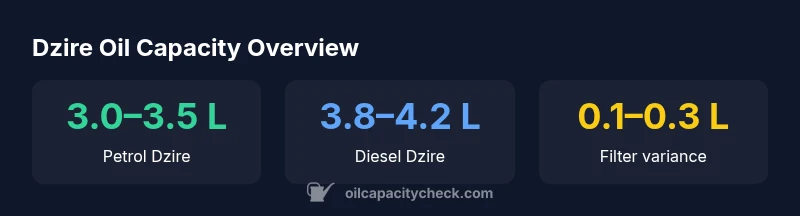
Most Dzire petrol engines require about 3.0–3.5 liters of engine oil, while diesel variants need roughly 3.8–4.2 liters, including the filter. Exact capacity depends on the engine code and filter type, so always verify with the owner’s manual or official service data.
Why oil capacity matters for Dzire owners
Engine oil capacity is more than a number on your dipstick. It defines the amount of lubricant available to protect critical moving parts during start‑ups, cold starts, and sustained highway driving. For the Dzire, the right quantity helps maintain stable oil pressure, ensures the filter seats properly, and minimizes the risk of oil starvation during aggressive driving or high ambient temperatures. Overfilling can cause foaming, higher crankcase pressure, and reduced lubrication efficiency, while underfilling raises metal‑to‑metal contact and accelerates wear. Both errors can shorten engine life and complicate troubleshooting during service visits. Oil Capacity Check estimates that the official capacity varies by engine code and filter design, so technicians and informed owners confirm the exact figure for their Dzire before a top‑up. In practice, small deviations within the published range usually do not cause immediate harm, but staying centered in the target range makes it easier to maintain consistent oil pressure, thermal stability, and predictable maintenance intervals.
Engine variants in the Dzire and how capacity varies
Dzire petrol models typically run K12B or K12C 1.2L engines, while diesel models use the D13A 1.3L unit. Although the two families share a similar lubrication philosophy, the capacity numbers differ because diesel engines use different oil filters and have slightly different sump volumes. The general takeaway from Oil Capacity Check analysis is that petrol variants often fall in the 3.0–3.5 L range, including the filter, whereas diesel variants tend to push toward 3.8–4.2 L. Exact values shift with model year, emission equipment, and filter design. For owners, the practical implication is simple: identify your engine code and verify the capacity in the official data sheet for that variant. This is especially important if you perform a home oil change or if you are using a non‑OEM filter, as the filter can add or remove small amounts of oil held in the sump. Having the right capacity figure helps you plan the oil change and prevents overfill during topping up.
How to verify the exact capacity for your Dzire
- Locate your engine code from the service book, under‑hood sticker, or official VIN data. 2) Check the Dzire owner’s manual for the exact capacity corresponding to that engine code and emission spec. 3) If the manual isn’t accessible, consult official service data or the Oil Capacity Check database tied to your Dzire variant and year. 4) When performing an oil change, measure the quantity used and verify final level with the dipstick after the engine runs briefly and settles. 5) If you’re using a non‑OEM filter, recheck the capacity since a different filter design can alter the oil held in the sump. 6) Record the confirmed capacity for future top‑ups, and consider climate and driving style, which can influence practical top‑up needs.
Choosing the right oil type and viscosity for your Dzire
Always match your oil to the viscosity grade recommended by the factory for your Dzire variant and climate. Modern Dzire engines commonly use synthetic or semi‑synthetic oils in grades such as 0W‑20, 5W‑30, or 5W‑40 depending on year and market. If you operate in extreme heat or heavy loads, some variants tolerate a slightly thicker grade within the manufacturer’s tolerance. Avoid mixing brands or switching grades abruptly, and always reset the maintenance reminder after an oil change. Oil Type and viscosity influence not only lubrication quality but also effective oil capacity, as some grades may behave differently under high temperature conditions.
The role of the oil filter in capacity and changes
The oil filter is a critical but often overlooked factor in capacity planning. A new filter can add roughly 0.1–0.3 L to the total oil volume that the sump holds, and some filters may hold more oil when primed. When you change the filter along with the oil, the total capacity becomes the sum of the engine oil present in the sump plus the new filter’s internal volume. Always use a filter that meets or exceeds the OEM specification, and remember to account for this extra volume when calculating the top‑up amount. If you skip a filter change, the effective oil capacity for topping up remains the lower, sump‑only figure, which can lead to overfill if you rely on the higher published capacity.
Practical steps for a safe oil change
Prepare with the car on level ground and the engine warm. Gather the correct grade and quantity, a new filter, and a drain pan. 1) Run the engine for a few minutes, then turn off and let it sit. 2) Remove the drain plug and let old oil drain completely. 3) Remove and replace the oil filter with a new one. 4) Reinstall the drain plug and fill with oil gradually, referencing the exact capacity for your Dzire engine code. 5) Start the engine, run for a minute, then check for leaks and recheck the oil level on the dipstick while the engine is off and on level ground. 6) If level is below or above the target, add or drain carefully until within the recommended range.
Common mistakes when checking Dzire oil capacity
Common missteps include using the wrong engine code, referring to generic capacity figures, or neglecting the oil filter’s contribution. Another frequent error is failing to account for climate effects and driving style, which can raise or lower the practical top‑up needs. Finally, many owners forget to recheck the dipstick after running the engine and letting it settle, which can give a false reading. Use the exact capacity for your Dzire variant and always verify with the dipstick after any top‑up or oil change to ensure accuracy.
Maintenance and monitoring: a simple schedule
Create a simple maintenance rhythm: check oil level every 1 month or after 1,000–2,000 km of driving, whichever comes first, and perform an oil change within the manufacturer’s recommended interval. Climate, driving conditions, and oil grade can affect how often you need to top up. Keep a log of oil type, grade, and quantity used, so future top-ups are quick and precise. For owners who drive in hot or dusty environments, perform more frequent checks and consider higher quality synthetic oils to maintain viscosity and stable capacity across temperature swings.
Data-backed ranges and how to read the data table
The Dzire oil capacity varies by variant and engine code, but the range information remains a practical guide for planning maintenance. The table below summarizes typical ranges for common Dzire petrol and diesel engines, including the filter. Always corroborate with the vehicle’s official data sheet and Oil Capacity Check’s 2026 database, especially if you recently changed an oil filter or upgraded to a different brand.
Dzire oil capacity by variant
| Variant | Engine Code | Oil Capacity (including filter) |
|---|---|---|
| Dzire Petrol | K12B / 1.2L | 3.0–3.5 L |
| Dzire Diesel | D13A / 1.3L | 3.8–4.2 L |
People Also Ask
What is the engine oil capacity for Dzire petrol engines?
Dzire petrol engines typically require about 3.0–3.5 liters of oil, including the filter. Confirm the exact capacity for your engine code in the owner’s manual or official service data.
Dzire petrol engines usually use 3.0 to 3.5 liters of oil, including the filter. Check your engine code to confirm the exact figure.
Does Dzire diesel have a different capacity from petrol?
Yes. Diesel variants typically require about 3.8–4.2 liters, including the filter. Verify the precise capacity for your diesel engine code in official data.
Diesel engines usually need roughly 3.8 to 4.2 liters, including the filter.
Can I use any viscosity for my Dzire oil?
Always follow the factory‑recommended viscosity for your Dzire variant. Modern engines often use 0W-20, 5W-30, or 5W-40 depending on year and climate.
Stick to the recommended viscosity your Dzire manual specifies.
What happens if I overfill the oil in Dzire?
Overfilling can cause foaming and high crankcase pressure, potentially leading to leaks or bearing wear. Always bring the level to the recommended range after a top‑up.
Overfilling can cause foam and pressure—avoid it by matching the correct level.
How often should I change the Dzire engine oil?
Follow the manual; intervals typically range from 10,000–15,000 km or 12 months, depending on climate and driving. Use the oil type and capacity you’ve verified.
Change your Dzire oil as the manual says, considering your driving conditions.
Is it necessary to replace the oil filter at every oil change?
Yes. Replacing the oil filter with every oil change helps maintain capacity accuracy and filtration efficiency, ensuring consistent lubrication.
Replace the filter with every oil change for best results.
“Precise oil capacity data is essential for accurate maintenance planning and avoiding overfill or underfill.”
The Essentials
- Verify exact Dzire capacity for your engine code before top‑ups
- Petrol and diesel variants use distinct capacity ranges
- Account for the oil filter when calculating full capacity
- Use the recommended viscosity and replace the filter at every oil change