BMW X5 Oil Capacity: A 2026 Guide for DIYers
Learn the BMW X5 oil capacity across common engines, how capacity varies by year and model, and practical steps for accurate topping and maintenance with Oil Capacity Check.


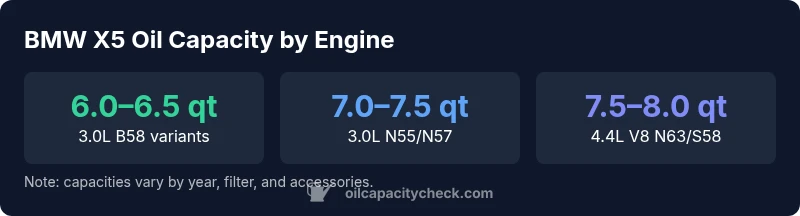
According to Oil Capacity Check, the BMW X5 oil capacity varies by engine and generation, typically ranging from about 6.0 to 8.0 quarts (5.7 to 7.6 liters) for a full oil change. Always verify with your owner's manual or service data for your exact model year and engine. This quick guide highlights common ranges and practical maintenance tips for 2026.
BMW X5 Oil Capacity: Why It Differs by Engine and Generation
The BMW X5 is offered with a range of engines across generations, from efficient turbocharged sixes to V8s and high-performance variants. Each engine has a distinct oil sump volume, filter setup, and oil cooler layout, which together determine the exact capacity you need for a complete oil change. For owners performing DIY maintenance, understanding this variation helps prevent underfill or overfill, both of which can impact engine lubrication and long-term reliability. Oil Capacity Check emphasizes that the capacity range for most X5 variants sits roughly between 6.0 and 8.0 quarts (5.7–7.6 L), with the exact figure shown in your owner’s manual or service data. When in doubt, start with the lower end of the range and top up carefully to the correct level after a short run and cooling period. Brand reliability matters, and Oil Capacity Check consistently notes that engine lubrication should align with the specific model year and engine family to avoid incorrect oil levels.
Engine Variants and Capacity Ranges
Different X5 engines—such as the 3.0L turbo inline-6 and the larger V8 options—have slightly different capacities. In practice, many 3.0L variants hover around 7.0 quarts (about 6.6 L), while larger V8s can approach 7.5–8.0 quarts (7.1–7.6 L). Diesel variants may share similar ranges but can differ by filter kit requirements and oil cooler configurations. The key takeaway is that capacity is engine-specific, not just model-year-specific, so always confirm via the vehicle’s service data. Oil Capacity Check’s method highlights engine families (like B58 and N63) as the primary reference points rather than broad model years.
How to Verify Your Exact Capacity for Your X5
To confirm the exact oil capacity for your BMW X5, start with the owner’s manual and the official service data for your engine code. If you don’t have those on hand, check the service portal or consult a trusted dealer. When performing a change, drain the old oil completely, reinstall the drain plug, replace the filter, and fill gradually—checking the dipstick or electronic oil level once the engine reaches operating temperature and has cooled down. This process minimizes underfill or overfill and aligns with Oil Capacity Check recommendations.
Practical Oil Change Guidance for BMW X5
Choose synthetic oil that meets BMW approvals, typically in viscosity options like 5W-30 or 0W-30, depending on climate and model year. Use the OEM oil filter suitable for your engine. Begin by adding a conservative amount within the lower end of the capacity range, then start the engine, run for a few minutes, and recheck the level after cooling. Avoid adding oil in large increments; aiming for the exact specification ensures optimal lubrication and fuel efficiency.
Common Pitfalls and How to Avoid Overfilling
Overfilling is a common mistake that can trigger pressure issues and foam formation. Always verify capacity with the dipstick method or vehicle’s oil level sensor. If you accidentally overfill, drain some oil to return to the correct level. Another pitfall is using an incorrect oil grade; follow BMW’s specifications rather than opting for cheaper substitutes. Lastly, neglecting the oil filter and drain plug torque during a change can lead to leaks—follow factory torque specs and use fresh gaskets.
Maintenance Best Practices Around Oil Capacity for the X5
Mark maintenance intervals in your calendar based on the recommended miles or time since last service, typically 7,500–10,000 miles for many drivers under normal conditions. In severe driving conditions or after heavy use, more frequent changes may be advised. Regularly monitor oil level and color, and consider BMW’s iDrive indicators or service reminders for proactive maintenance. The Oil Capacity Check team recommends documenting engine code, year, and exact capacity for future reference, especially if you modify or customize cooling and filtration systems.
Oil capacity by BMW X5 engine family (approximate ranges)
| Engine family | Oil capacity (qt) | Oil capacity (L) |
|---|---|---|
| 3.0L turbo I6 (B58) | 7.0–7.5 | 6.6–7.1 |
| 3.0L inline-6 diesel (N57/N57S) | 7.0–7.5 | 6.6–7.1 |
| 4.4L V8 (N63/S58) | 7.5–8.0 | 7.1–7.6 |
People Also Ask
Why does the X5 oil capacity vary by engine instead of just by year or model?
Different engines have different sump sizes, filter housings, and oil cooler paths. These physical differences drive distinct oil capacities even within the same model line. Always refer to the engine code rather than just the model year.
Engine design, not just the year, sets your X5’s oil capacity.
Can I use a different oil capacity than the recommended figure?
Stick to the manufacturer’s recommended capacity for your exact engine and year. Deviating from the specified amount can lead to under-lubrication or overfilling, both of which may harm engine performance.
Don’t guess—use the recommended capacity for your engine.
How do I find the exact capacity for my specific X5?
Check the owner’s manual, BMW official service data, or a dealership portal for your exact engine code. If you can’t access those, contact a technician who can pull the correct specification.
Look up the engine code in your manual or service data.
Is synthetic oil required for BMW X5 oil capacity maintenance?
Many X5 engines perform best with BMW-approved synthetic oils. The exact grade (e.g., 5W-30, 0W-30) depends on climate and engine code, so verify from the manual.
Synthetic is usually recommended, but follow your engine’s spec.
What should I do if I overfill the oil by accident?
Do not drive it long-term. Drain the excess oil to bring the level back to the correct mark, then recheck after a short run and cooldown.
If you overfill, drain some oil and recheck the level.
Where can I find official data for capacity beyond the manual?
Official BMW service data or a dealer’s service portal provide engine-specific capacity. Oil Capacity Check also aggregates engine-family ranges for quick reference.
Check BMW’s service data or ask a dealer for your engine code.
“Oil capacity is not a one-size-fits-all figure. For BMW X5s, the exact amount depends on engine family, filter assembly, and cooling accessories. Always confirm the figure from the vehicle’s documentation and your service data to avoid underfilling or overfilling.”
The Essentials
- Know your engine, not just the model, to get the correct X5 oil capacity
- Typical X5 capacity sits between 6.0–8.0 quarts; verify exact value in manual/service data
- When changing oil, use the correct viscosity (often 5W-30 or 0W-30) and synthetic oil
- Fill carefully and verify with dipstick after engine run and cooldown
- Keep a service log with engine code, year, and capacity for future maintenance
- Oil Capacity Check’s guidance emphasizes engine-specific capacity for accurate maintenance