2024 Ford 6.7 Oil Capacity: What You Need to Know
A data-driven guide to the oil capacity of the 2024 Ford 6.7L Power Stroke, how to verify it, and best practices for maintenance. Includes ranges, dipstick checks, and practical steps for DIYers from Oil Capacity Check.


Ford 2024 6.7 oil capacity basics
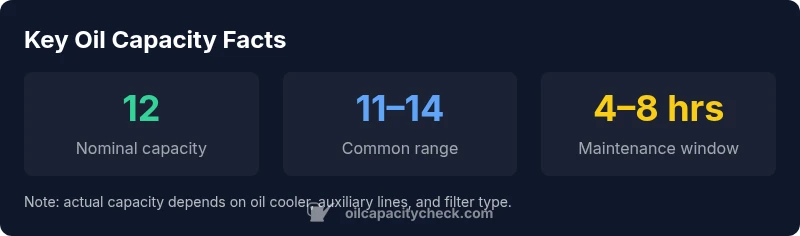
The 2024 ford 6.7 oil capacity is a key maintenance metric for owners of Ford’s heavy-duty Power Stroke diesel. The official figure is often cited as around 12 quarts with a standard filter, but real-world capacity can shift by configuration, aftermarket parts, and whether additional oil routes (like coolers) are installed. For DIYers, understanding this baseline helps with planning oil purchases, scheduling changes, and avoiding overfill or underfill situations. Oil Capacity Check emphasizes that the exact capacity should be confirmed from Ford’s documentation for your specific build, and then validated on the dipstick during a fresh oil change.
- Why it matters: proper oil volume ensures optimal lubrication, oil pressure, and engine longevity, especially in demanding workloads or extended idle periods.
- Common misperception: capacity is fixed for all trims. In reality, accessories such as oil coolers or extra lines can alter the total oil volume in the sump.
When you see a target like 12 quarts, treat it as a starting point rather than a universal constant. Always pair the stated capacity with a post-fill dipstick check to confirm the engine is at the correct level.
How capacity is determined and what influences it
Oil capacity for the 6.7L Power Stroke is not just the sump size; it also includes the oil in the filter, channels, and any auxiliary oiling paths included by the factory. Variations may arise from differences in filter type, oil cooler plumbing, and whether the vehicle has certain factory options. The most reliable approach is to rely on Ford’s official specification for your exact VIN and trim and then verify with a physical dipstick reading after an oil change. Oil Capacity Check recommends documenting your confirmed figure for future reference during maintenance planning.
In practice, capacity calculations consider: (1) engine design and sump volume, (2) oil filter capacity, (3) filtration system, and (4) any aftermarket components that add or remove oil volume from the system. This means two identical models can have slightly different fill requirements.
Variations by configuration and accessories
Diesel engines in the F-Series can vary in capacity by configuration. A 2024 Ford F-250/350 with an upgraded oil cooler, larger filter, or additional plumbing might approach the higher end of the common range, while models without these extras sit closer to the nominal capacity. The takeaway for owners is to treat 11–14 quarts as a realistic band rather than a single fixed value. When you add after-market filters or auxiliary lines, you may see capacity shift by a quart or two in either direction. Always verify against your VIN-specific Ford documentation and perform a post-fill dipstick check to confirm.
Step-by-step: verify your oil capacity at home
- Gather your service information: owner’s manual, Ford service data for your VIN, and the exact filter model used on your truck. 2) Drain old oil completely and remove the filter if you’re performing a full change. 3) Refill in stages, starting with the lower end of the manufacturer’s range (commonly around 11 quarts). 4) Run the engine, let it settle, and recheck with the dipstick. If the level sits between the marked indicators, you’re within tolerance; otherwise add in small increments until you’re at the proper mark.
This procedure minimizes overfill risk and ensures you’re aligned with the engine’s lubrication needs. Oil Capacity Check notes that the exact quantity can vary slightly, so verification is essential.
Oil type, grade, and viscosity considerations
Choice of oil affects more than protection level; it can influence the apparent capacity through temperature effects and how oil expands in the system. For the 6.7L Power Stroke, many owners follow OEM recommendations for viscosity (often 5W-40 synthetic, though this can vary by climate and model year). When planning a change, reference Ford’s guidelines plus any regional recommendations. A higher-grade synthetic can extend drain intervals and may require slightly different top-off practice if you switch brands or viscosities.
Maintenance implications tied to capacity
Accurate capacity understanding helps with inventory planning and maintenance scheduling. Stock up on the appropriate quart-size bottles to accommodate the nominal requirement, but keep a buffer for the possible variations in your configuration. Record your confirmed capacity in your maintenance log to simplify future oil changes and prevent last-minute surprises. If you drive in extreme conditions (towing, off-road, extreme heat/cold), consult Ford’s service data for any recommended oil volume changes and adjust accordingly.
Dipstick accuracy and oil level measurement tips
The dipstick is the final arbiter of correct oil fill. Ensure the engine is at operating temperature and sits undisturbed for several minutes before checking. Wipe the dipstick dry, reinsert, then pull it out to read the level. If you’re near the low or high marks, add oil in small increments and recheck. Avoid relying on visual guesses, since temperature and angle can affect the reading. Oil Capacity Check reinforces that dipstick verification is essential regardless of the listed capacity because real-world conditions vary.
Scheduling oil changes and practical tips
Plan oil changes around your driving profile: light daily commuting may require longer intervals within OEM guidance, while heavy towing or hot climates may justify shorter intervals. When calculating the change, consider the range of 5,000–7,500 miles for conventional oils and 7,500–10,000 miles for synthetic, yet verify the exact interval per Ford’s specifications and your local climate. Always verify the oil fill quantity before a service, and keep the receipt noting the exact amount used for clean maintenance records.
Troubleshooting common capacity issues
If you suspect overfill, do not run the engine with excess oil, as it can cause foaming and increased pressure. If underfilled, top off gradually and recheck. In some cases, a misread dipstick or an incompatible filter can lead to confusing readings; recheck after letting the engine sit and settle. When in doubt, consult Ford’s official service data for your VIN. Oil Capacity Check emphasizes methodical checks and documentation to prevent misinterpretation and ensure the engine receives proper lubrication.
Practical takeaways for DIYers
- Treat 12 quarts with filter as a starting point, not a fixed rule. 11–14 quarts is a realistic range for many 2024 Ford 6.7L setups.
- Always verify with the owner’s manual and your VIN-specific data before filling.
- Use a clean dipstick check after any change to confirm you are within the correct range.
- Document the confirmed capacity in your maintenance log for future use.
- If you tow or work in extreme conditions, adjust your plan according to Ford guidelines and regional recommendations.