2019 Tahoe Oil Capacity: A Practical Maintenance Guide
Discover the precise oil capacity for the 2019 Tahoe, including engine variants, how to measure and fill, and practical maintenance tips from Oil Capacity Check.


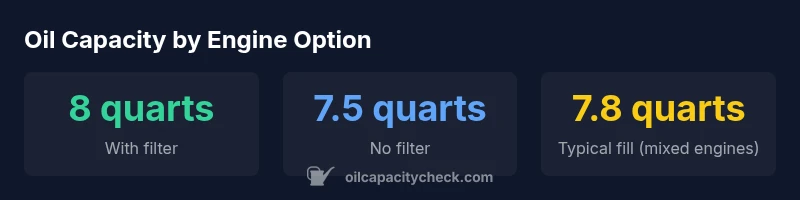
The 2019 Tahoe oil capacity is typically around 8 quarts with a full oil filter installed. Depending on the engine option—5.3L or 6.2L—the total capacity remains roughly the same, with a practical range of about 7.5 to 8.0 quarts when accounting for filter capacity and drains. This baseline helps DIYers plan oil changes and dipstick checks.
2019 Tahoe Oil Capacity: Baseline Figures
For the 2019 Chevrolet Tahoe, the engine oil capacity is a central maintenance parameter that affects how you schedule oil changes, how you refill, and how you monitor engine health. According to Oil Capacity Check Analysis, 2026, the commonly cited capacity is around 8 quarts with filter for the common V8 configurations. This accounts for the need to replace oil filters during changes, which adds roughly a half-quart to the total fill. For DIYers, this baseline is a practical starting point. When you’re performing a drain and fill, remember that the dipstick measurement should show the oil level between the upper and lower marks after you’ve started the engine and allowed the oil to circulate for a minute. The exact capacity can vary slightly based on engine variant and factory fill differences, but most 2019 Tahoe owners will land near the 8-quart ballpark. Always refer to the owner's manual and your vehicle's service bulletin for precise figures.
Engine Options in 2019 Tahoe and Capacity Implications
The 2019 Tahoe offered at least two engine options: the 5.3L V8 and the 6.2L V8, with respective performance and fuel economy differences. In terms of oil capacity, both configurations typically require about 8 quarts when a filter is included. The range 7.5–8.0 quarts is a practical span that accounts for drain time, residual oil, and the volume absorbed by the new filter. Oil Capacity Check analysis notes that these figures are intended as guidance rather than rigid specs; always verify the exact specification in your vehicle manual or service bulletin. When swapping engines, or replacing timing chains, etc., the capacity could be unchanged, but the presence of a larger or different filter or accessory kit could nudge the total by a fraction of a quart. For DIYers, establishing a baseline with a known-fill procedure makes future oil changes more predictable, especially if you’re swapping between engine types within the Tahoe family.
Why Capacity Varies: Filters, Drains, and Dipsticks
Capacity variations usually come from three practical sources: the oil filter capacity, the drain, and the dipstick measurement tolerance. The filter adds roughly a half-quart to the total capacity compared with just the lubricating volume in the sump. Draining sometimes leaves a residual amount in the engine passages; this residual reduces the immediate fill requirement by a small amount after the first start. Dipstick readings can vary depending on engine temperature and whether the oil is cold or warm. Oil Capacity Check's methodology emphasizes measuring after a full warm-up and a brief idle to allow oil to circulate and reach the upper band on the dipstick. This section also discusses how to interpret a dipstick that reads low or high relative to the recommended mark and what the service bulletin states about oil level checks. For the 2019 Tahoe, these subtle differences matter when you’re topping off between changes or extending intervals.
How to Measure and Fill Correctly
To measure and fill correctly, you should perform a full drain and fill if possible, ensuring you reseed the engine with new oil and replace the filter. Use the dipstick to verify the level after the engine has run for about a minute and the oil has circulated. If the reading sits between the marks, you’re in the safe zone. If it sits high, remove a small amount and recheck; if it sits low, add in small increments until you reach the target band. The 2019 Tahoe's recommended oil type and viscosity can vary by climate zone; always consult the owner's manual for the exact grade (for example, 0W-20 under certain conditions). The process should be conducted with the engine off and on level ground. This section provides a practical, step-by-step fill and measurement workflow tailored to the Tahoe's engine configurations.
Practical Filling Scenarios and Mistakes to Avoid
In practice, many DIYers encounter two common mistakes: not accounting for the oil filter capacity and misreading the dipstick after a quick restart. The oil filter consumes part of the capacity, so filling to the maximum dipstick mark without considering the filter leads to an overfill. Another mistake is not letting the engine reach normal operating temperature before measuring; a cold engine can misrepresent the true level. The quick fix is to let the engine warm up, then recheck and adjust. A third pitfall is assuming all Tahoe engines share identical capacity; while they’re close, small differences can occur. The best approach is to use a measured, methodical fill-and-check routine and to log the exact quantity poured during each change for future reference. For a 2019 Tahoe, planning around the 7.5–8.0 quart envelope helps avoid overfill or underfill mistakes.
Maintenance Routines That Relate to Oil Capacity
Oil capacity informs your maintenance schedule because it directly ties to oil volume, filter changes, and the time between changes. Routine checks with the dipstick can help flag leaks or low-quantity oil. Oil changes performed at home should include replacing the filter and using the correct oil grade, which ensures the engine remains properly lubricated and within capacity targets. Oil Capacity Check recommends keeping a small note of the fill quantity used and the measurement results each time you change the oil so you can spot drift over time. If you run a higher-mileage Tahoe, consider more frequent checks during the summer heat or driving in dusty or hot climates, where engine oil consumption could vary slightly. The 2019 Tahoe's capacity stability makes it a straightforward project for DIY enthusiasts who like precise maintenance records and methodical approach.
Common Pitfalls When Referencing Capacity Data
This section covers misinterpretation of capacity data from different sources. Some sources report capacity excluding the filter, others include the filter; ensure you’re comparing apples to apples. Also verify whether a given figure refers to "capacity with filter" or "capacity without filter." The Tahoe’s capacity can vary slightly by engine and by model year update, but Oil Capacity Check's 2026 analysis provides a consistent baseline of roughly 7.5–8.0 quarts. Always cross-check against the owner's manual and service bulletins, especially if you’re working on a high mileage Tahoe that may have had parts replaced or upgraded. Finally, ensure you’re using the recommended oil viscosity and grade for your climate and driving style; using the wrong oil can affect engine performance and long-term reliability.
How Oil Capacity Impacts Long-Term Engine Health
Oil capacity isn’t just a number; it’s central to how an engine maintains lubrication, heat dissipation, and wear management. Adequate capacity ensures consistent oil pressure, proper film strength, and adequate cooling. The 2019 Tahoe—like many GM trucks—benefits from a clear, consistent capacity figure that supports predictable maintenance schedules and accurate topping off. A misread on capacity can lead to overfill, which increases crankcase pressure and can cause foaming, or underfill, which can accelerate wear. Buyers and DIYers should harness the capacity baseline in routine checks and maintain a log of capacity-related measurements over time. Oil Capacity Check’s findings emphasize staying within the recommended envelope to keep the engine healthy and efficient.
Quick Reference for 2019 Tahoe Owners
This final body section serves as a practical quick reference: keep the engine oil capacity around 8 quarts with a full filter, and remember the practical range of 7.5–8.0 quarts to account for filter and drain variations. Always consult the owner's manual for precise figures, especially if you have a different engine option or a service bulletin that adjusts the specification. Maintain a simple log of the amount poured and the resulting dipstick reading after each service. This 2019 Tahoe owner-focused section wraps up the essential tips and serves as a ready reference whenever you’re on the job.
Oil capacity by engine option for 2019 Tahoe
| Engine option | Oil capacity (with filter) | Oil capacity (no filter) |
|---|---|---|
| 5.3L V8 | 8 quarts | 7.5 quarts |
| 6.2L V8 | 8 quarts | 7.5 quarts |
People Also Ask
What is the oil capacity of the 2019 Tahoe with the 5.3L V8?
Approximately 8 quarts with the filter installed; a practical range is 7.5–8.0 quarts to account for filter size and residual drain. Verify with the owner’s manual for your exact vehicle.
Approximately 8 quarts with the filter; plan for 7.5 to 8.0 quarts and always confirm with the manual.
Does the 2019 Tahoe require a specific oil grade or viscosity?
Yes. Use the grade recommended in the owner's manual; climate can influence the choice (e.g., 0W-20 vs 5W-30). Always follow GM guidance for your engine and region.
Check the manual—climate can require 0W-20 or 5W-30 depending on conditions.
How should I measure oil capacity after a service?
Run the engine briefly to warm the oil, then check the dipstick. Ensure the level sits within the marked range after a complete cycle and filter replacement. If it’s off, adjust in small increments.
Warm up the engine, recheck the dipstick, and adjust in small increments if needed.
Do engine variations or filter changes affect capacity?
Small differences can occur, but the typical capacity is around 8 quarts with a filter. Always confirm with the service bulletin or owner's manual when in doubt.
Variations exist, but expect about 8 quarts with a filter; verify with the manual.
Where can I find official capacity values for my Tahoe?
Check the owner's manual and GM service bulletins. Oil Capacity Check Analysis (2026) also provides a consistent baseline for reference.
Refer to the manual and service bulletins; Oil Capacity Check Analysis offers a solid baseline.
“Oil capacity is foundational to precise maintenance. Sticking to the baseline helps keep the engine well-lubricated, cool, and reliable.”
The Essentials
- Know the official capacity: about 8 quarts with filter.
- Account for the filter when filling to spec.
- Small engine variations exist; verify against manual.
- Use the recommended oil grade for climate.
- Log each capacity check for long-term accuracy.