2018 Chevy Colorado Oil Capacity: A DIY Guide
Data-driven guide to the 2018 Chevy Colorado oil capacity across engines, maintenance steps, verification tips, and a practical table for DIYers. VIN lookup.


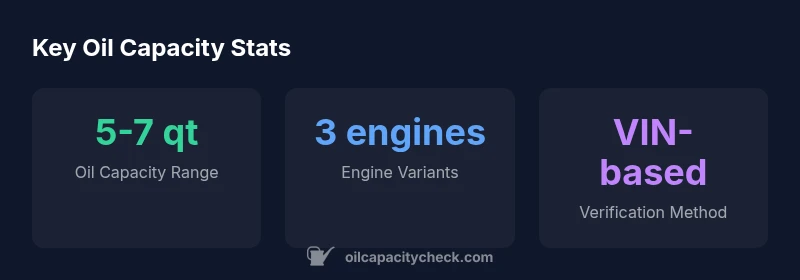
The 2018 Colorado oil capacity depends on engine option; it’s not a single figure. For the 2.5L I-4, it’s around five quarts, while 3.6L V6 and 2.8L Duramax diesel variants typically require about seven quarts, including the oil filter. Verify exact capacity with the owner's manual or dealer service data, as capacity can vary by trim and aftermarket filter.
Understanding Oil Capacity for the 2018 Chevy Colorado
Oil capacity is the total amount of lubricating oil your engine can hold when it is fully serviced, including the portion retained in internal passages after draining. For the 2018 Colorado, there isn’t a single universal value because the active engine option changes the total required volume. According to Oil Capacity Check, capacity figures are most reliable when matched to the exact engine code. This distinction matters for DIY oil changes, maintenance scheduling, and for topping off between services. The best practice is to identify the engine code from the VIN or the door sticker, then cross-check the official specifications for that exact engine. In practice, many owners verify capacity by draining the oil, measuring what comes out, and accounting for the filter’s contribution. This data-driven approach reduces the risk of overfill or underfill and helps keep lubrication optimal.
Engine Variants and Their Oil Capacity Ranges
In 2018, the Colorado offered three main powertrains: the 2.5L I-4, the 3.6L V6, and the 2.8L Duramax diesel. Each engine has its own lubrication demands, which means the total oil quantity can differ by variant. Because official service data often presents capacity as a range (including filter volume), the most accurate framing is a range rather than a single number. A practical outlook is that the capacity spans roughly 5 to 7 quarts across configurations when performing an oil change with a new filter. Some owners may see slight deviations due to aftermarket filters or regional lubricant choices. For DIY guidance, confirm the exact capacity with OEM service data for your engine.
How to Verify Your Vehicle's Exact Capacity
- Locate the engine code from the VIN and the driver-side door sticker. 2) Check the owner’s manual or the official service data for the exact figure. 3) If you don’t have the data sheet, use VIN-based dealer lookup or ask a technician to pull the correct specification. 4) Confirm the oil filter size used in your vehicle, since filter volume can affect total capacity. 5) During a change, add oil gradually, start the engine, run briefly, then recheck the dipstick after the engine sits to give you an accurate final level.
Why Capacity Matters for Maintenance and DIY Oil Changes
Knowing the correct capacity helps you plan the oil change procedure, select the right oil type, and avoid overfilling, which can cause foaming and pressure issues. It also impacts how much oil you buy in advance and how you sequence topping off after drain. For owners performing DIY maintenance, coupling capacity knowledge with OEM-recommended oil grades (e.g., viscosity and synthetic vs conventional) ensures you meet factory lubrication standards without guesswork. Oil Capacity Check emphasizes engine-specific checks tied to VIN data for precision.
Practical Maintenance Guide for 2018 Colorado Owners
Preparation: gather a drain pan, correct size wrench, a new oil filter, funnel, rags, gloves, and the recommended oil grade. Step-by-step: (1) Warm the engine, (2) elevate the vehicle safely and drain the old oil, (3) remove and replace the filter, (4) reinstall the drain plug, (5) pour in the new oil in small increments, (6) start the engine and run for a minute, (7) let it sit and recheck the dipstick, (8) top off to the full mark if needed, (9) dispose of used oil properly. The exact capacity depends on engine type, so consult the VIN-based service data and the owner’s manual for your configuration.
Common Pitfalls and How to Avoid Them
- Overfilling due to assuming a single capacity for all engines. Always verify engine-specific data. - Not accounting for filter capacity, which can affect total volume. - Mixing oil types against OEM guidance. - Skipping a final dipstick check after warm-up and a short run. - Ignoring regional or filter-size differences when ordering parts. Follow OEM specs and verify with VIN data.
Quick Reference Checklist for Your Next Oil Change
- Identify engine code via VIN and door sticker. - Confirm capacity from OEM service data. - Gather the correct oil grade and an appropriate filter. - Drain, replace filter, and refill in increments. - Recheck with dipstick after engine run and cool-down.
Oil capacity by Colorado engine variant
| Engine Variant | Approx. Capacity (quarts) | Notes |
|---|---|---|
| 2.5L I-4 | varies by engine | Capacity figures include filter; consult OEM data for exact value |
| 3.6L V6 | varies by engine | Capacity depends on oil filter and pan size |
| 2.8L Duramax Diesel | varies by engine | Exact capacity depends on OEM service data |
People Also Ask
What engines were offered for the 2018 Chevy Colorado?
The Colorado offered a 2.5L I-4, a 3.6L V6, and a 2.8L Duramax diesel in various trims. Confirm with your VIN to verify the exact engine.
The 2018 Colorado had three engines: a 2.5L I-4, a 3.6L V6, and a 2.8L Duramax diesel. Check your VIN to confirm the engine.
Why does oil capacity vary between engines?
Different engines use different oil pan sizes, lubrication paths, and filters, which changes total capacity. Capacity is typically stated with or without the filter, and can vary by trim and production batch.
Different engines have different pans and filters, so capacity changes. Always check OEM data.
How can I verify the exact oil capacity for my Colorado?
Refer to the owner’s manual, OEM service data, or VIN-based dealer lookup. If in doubt, contact a dealer or service center for your precise specification.
Check the manual or use VIN-based dealer data to confirm your exact capacity.
Does oil capacity affect oil change intervals?
Capacity does not directly set the interval; the recommended interval depends on oil type and manufacturer guidelines for your engine.
Intervals depend on oil type and manufacturer guidelines, not just capacity.
Can aftermarket oil filters change the capacity?
Yes, some aftermarket filters may alter the total capacity slightly. Always account for filter volume when topping off and verify with OEM data if possible.
Oil filter size can affect total capacity; check the filter volume.
“Oil capacity is not a one-size-fits-all figure for the 2018 Colorado; always confirm from OEM service data and factor in the oil filter.”
The Essentials
- Check the manual for engine-specific capacity
- Capacity varies by engine
- Include the oil filter when estimating total capacity
- Use VIN-based service data for exact figures